
Even after you find a stock you like and decide what price to pay, one question remains: how many shares will you buy? Even with the same stock, if you put in most of your money, your account can take a heavy hit if you turn out to be wrong.
When you decide the number of shares, look not only at how much you want to invest but also at how large a loss you could bear if your judgment proves wrong.
First, decide what your account can bear
Suppose your home currency is the Korean won (KRW) and you have KRW 10 million in a hypothetical investment account. You decide that the loss you plan to accept on a single trade is 1% of the account, or KRW 100,000. You also decide that the amount put into one stock will not exceed 10% of the account, or KRW 1 million.
The 1% and 10% here are arbitrary numbers for illustration. Living costs, investment horizon, existing holdings and the ability to withstand losses differ from person to person, so they are not standards that suit everyone.
Calculate the loss per share
Consider a situation where you plan to buy a hypothetical U.S. stock at $50 and would sell at $45 to close out the idea. Assume buying and selling costs of $0.10 per share each way, and an exchange rate of KRW 1,400 to $1 both when you buy and when you sell. Taxes, currency conversion costs and unexpected price gaps are left out.
If you buy one share at $50 and sell it at $45, the price difference is $5. Adding the trading costs on both sides, the planned loss per share is $5.20.
($50 − $45 + $0.10 + $0.10) × KRW 1,400 per dollar = KRW 7,280
KRW 100,000 ÷ KRW 7,280 = about 13.74 shares. This example assumes you can only buy whole shares, so you drop the fraction and set the number at 13 shares.
Check the investment limit separately
The money needed to buy one share is the share price plus the buying cost, or $50.10. At the assumed exchange rate, that is KRW 70,140.
KRW 1 million ÷ KRW 70,140 = about 14.26 shares
Looking only at the investment limit, the maximum is 14 shares, but the loss limit calculated earlier gives 13 shares. To respect both limits, the smaller number, 13 shares, is the maximum for this hypothetical plan.
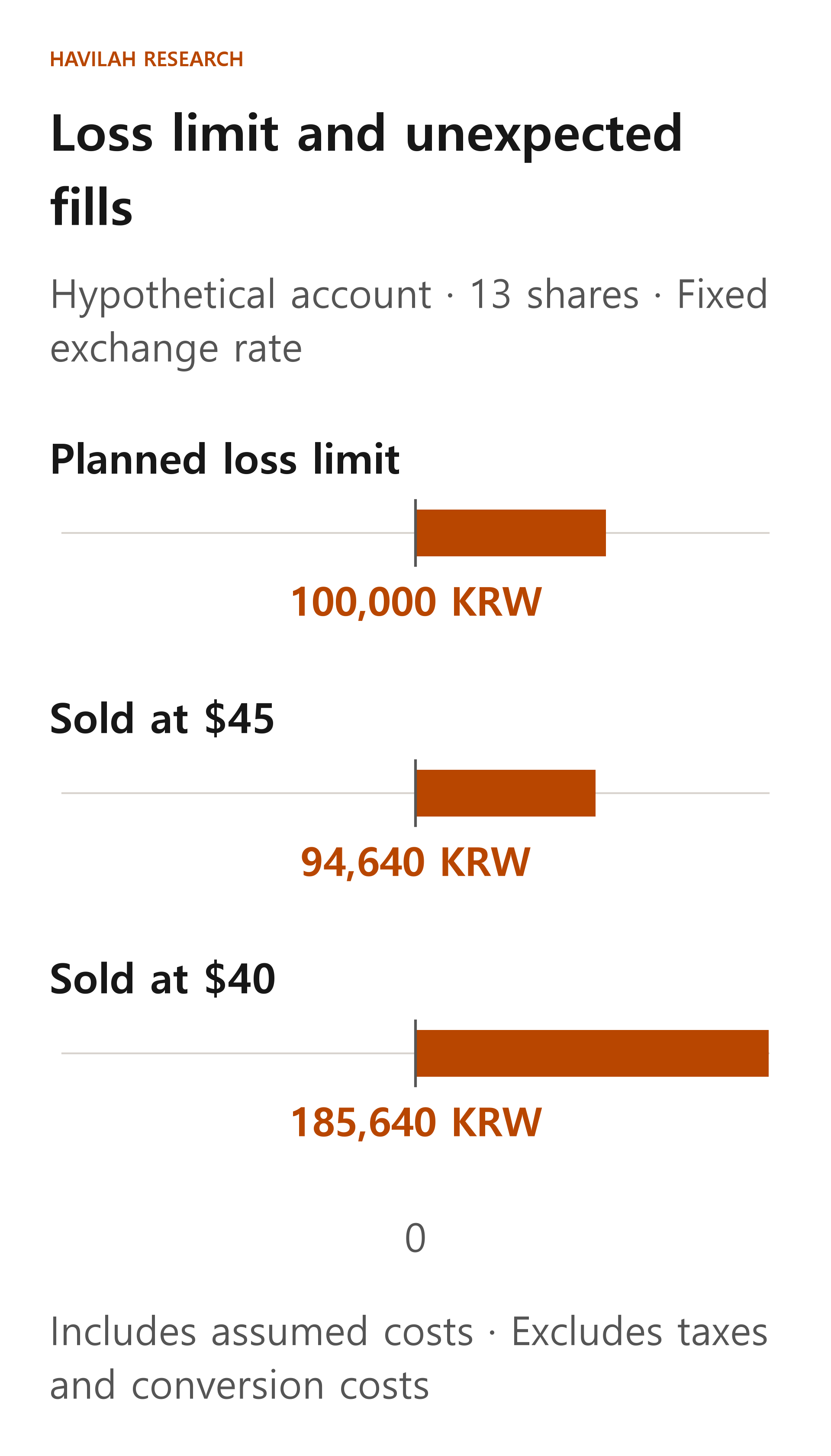
Buying 13 shares requires KRW 70,140 × 13 = KRW 911,820. If all of them are sold at $45 as assumed, the planned loss is KRW 7,280 × 13 = KRW 94,640. This is the amount spent buying minus the amount received from selling, including the costs on both sides.
The loss you plan is not the largest loss possible
$45 does not guarantee your actual selling price. For example, bad news may come out while the market is closed, and your next trade may be filled at $40. With the same exchange rate and costs, the loss per share is $10.20, or KRW 185,640 for 13 shares. That exceeds the original KRW 100,000.
A standard U.S.-style stop order also becomes a market order after the set price is reached, so it can be filled at a worse price than you expected. An order that limits the price may not be filled at all. Check whether these orders are available, and on what terms, with the broker you use.
The exchange rate is not fixed either. To get close to your actual profit or loss in your home currency, you need to check not only the gain or loss on the stock in dollars but also the exchange rates when you buy and sell dollars, the currency conversion costs and taxes. If your broker charges a flat fee or has a minimum commission, you should not apply the per-share cost method above as it is.
What to look at before the numbers
When you set your stop-loss price, do not place it too close to your buying price just to increase the number of shares. Think about the stock's usual price swings and the conditions under which you would decide your reason for investing was wrong. Nor should you assume that any particular level will hold, even for a price meant to limit losses.
If you already hold many similar companies, your whole account can be tied to the same risk even if the new stock is a small share of it. Decide the number of shares after checking your spare cash and all your holdings. In the next lesson, we will place a hypothetical order and look at how to check the fill and the settlement.