
Your investment is not finished the moment you press the buy button. You need to check whether the order was received, how many shares actually traded and at what price, and when the cash and the shares are settled.
Before placing a real order, let us walk through this process once with a hypothetical trade. Screen names and available features differ from broker to broker.
Check the order details first
A hypothetical investor wants to buy 13 shares of a hypothetical company listed in the United States, paying at most $50 per share. In a buy limit order, they enter the stock, "buy," a quantity of 13 shares and a price of $50, and check how long the order stays valid. As in the calculation in Lesson 207, assume a buying cost of $0.10 per share.
Before sending the order, check that the stock name and ticker symbol are correct, that you have not mixed up buy and sell, and that the account and currency are right. Also check how commissions and currency conversion terms are reflected in the estimated amount your broker shows you will need.
If all 13 shares are filled at $50, the cost of the shares is $650 and the assumed costs are $1.30, for a total of $651.30. This is one possible result, not an amount fixed just because the order was received.
An order received is not an order filled
An order being received means the broker has accepted it. Being filled means a trade has actually taken place. A limit order can buy at or below the price you set, but if there are not enough matching orders on the other side or the price moves, it may be only partly filled or not filled at all.
For example, suppose you ordered 13 shares but only 8 were filled at $50. The remaining 5 shares have not been filled yet. You have actually bought 8 shares, and their cost plus the assumed costs comes to 8 × $50 + 8 × $0.10 = $400.80.
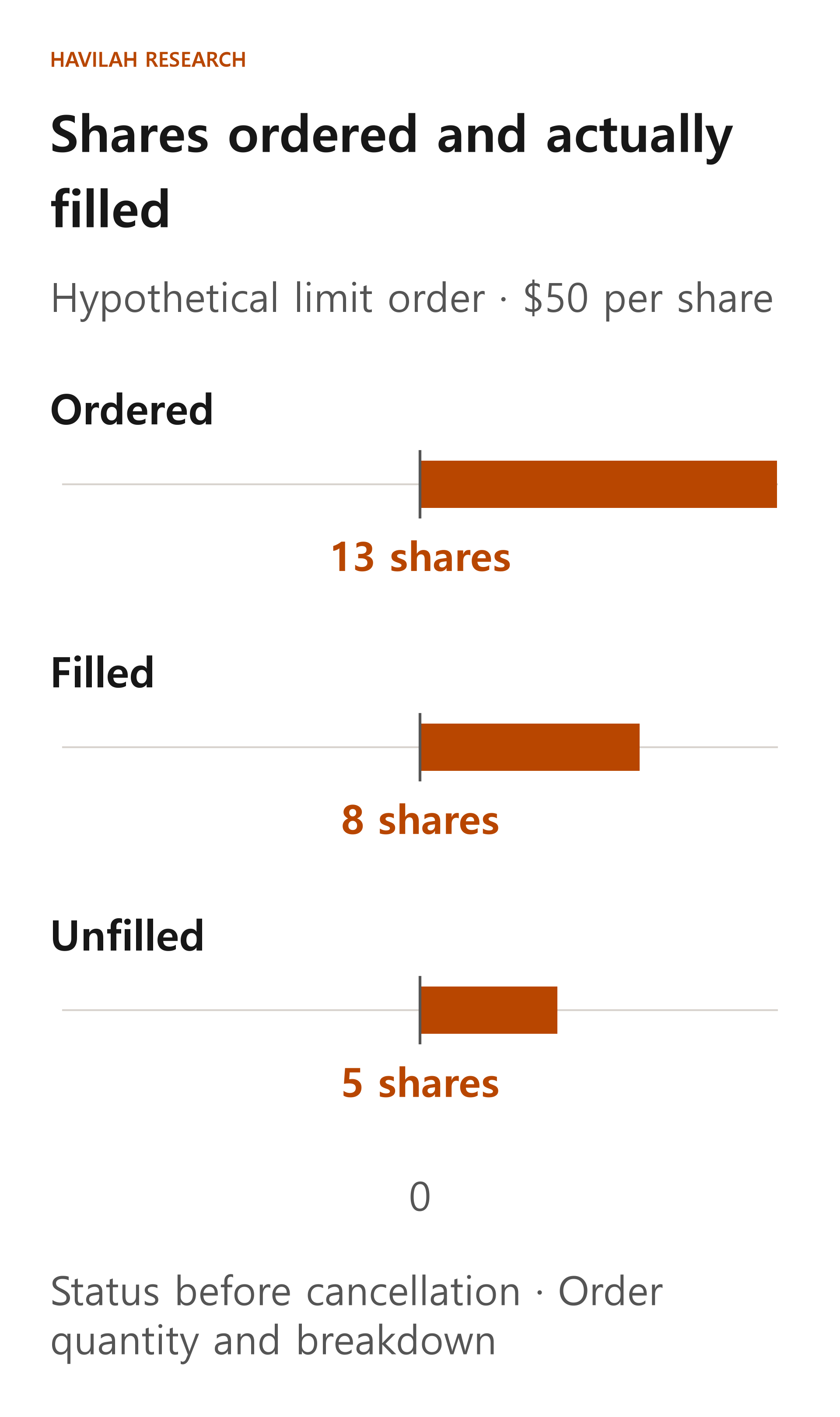
What happens to the rest of the order depends on how long the order stays valid and on your broker's terms. Before you enter the order again because it seems not to have gone through, first check the filled and unfilled quantities of the existing order. This reduces the chance of buying more than you intended through a duplicate order.
Check again even after pressing cancel
If you want to cancel the remaining 5 shares, you send a cancel request. But a trade may take place while the request is being sent. Do not stop at a message saying the cancellation was received; check the quantity actually canceled and whether any further shares were filled.
Before selling some of the 8 shares or placing the rest of the order again, also check your current holdings and the order status on the screen. If you do not understand what is shown or the order status is unclear, confirm with your broker before going ahead.
Tell the trade date and the settlement date apart
The trade date is the day the trade takes place. The settlement date is the day the securities and the cash for the trade are actually exchanged. In the United States, the standard settlement cycle for eligible stock trades is usually T+1, the business day after the trade date. For example, if Monday and Tuesday are both settlement business days for that market, the standard settlement date for a Monday trade is Tuesday.
If a weekend or a U.S. holiday falls in between, it may not simply be the next calendar day. There are also exceptions, so check your broker's information for the actual settlement date, the amount available to order and the amount available to withdraw. The way a broker in your country shows these on screen, and its processing times, may also differ.
Keep a record of your trades
Once a trade is filled, record the trade date, the stock, the quantity, the actual fill price, the currency and the fees. If you also keep separate records of the exchange rate and conversion costs applied when converting into your home currency, and of later sales and dividends, it will be easier to review your gains and losses and to prepare your tax records.
The unrealized gain or loss shown on screen and the gain or loss used for tax calculations can be based on different rules. Tax rules, and how they apply to the figures in broker statements, can change, so before you actually file, check the official guidance from your tax authority for that year and your broker's statements.
The key point to check in this example is simple. Even though 13 shares were ordered, only 8 were actually filled. The habit of checking your order history and trade results separately reduces mistakes in real trading. In the next lesson, we will look at how to change your judgment when new information comes out while you hold a stock.