
Finding a company that looks good does not mean you have to place an order right away. First decide how much you are willing to pay and in what situations you would change your mind. This keeps you from making impulsive decisions every time the price moves.
Estimated value and the price you pay are different
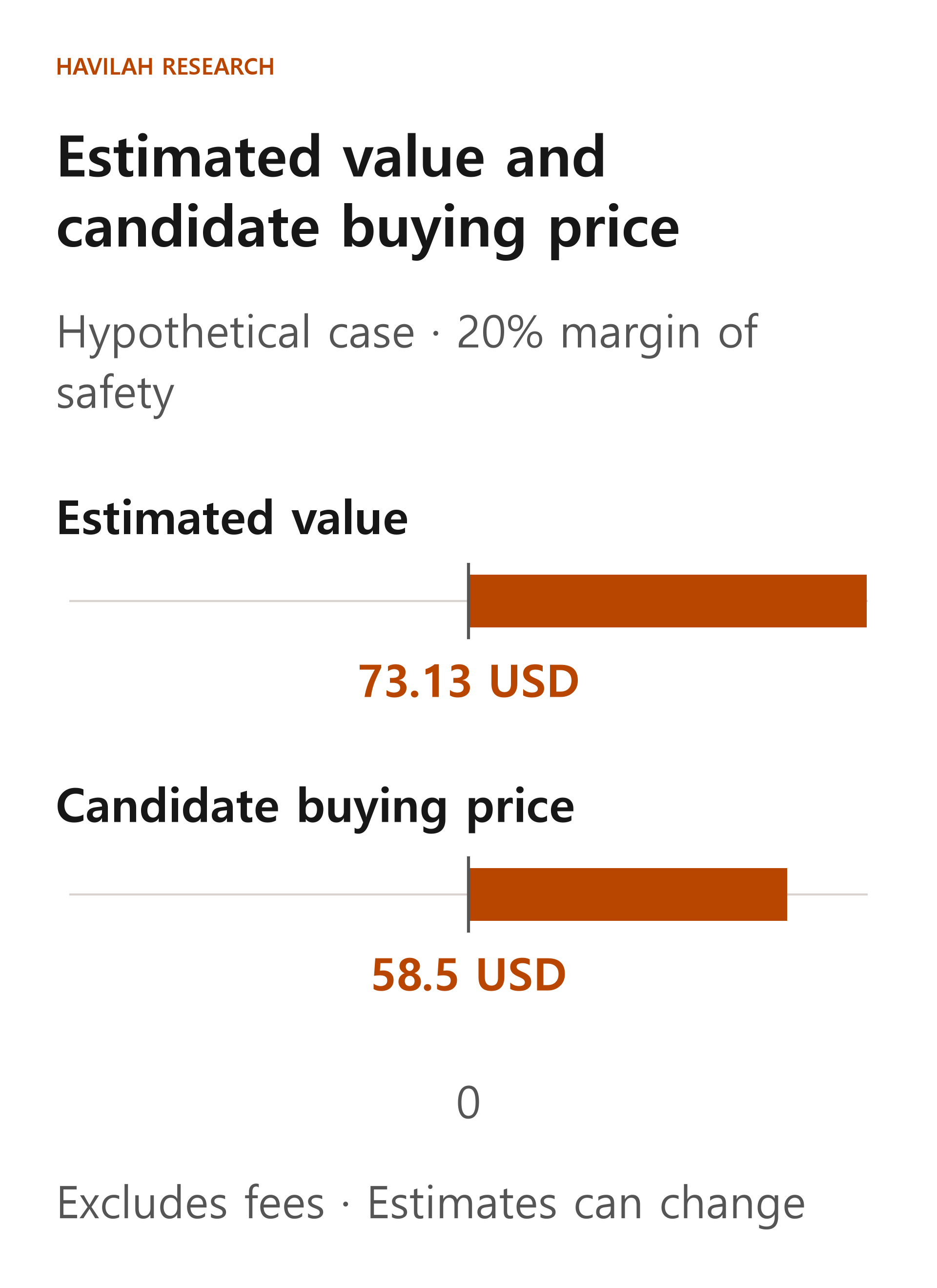
Let us look again at the hypothetical company from Lesson 205. The value per share calculated with several assumptions was about $73.13. Changing only the discount rate gave about $69.29. These two numbers are not correct answers about the future; they are estimates that change with the assumptions.
If the current share price is $100, an investor might decide to wait for now. Rather than buying without understanding why the price is above their estimate, they would check again whether they missed growth prospects or assets. Conversely, even if a lower price appears, they should recalculate if the business outlook has worsened.
For example, if an investor decides to leave a 20% cushion below the hypothetical estimate of $73.13, the calculated candidate price is about $58.50.
$73.13 × (1 − 0.20) = $58.504 → about $58.50
This cushion is called a margin of safety. It is the gap you leave between the price and the estimated value, allowing for the chance that your estimate is wrong. 20% is not a rule that suits everyone. If your estimate is badly wrong, you can lose money even when buying below that price.
Use charts and volume to check the trading conditions
Even if you like a company, it can be hard to place an order at the price you want if the stock trades rarely. Check the gap between the price buyers are bidding and the price sellers are asking. If this gap is wide, the price you actually trade at can differ a lot from the last traded price.
A chart shows past price movements. Volume is the number of shares traded over a given period. Just because the price stopped at a certain level several times does not guarantee it will stop there again next time. A chart is a tool for looking at prices and trading conditions; it does not settle a company's value or its future.
Before buying, also check the date of the next earnings release. Right after a release, the price can move quickly as the market reacts to new information. Decide whether to trade around the release or wait, and after the results come out, review your existing business outlook and price criteria again.
Before buying, write down what would change your mind if it turned out wrong
Suppose you became interested in the hypothetical company above because "existing customers keep using its products and new customers are growing, so revenue is rising." If it later loses a large customer or has to cut prices sharply because of a competing product, the basis for your original decision may weaken.
Do not judge by the share price alone; look at customer losses, revenue and profit, and the company's explanations in its new filings together. You also need to tell whether one bad quarter is temporary or whether the structure of the business has changed. Depending on what you find, you can keep holding, reduce your position or sell, and if you do not have enough information to judge, you can put off the decision.
When the share price has risen a lot, also check whether the price now reflects expectations far higher than you first assumed, and whether one stock has become too large a share of your portfolio. A price returning to where you bought, or reaching a target price, does not by itself tell you the right conclusion.
A price criterion and an order being filled are different things
A buy limit order is an order that can only buy at or below the price you set. But even if trades appear at that price, your order may be only partly filled or not filled at all, depending on the size of your order and its place in the queue. Check the actual fill records before and after you place the order.
To limit losses, you can also set a sell order to be triggered at a certain price. A standard U.S.-style stop order becomes a market order when the stop price is reached, so the actual selling price can differ from that price. A stop-limit order can be set to avoid prices worse than your limit, but if the price drops quickly, it may not sell at all. Whether these orders are available, and on what terms, differs from broker to broker.
A short note before you trade
For a hypothetical investment plan, you could sum it up like this: "The current price is above my estimate, so I will wait. Even if the price approaches $58.50, I will check the filings and my value estimate again at that time. If key customers keep leaving or profitability keeps worsening, I will review my decision."
This note contains no sentence promising a sure profit. It is a commitment to look at the price, changes in the business and the risk you can bear together. In the next lesson, we will connect this same decision to how many shares you can buy.