
Even with a good company, if you buy its shares at too high a price, it can be hard to earn the return you hoped for. So after studying a company's future business, you need to check what expectations are built into the current share price.
The fair value calculated here is not the one correct answer. It is one estimate, and the result changes if the expected cash, growth or risk changes.
Turn money you will receive in the future into today's value
Suppose you are promised $110 in 1 year. If $100 invested today at 10% a year grows to $110 in 1 year, then under this condition the present value of $110 in 1 year is $100.
$110 ÷ 1.10 = $100
The rate you use to turn a future amount into today's amount is called the discount rate. Because the future is uncertain, and because you could invest the same money elsewhere, you do not simply add future money and present money together. The right discount rate in practice depends on the risk and the financing conditions; 10% is an assumption for the calculation.
Apply cash flows to a hypothetical company
In Lesson 204, we calculated the cash left over by a hypothetical company in the first, second and third years as 68, 76.8 and 86.48 thousand dollars. Because the unit is thousands of dollars, $68 thousand is $68,000. This time, we use these amounts as the cash the business generates before any payments to lenders. The previous lesson assumed there was no debt, but this time, to separate the value of the business from the value to shareholders, we make a new assumption that the company currently has debt. Interest and other non-operating gains and losses are not included in the cash estimates.
To keep the valuation simple, assume the business is sold for $800 thousand at the end of year 3. This is the sale price of the business before subtracting debt, and it is separate from the business cash in year 3. Taxes and transaction costs on the sale are left out. There is no guarantee that it could actually be sold at that price. Assume a discount rate of 10% a year, reflecting the average cost of funding the business, and that the cash arrives at the end of each year.
| Hypothetical point in time | Expected cash | Value today |
|---|---|---|
| End of year 1 | $68 thousand | About $61.82 thousand |
| End of year 2 | $76.8 thousand | About $63.47 thousand |
| End of year 3 | Business cash after investment $86.48 thousand + sale proceeds $800 thousand | About $666.03 thousand |
The $68 thousand at the end of year 1 is discounted as 68 ÷ 1.10. The amount at the end of year 2 is discounted as 76.8 ÷ 1.10², and the amount at the end of year 3 as (86.48 + 800) ÷ 1.10³. The further away an amount is, the more times you divide by 1.10.
Adding the numbers before rounding, the present value of the business cash and the sale proceeds is about $791.31 thousand. This method of estimating future cash, converting it to present value and adding it up is called discounted cash flow, or DCF.
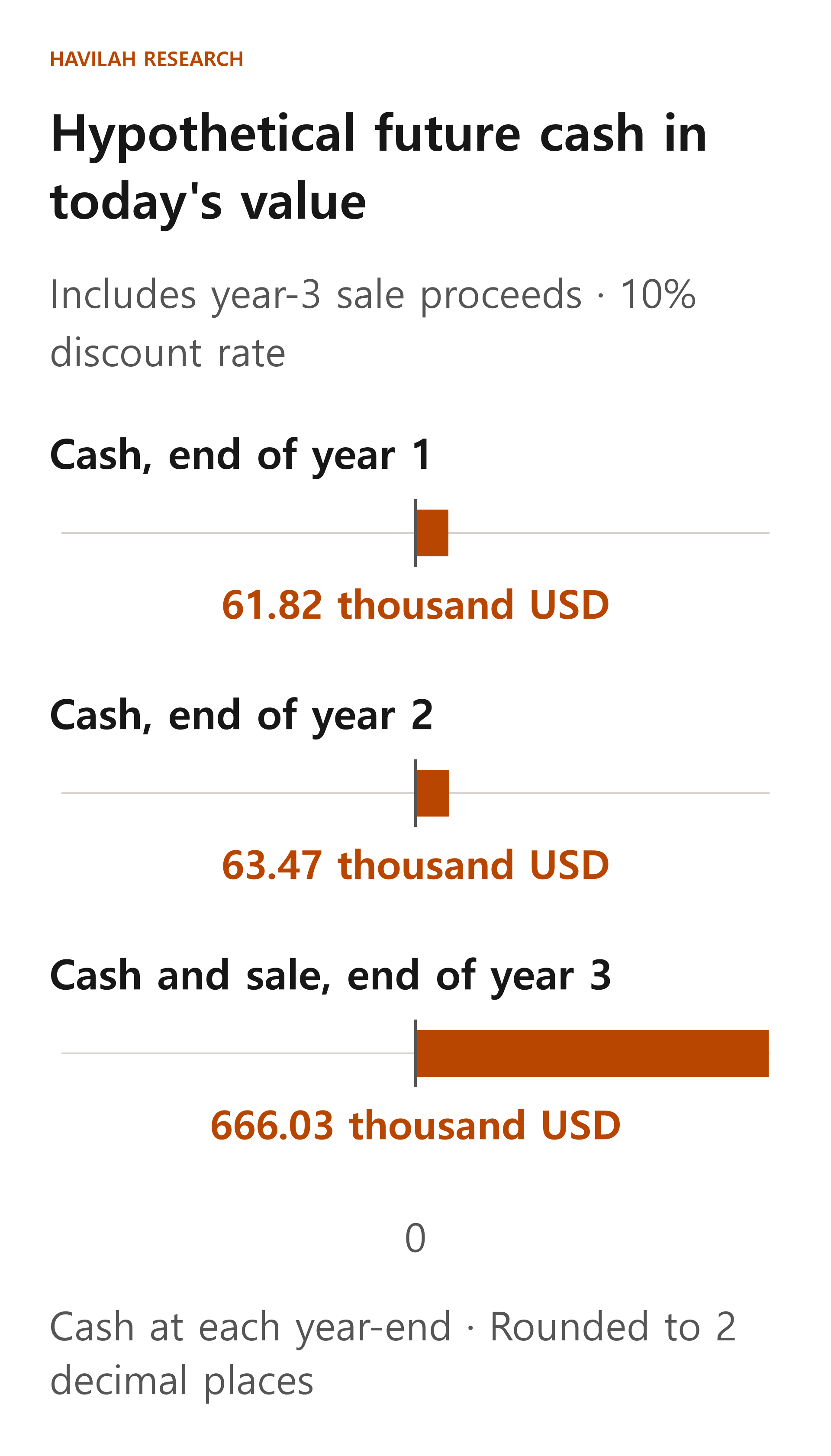
The sale proceeds at the end of year 3 have an especially large effect on this estimate. If the $800 thousand assumption changes, the value changes a lot too. When valuing a real company that keeps operating, you can separately estimate the value of the business beyond a certain period, but that value is also uncertain.
From business value to the value of one share
The present value of the cash the business will generate is not, by itself, the whole amount that belongs to shareholders. In this example, assume the company holds $40 thousand of cash separate from the business and that the current market value of its debt is $100 thousand. Assume there are no other claims, such as preferred shares, and that interest on this cash is not included in the business cash estimates.
Business value $791.31 thousand + cash held $40 thousand − debt $100 thousand = about $731.31 thousand
If there are 10,000 shares, $731.31 thousand is about $731,310, so the estimated value of one share is about $73.13. The calculation uses intermediate values that were not rounded.
For a real company, you also need to look at leases, preferred shares, the portions that belong to other investors and so on. Keep the scope of the value consistent, so that you do not add back cash already reflected in the business cash flows or subtract debt twice.
Comparing with similar companies can give a different answer
Let us also look at another hypothetical method. Suppose the company's annual earnings per share are $6 and comparable companies trade at 15 times earnings. Then $6 × 15 = $90. The multiple of share price to earnings is called the price-to-earnings ratio, or P/E.
Under the same assumptions, if the share price is $100, the current P/E is 100 ÷ 6 = about 16.67x. This does not mean that market participants are precisely predicting a particular future. It is a starting point that shows how many times earnings the current price is.
The fact that the DCF estimate of $73.13 differs from the $90 from the comparison method does not automatically make either one the right answer. You need to check whether the comparable companies differ in growth, risk, debt and the durability of their earnings. If earnings are temporarily high or low, the P/E can also be distorted.
Put in opposing assumptions before you decide
Before deciding to buy, do not write down only optimistic assumptions. For example, recalculate how much the cash would shrink if sales came in below expectations or equipment costs rose. Also look at cases where the sale proceeds differ or the discount rate is higher.
Keep the other conditions the same and raise only the discount rate from 10% to 12%. The business value becomes 68 ÷ 1.12 + 76.8 ÷ 1.12² + (86.48 + 800) ÷ 1.12³, or about $752.92 thousand. Adding the $40 thousand of cash, subtracting the $100 thousand of debt and dividing by 10,000 shares gives about $69.29 per share. That is lower than the $73.13 at 10%. This difference is not a forecast that interest rates will actually move that way; it shows how sensitive the result is to the discount rate assumption.
Even if the current share price looks lower than your calculated value, the gap may come from wrong assumptions, risks you missed or incomplete data. If you cannot explain why your estimate differs from the price, putting off the decision and checking more data is also a choice.
In the next lesson, we will connect the value and risks worked out this way to candidate buying prices and decisions about selling.