
When you start looking for stocks, you find thousands of companies. You cannot analyze all of them, so first you need to narrow down what to look at. The list you make here is not a list of stocks to buy right away. It is a list of candidates whose business and price you will spend time researching.
About ten is enough to begin with. There is nothing special about the number ten for your investments. It is just an example: enough to compare different businesses while still letting you look at each company one at a time. If you only have five candidates you understand, you do not need to force the list up to ten.
Start from an industry you are interested in
Think about the services and products you use every day. Areas that catch your interest, such as online shopping, payments, semiconductors or medical devices, can be a starting point. But a company with a familiar name is not necessarily a good investment.
Even companies in the same industry make money in different ways. Among companies tied to online shopping, for example, some sell goods directly, while others provide a marketplace for sellers and charge them fees. The reasons their revenue grows and the costs they carry can differ, so try describing each business in one sentence.
"Who is the customer, what does the company sell, and how does it get paid?" If you find this question hard to answer, the company needs a little more study. At the stage of finding companies of interest, you can keep it on the list, but do not jump to a decision to buy before you understand it.
Ask every candidate the same questions
You do not need to analyze every number from the start. For each candidate, briefly check the following five things.
| What to check | Question to ask first |
|---|---|
| Business | What does it sell, and who pays for it? |
| Industry | Why might the number of customers grow or shrink? |
| Trading | Is the stock you plan to trade easy to buy and sell? |
| Financials | Can you check its revenue, profit, debt and cash flow? |
| Filings | Can you find the documents the company has published itself? |
These questions are not a test that a company passes only if every answer is good. They are a starting point for marking what you need to look into further. For example, a company that is losing money is not automatically one to exclude. But you need to look more carefully at why the losses continue and whether it has the cash to cover them.
Do not look only at volume; check the actual bid and ask prices
Liquidity means how easily you can buy and sell a stock. If trading is not active, it can be hard to buy or sell at the price you want at the moment you want.
For example, suppose hypothetical Stock A has recently traded an average of 100,000 shares a day, and Stock B 1,000 shares. B's volume is lower, but from this number alone you cannot conclude that your order in B will not be filled, or that A is safe.
At the same moment, also look at how far apart the bid (the highest price buyers are offering) and the ask (the lowest price sellers are asking) are, and how many shares are available at each price. Average daily volume changes with the date and time of day, and there is no guarantee that trading that was active in the past will stay active. For foreign stocks, conditions during regular trading hours and extended-hours trading can also differ.
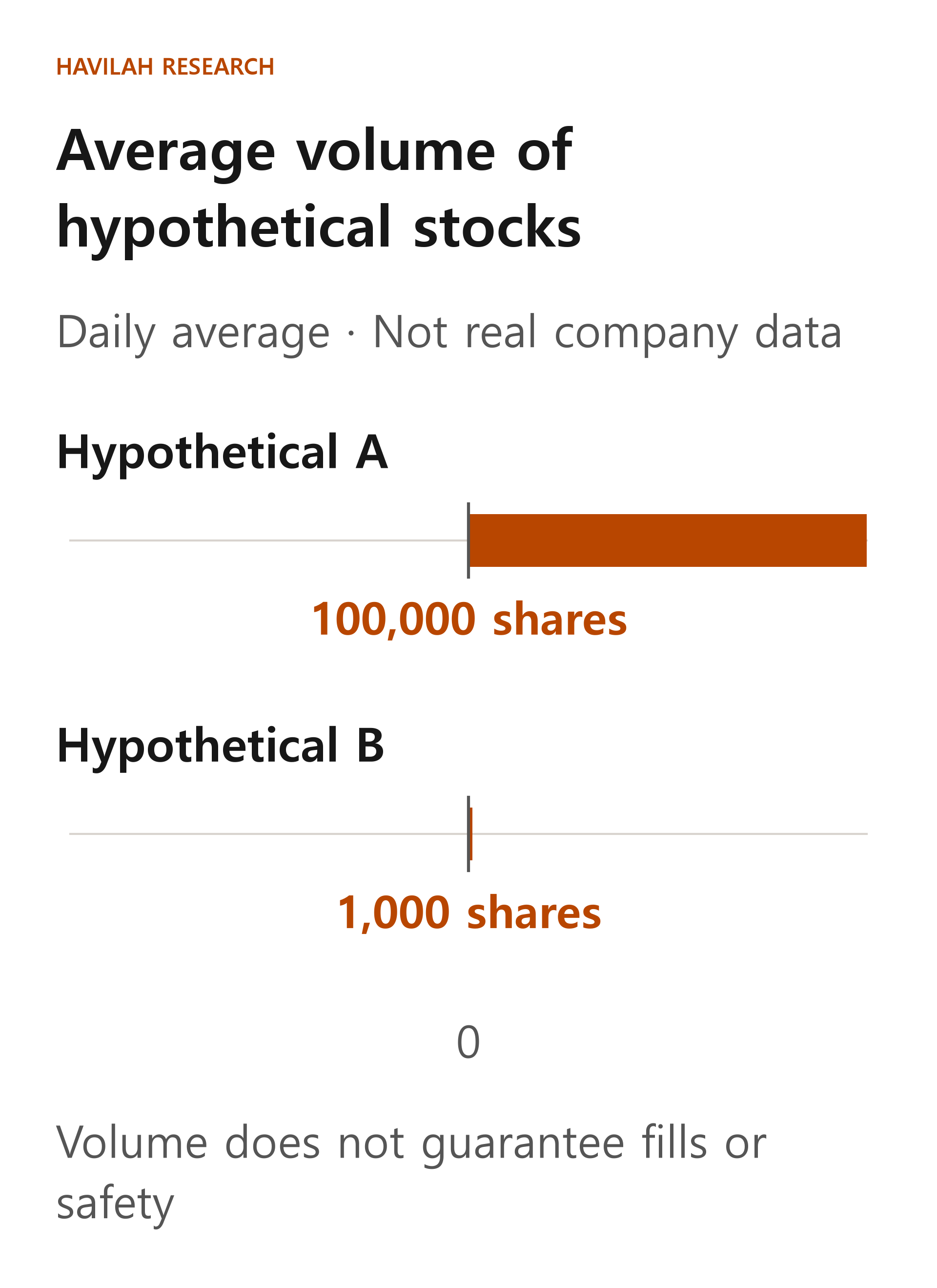
The 100,000 and 1,000 shares in the figure are hypothetical numbers for illustration. Even a stock with high volume can fall sharply in price. Being easy to trade is a different matter from the company or its share price being safe.
Find the documents the company published itself
Videos and posts that introduce a company can be a starting point for ideas. But rather than judging from that content alone, you should check the business, the financials and the risk descriptions in the reports the company has published itself.
On EDGAR, the electronic filing system of the U.S. Securities and Exchange Commission (SEC), you can find filings by searching for a company name or ticker. The annual report of a U.S. company, the 10-K, covers its business, its main risks, its financial statements and more. Foreign companies listed in the United States may report on different forms, so check the company's actual filings.
Even after you find the filings, it is too early to reach a conclusion from the numbers alone. Check whether the documents are the latest, what period the results cover and whether they are for the whole consolidated group, and compare them on the same basis. If the filings are hard to find or you do not understand their content, write "needs checking" next to the company.
Choose which of the 10 companies to look at first
Suppose you have gathered 10 hypothetical candidates. Three of them have businesses that are hard to explain, and two others, not among those three, are companies whose filings you have not found yet. For the remaining five, you can check the business and the documents first. This split only sets the order of your research. It does not mean the five you set aside for now are bad companies, or that the five you check first are good ones to buy.
Once you have picked one company to look at first, briefly write down a description of its business, its latest reports, your open questions and the ways you might be wrong. If your candidates are all concentrated in the same industry, they may be exposed to similar risks together, so look at how your list is made up.
A good candidate list is not a table of stock recommendations; it is a list of questions. In the next lesson, we will find the original documents for the one company you chose and see where to read the information you need.