
If the price keeps rising after you sell a stock, it is easy to regret selling too early. If the price falls after you sell, you think you sold well. But if you look only at what the price did afterward, it is easy to forget what information you saw at the time and why you made the decision.
An investment journal is a record that keeps your thinking at the time separate from the actual results. It is not a diary for showing off gains or blaming something for losses. It is a tool for finding out what you need to check the next time you make a similar decision.
Write down your thinking before you trade
Before you press the buy button, write down in a sentence or two why you want to buy this company. For example, "I judged that revenue would increase if sales of the new product grew" is easier to check later than "Revenue looks likely to rise."
If you write down only the good prospects, important problems may be left out. Also write down which facts would lead you to conclude that your view was wrong. For example, sales of the new product might fall, contrary to what you expected, or a competitor might launch a cheaper product. The actual conclusion will differ with each company and situation.
Also keep a note of the filings and announcement dates you used in your decision, and of anything you could not check. If you edit the record as if you had already known information that was announced later, you cannot look back accurately at the decision you made at the time. It is better to add new information under a new date.
Keep the plan separate from the actual order
The price you meant to buy at and the actual fill price can differ. Placing an order also does not guarantee that all of it will trade. Check and record the date, the stock, the order type, the quantity, the actual fill price and the commission. If the order was only partly filled, write down the filled quantity and the remaining quantity separately.
It is a good idea to go through your trade confirmations and account statements to check that the actual dates, prices and quantities match your records. If you made simulated (paper) trades, mark them separately from real trades. Prices and fills in simulated trading may not reproduce real trading conditions exactly.
If you keep your trade confirmations and account statements, you can look through them again later.
The following is a hypothetical trade record. It is not a real stock or an investment recommendation.
| Item | Hypothetical record |
|---|---|
| Thinking before buying | Sales of the new product may grow and improve profits |
| Opposing possibility | A competitor's price cut may make sales fall short of expectations |
| Plan | Limit order to buy 10 shares at $50 or less |
| Actual result | 10 shares filled at $50; buying commission $1 |
| Later sale | 10 shares filled at $54.80; selling commission $1 |
Assuming the prices, quantities and commissions in this record are all accurate, the cost of buying is $50 × 10 shares + $1 = $501. The amount received after selling is $54.80 × 10 shares - $1 = $547. The gain is $547 - $501 = $46.
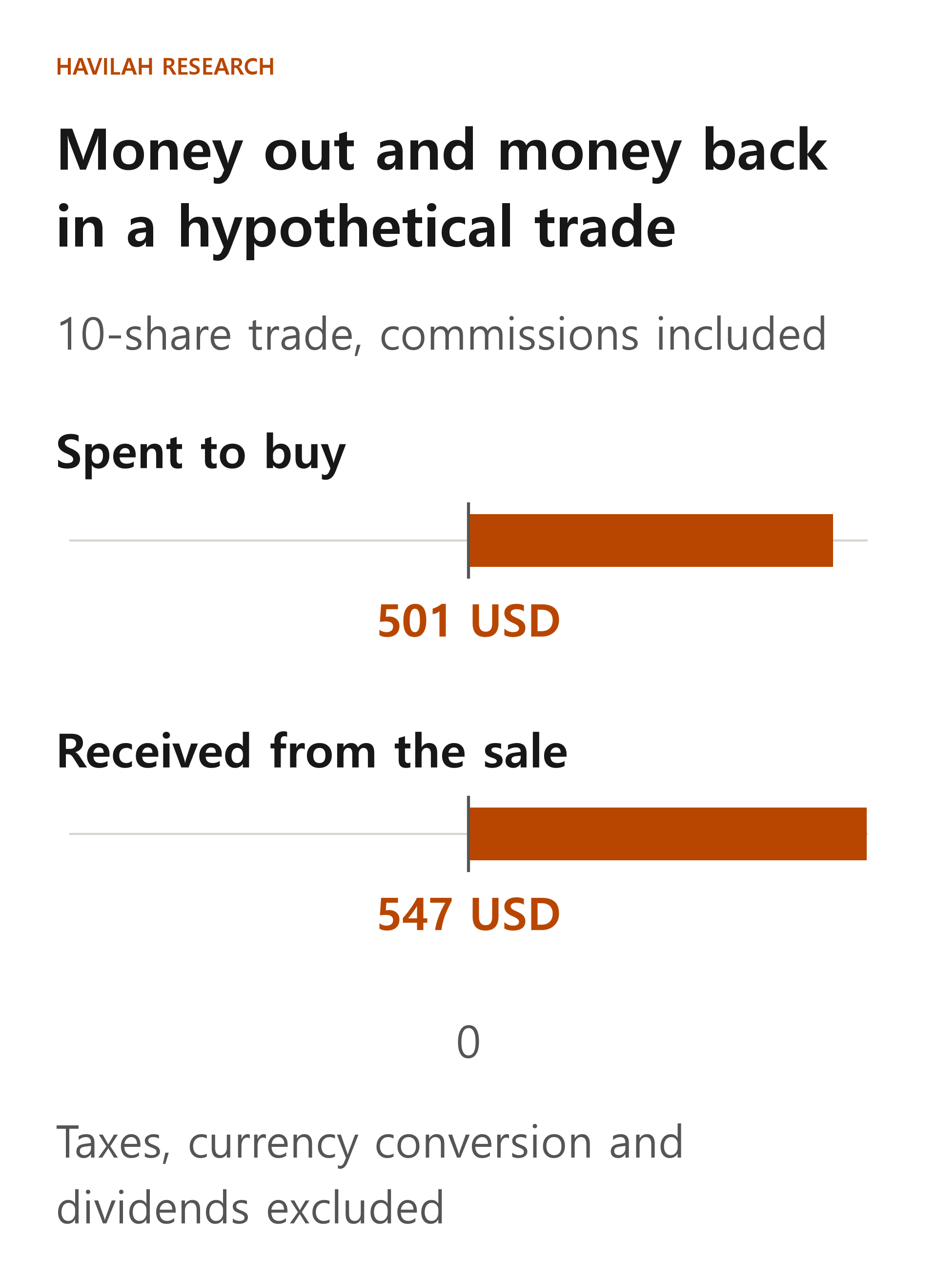
Taxes and currency conversion costs are not included here, and we assumed there were no dividends. Even when a trade makes money, you need to check separately whether your forecast for sales of the new product was actually right. If the share price rose because of some other event, your forecast and the result may have lined up by chance.
Look at the outcome and the decision process separately
After a trade, write down two things separately. One is what actually happened. The other is whether your decision at the time met the criteria you had set.
For example, even if the share price rose and you made money, there may have been a risk-management problem if you ignored the investment limit you had set at the start. On the other hand, if you checked the filings and bought within your planned amount, but an unexpected event caused a loss, the loss by itself does not prove that every decision you made was wrong.
When you look for what went wrong, do not stop at "I was unlucky" or "My instincts were good." Look specifically at whether you missed a filing, whether you changed your reason for buying because the price had risen, and whether the risk you expected at the start actually appeared.
Leave one lesson for your next decision
You do not need to write a long report every time. Before a trade, write down your reason for buying, the opposing possibility and the amount you will invest. After the trade, record the actual fill, the result and one thing you learned.
A sentence that can change what you do, such as "Next time, check the earnings release date before buying," is useful. Once you have collected a number of records over time, you can also see whether similar mistakes keep happening. If you have made only a few trades, do not treat a result that may be chance as proof of your skill or a definite strength of your strategy.
It is best not to put sensitive information such as account numbers or passwords in your investment journal when you do not need to. When you save your records, also check who can access them and where they are stored.
In the next lesson, we will look at the criteria for choosing which companies to actually analyze.