
You promised yourself you would research a company thoroughly before buying, but when the share price shot up, you bought sooner than planned. Or you heard news that the business had weakened, but you did not want to admit the loss, so you did not check anything.
Anyone's decisions can be influenced by emotions and familiar ways of thinking. Knowing about these tendencies does not make mistakes disappear, but it can help you check once more before you rush a decision.
When you look only for information that fits your view
Suppose you bought a company's stock because you thought its new product would succeed. If you then keep reading only positive articles and ignore material about competitors' new products or customers leaving, you can miss important changes. The tendency to give more weight to information that supports what you already believe is called confirmation bias.
When this happens, write down not only your reasons for buying but also the facts that could show you were wrong. For example, if you expected growth in new customers to lead to revenue growth, check in the next earnings results whether the number of customers and revenue actually grew together.
Not every opposing view is right, either. Check who is making the argument, what period the data covers and whether it matches the company's filings.
When it is hard to admit a loss
Suppose a stock you bought at $100 has fallen to $80. You have lost $20 per share, a loss of 20%. To get from $80 back to $100, it has to rise 20 ÷ 80 × 100 = 25%. This is a hypothetical calculation that leaves out commissions and taxes.
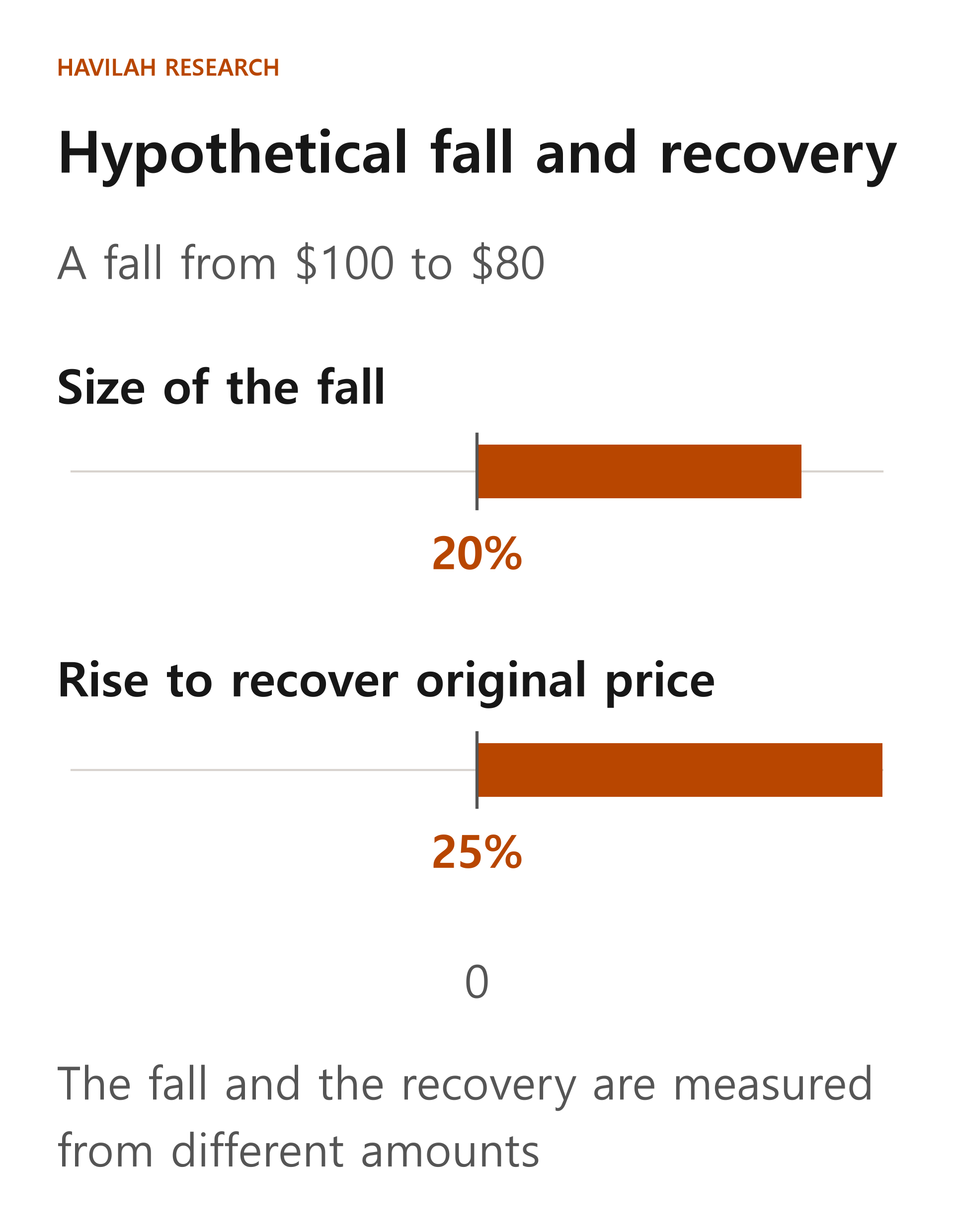
The tendency to react more strongly to a loss than to a gain of the same size is called loss aversion. Reactions differ from person to person and from situation to situation, and the mere fact that someone keeps holding a losing stock does not tell you why they do it.
Wanting to avoid losses is natural. But if you simply wait to break even without checking how the business is changing and what risks lie ahead, you may fail to notice whether your original reasons for buying still hold. Equally, this does not mean you must sell right away just because the price has fallen.
The important question is not "I bought at $100, so should I wait?" but "Is there still a reason to hold this company now, at $80?" The price you paid is needed to calculate your gain or loss, but it does not by itself determine what the company is worth today.
When you get tied to the first number you see
People tend to use the first number they come across, or a familiar price, as the reference point for their judgments. This is called anchoring: relying too heavily on a reference point. Concluding that $80 is cheap today only because the stock's past high was $100 is one example.
The company's earnings outlook and debt may be different from before, and the $100 price back then may itself have been too high. Even if you use past prices as a reference, look again at the company's recent business and financial position.
When you rush for fear of missing out
When you hear that everyone around you has made money, you may feel you are the only one missing the opportunity and buy in a hurry. This feeling is called FOMO, short for "fear of missing out." A rising stock is not necessarily a bad one, but an order placed only because the price has gone up, without checking what you are buying and how much you could lose, is risky.
Pause and check how the company makes money, what expectations are built into the current price and how large a share of your account the position would be. If you need time to check, putting off the purchase is also a choice. After you wait, the share price may rise further, or it may fall.
Keeping records to reduce mistakes
Before you buy, briefly write down three things: why you want to buy, which facts would make you change your mind and how much you can invest. After that, do not watch only the price; check whether those facts have actually changed.
Holding on to an investment that has fallen, or selling one that has risen, is not always a psychological mistake. Taxes, a need for cash and new information can all affect the decision. Rather than judging a past decision by its outcome alone, it is better to review it together with the information you had at the time and how you reached the decision.
In the next lesson, we will look at what data can be missing when you test an investment strategy that showed good returns in the past.