
Looking at the same company, one person buys now and another waits. That is because one sees the share price as low compared with the company's value, while the other thinks the growth rate or the price trend is not yet strong enough.
Lesson 180 looked at how investment criteria differ. This time, we will see how those criteria turn into actual plans for buying and selling.
Value investing: is it cheaper than what I think it is worth?
A value investor looks at the money a company can earn, the assets it owns and its risks, and estimates what they think it is fairly worth. If the share price is far enough below that estimated value, they consider buying. An estimated value is not a fixed price. It is a number built on assumptions about the future.
Suppose a hypothetical stock trades at $100 and an investor estimates its value at $120. The difference is $20. Measured against the estimated value of $120, the discount is 20 ÷ 120 × 100 = about 16.67%. This gap is sometimes called the margin of safety. It is not a cushion that guarantees future returns or protects you from losses; it is a number that depends on whether the estimate is right.
If the price has moved close to the estimated value, or the business has done worse than expected and the estimated value has fallen, you might consider selling. On the other hand, even if the price has risen, you might keep holding if the estimate of the business's value has risen by more. It can take a long time for the value to show up in the price, and the reason a stock looked cheap may be that the business is getting worse.
Growth investing: is the future growth enough for the price?
A growth investor focuses on how much customers, revenue and profits will grow in the future. For example, suppose a hypothetical company has annual revenue of $1 million and assume it grows 20% a year for the next 2 years. Revenue would be $1.2 million in the first year and $1.44 million in the second. This is only an assumption, not actual results.
Even if revenue grows, profit may be smaller than expected if costs rise faster. And if the share price already reflects even faster growth, the price can fall despite good results. You need to look not only at growth but also at profits, cash flow and the expectations built into the current price.
When you consider buying, check what is driving the growth and how long it is likely to last. Later, if growth in new customers slows, or your expectations turn out to be wrong because of competition or costs, review the assumptions behind holding the stock. You might also consider selling when the share price has risen so much that you judge it expensive relative to the growth you expect.
Trend following: is the price trend holding?
Trend following means watching for prices that move in one direction and trading in line with that movement. Each investor uses a different time frame and different rules. You should also distinguish relative momentum, which picks stocks that have risen more than others, from methods that look at a single stock's own price trend.
As one hypothetical method, you could decide to consider buying when the share price is above its 100-day moving average and to consider selling when the closing price falls below it. A moving average is the average of prices over a given period. The 100-day period is chosen for illustration; it is not a proven rule that works for everything.
If you judge the signal from the closing price, do not calculate as if you had already placed the order at that day's closing price. Check the price at which your next trade is actually filled, and how much you pay in commissions and taxes. If the price moves up and down around the average, buy and sell signals can repeat, and losses and costs can pile up.
The same stock, different starting points
| Approach | Main question before buying | What prompts a second look at selling |
|---|---|---|
| Value | Is the price low compared with the company's value? | Has the value estimate fallen, or has the gap between value and price narrowed? |
| Growth | Is the future growth enough for the price? | Are the growth assumptions in doubt, or have the expectations in the price risen? |
| Trend following | Does the price trend over your chosen period meet your criteria? | Has the trend you defined, or the condition in your selling rule, changed? |
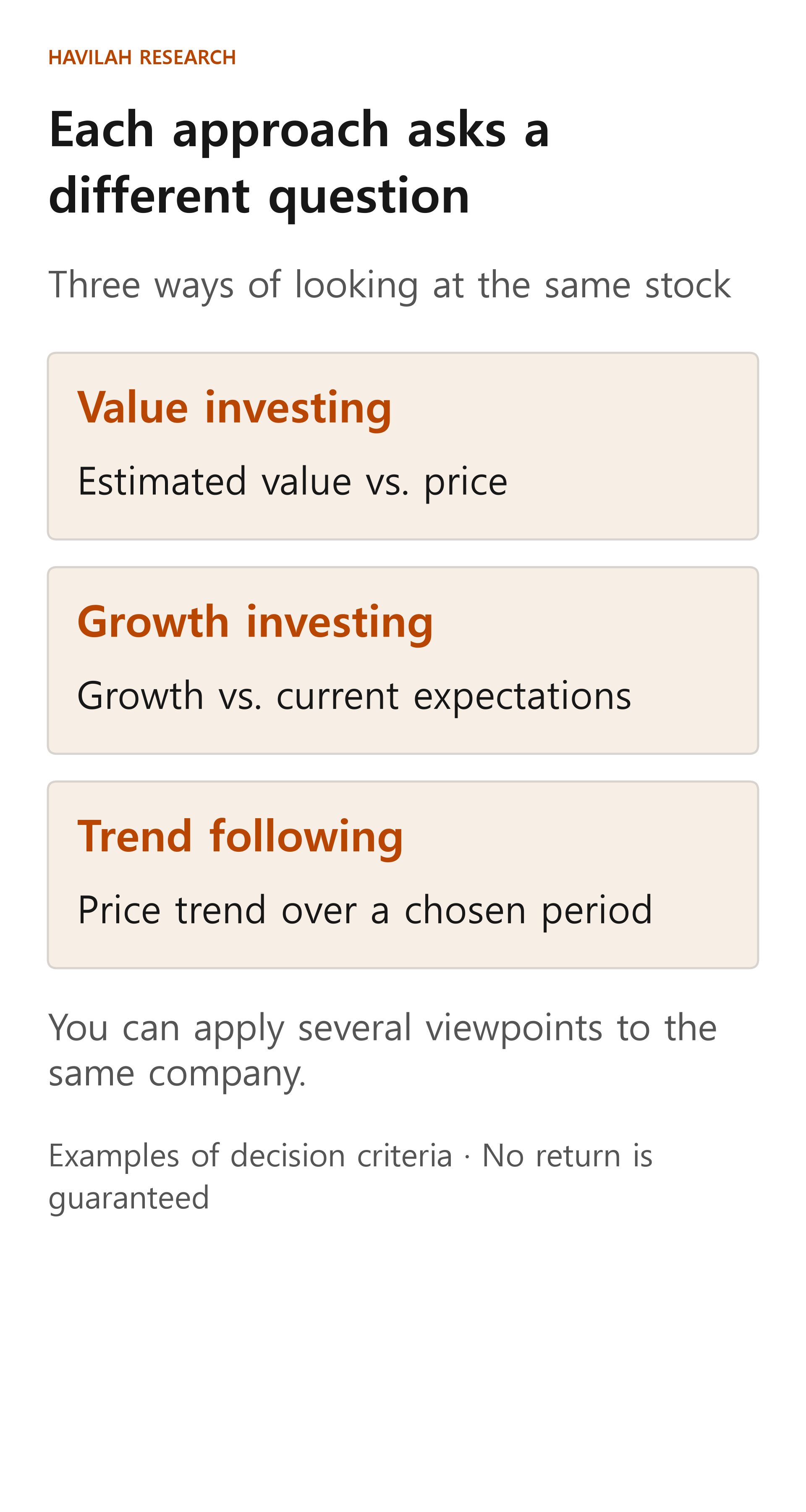
These are only examples of each approach; they do not mean every investor behaves the same way. Value investors also look at growth rates, and growth investors also weigh the price. Investors who use trends still need to decide which assets to trade and how much loss they can bear.
Turning it into your own plan
Whichever approach you choose, write down in advance your reason for buying, how long you can hold, and the conditions under which you would decide you were wrong. In a plan based on value or growth, quarterly results and changes in the business may be important. In a plan that watches trends, how often you check prices and how you place orders may matter more. No approach guarantees a set holding period or a return.
When you compare results, also look at trading costs, taxes and the actual time your orders were filled, using the same conditions for each. In the next lesson, we will look at why investors keep making mistakes even when they know the plan they have set.