
An account that usually looks fine can shrink more than you expect when stocks and bonds fall together. If at the same time you have to take money for living expenses out of your investments, your decisions become even harder.
No one can predict a future crash precisely. Instead, you can assume several bad scenarios and calculate in advance how hard your account might be hit. This kind of check is called a stress test.
Start by writing down where your account stands
This is a hypothetical account for illustration. It holds $6,000 in stocks, $3,000 in bonds and $1,000 in cash waiting to be invested, for a total of $10,000. The stocks include $1,500 in hypothetical Company A, which could have trouble raising money. The rest of the stocks come to $4,500.
All the rates of change below are numbers chosen arbitrarily for illustration. They are not real forecasts or maximum losses. Each scenario happens on its own from the same starting point, and dividends, interest, trading costs, taxes and exchange rates are left out. Assume the values change without any trading.
Scenario 1: What if market interest rates rise quickly?
With other conditions roughly the same, when market interest rates rise, the prices of fixed-rate bonds can fall. Stocks respond to companies' profit outlooks and investors' expectations, so rising rates do not always mean the same fall in share prices.
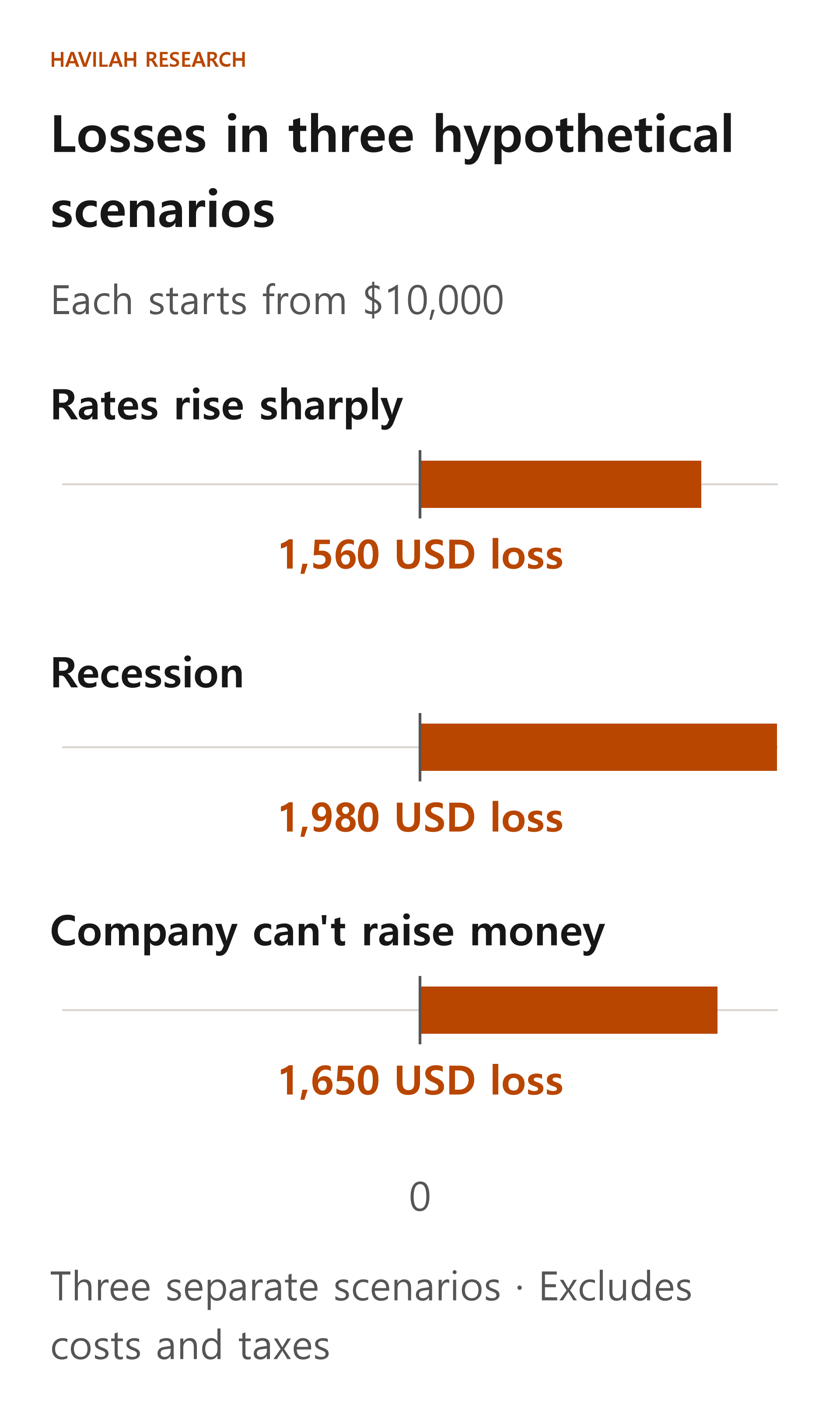
Here, assume stocks fall 20%, bonds fall 12% and cash stays the same. The loss on stocks is 6,000 × 20% = $1,200, and the loss on bonds is 3,000 × 12% = $360. The total loss is $1,560, and the account value is 10,000 - 1,560 = $8,440. The account has lost 15.6% of its starting value.
Scenario 2: What if a recession hits?
When the economy weakens, companies' sales and profit outlooks can worsen. In the same situation, bonds may rise or fall, depending on interest rates and the issuer's creditworthiness.
This time, assume stocks fall 35%, bonds rise 4% and cash stays the same. The loss on stocks is 6,000 × 35% = $2,100, and the gain on bonds is 3,000 × 4% = $120. Combined, the loss is $1,980, and the account falls to $8,020. That is a loss of 19.8%.
The fact that bonds rose in this example does not mean bonds will shield you from stock losses in every recession. Check separately for the case where bonds fall at the same time.
Scenario 3: What if a company you own cannot raise money?
A company may need to repay debt that is coming due, either with cash it has or with new money it raises. If raising money becomes difficult, it may cut back its investment plans or face something more serious, such as failing to make payments it owes. If it issues new shares, the percentage of the company that existing shareholders own may also shrink.
Assume the $1,500 in hypothetical Company A's shares falls 70%, and the remaining $4,500 in stocks falls 10%. The $3,000 in bonds falls 5%, and cash stays the same.
The loss on A is 1,500 × 70% = $1,050, the loss on the other stocks is 4,500 × 10% = $450, and the loss on bonds is 3,000 × 5% = $150. The total loss is $1,650, and the account falls to $8,350. A is already included in the $6,000 of stocks, so do not subtract it a second time.
What should you change after seeing the numbers?
The losses in the three scenarios are $1,560, $1,980 and $1,650. Each comes from a different set of assumptions, so do not add them together. Real losses could be smaller or larger than these, and several problems could arise at once.
First, check whether you could still cover your living expenses in the most uncomfortable scenario. Cash waiting to be invested is an asset inside your account; the emergency fund you need for daily life should be thought about separately. Next, check your weight in particular companies or industries and their risk of not being able to raise money. You can read what a company's filings say about its cash and financing. Also check when its borrowings are due to be repaid.
If the results are more than you can bear, you can review how much you invest, your asset allocation or where you keep money you will need soon. But no adjustment can remove losses completely. In the next lesson, we will compare what value investing, growth investing and trend following each look at when making decisions.