
At first you split your money between stocks and bonds, but after a while you find that stocks take up a much larger share of your account. This happens when prices rise, even if you have not bought any more stocks.
If your current holdings no longer match the risk you first had in mind, you can consider rebalancing, which means bringing your weights back to their targets. What matters is deciding in advance when you will check and how far you will adjust.
Compare your target weights with your current weights
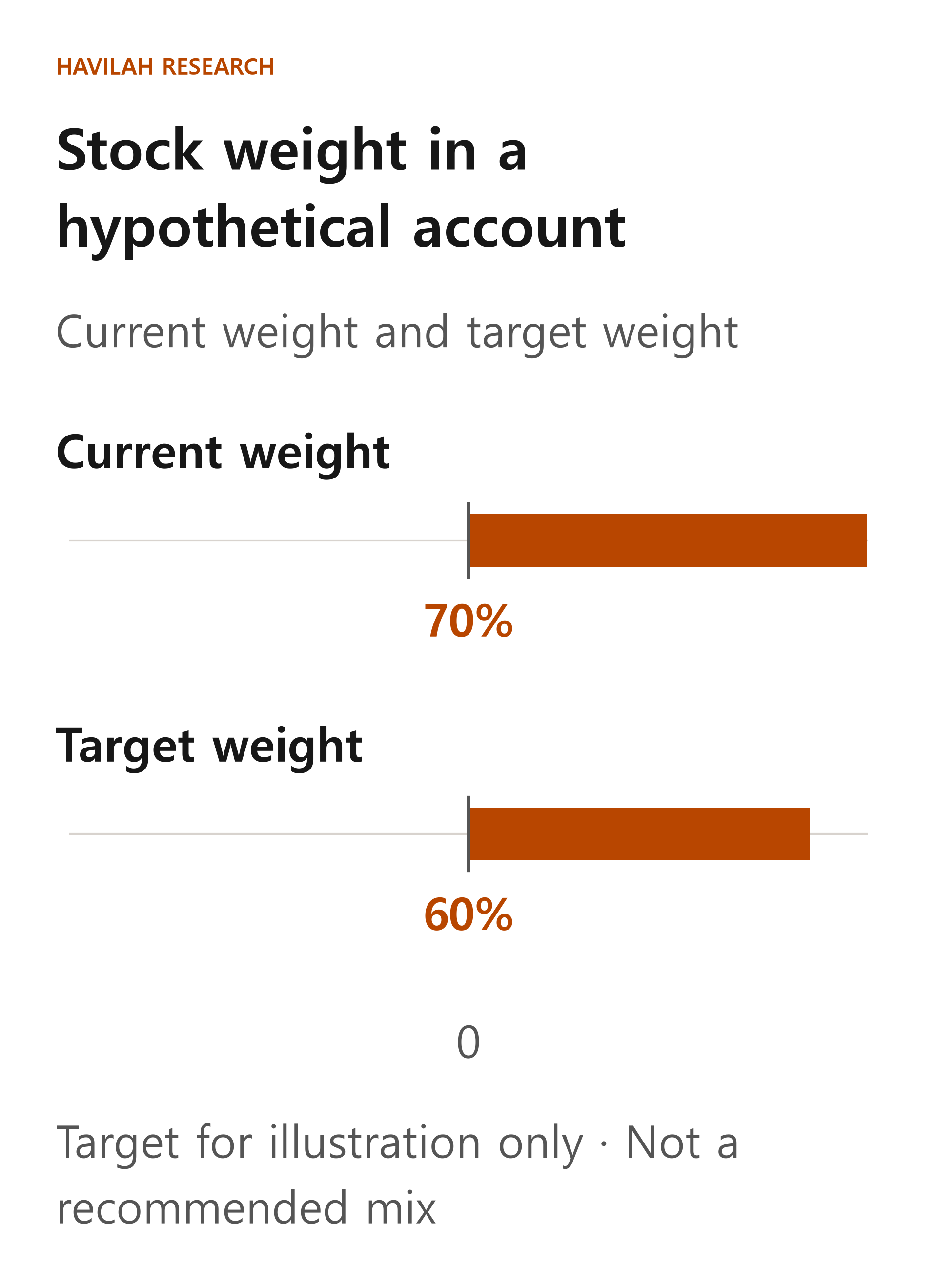
The following is a hypothetical example for illustration. The target is 60% stocks and 40% bonds, and the account currently holds $7,000 in stocks and $3,000 in bonds. These two amounts make up the whole account, and costs, taxes and exchange-rate changes are left out. These percentages are not a recommended mix.
The total is $10,000, so the current weights are 70% stocks and 30% bonds. Stocks are 10 percentage points above the target. Be careful to tell these apart: the change from 60% to 70% is a difference of 10 percentage points, not 10% of the target.
If prices stay the same and you can trade any amount you want at no cost, the stock holding that matches the target is 10,000 × 60% = $6,000. If you sell $1,000 of stocks and add $1,000 to bonds, you end up with $6,000 in stocks and $4,000 in bonds. In real trading, the result can differ because of the number of shares you can trade, price changes, costs and taxes.
In Lesson 184, we calculated target amounts for core and satellite holdings. Here, we look at how far your weights can drift from the target before you check them, and at ways to adjust besides selling.
Decide when you will check
The first method is to set dates. For example, every 6 months you compare your target weights with your current weights. Check dates are easy to remember, but your weights may shift a lot before the next check. You do not have to trade every time you check.
The second method is to set a tolerance band. Suppose you center your stock weight on the 60% target, allow a range of 55% to 65%, and consider adjusting when the weight moves outside that range. The current 70% is 5 percentage points above the 65% upper limit. However, you also need to decide how often you will look at your weights; otherwise you will not notice when they leave the range.
The third method combines the two. For example, you could check every 6 months but consider adjusting only when the weight is outside the 55% to 65% range. You may miss drifts that happen between checks. The 6 months and the 5 percentage points are numbers for illustration, not the right answer for everyone.
You can also adjust without selling
Suppose the $10,000 account above receives $2,000 of new money to invest. If you buy bonds with all the new money and do not sell any stocks, you have $7,000 in stocks and $5,000 in bonds. The total is $12,000, and the stock weight is 7,000 ÷ 12,000 × 100 = about 58.33%.
That is not exactly the 60% target, but it is now inside the hypothetical 55% to 65% band. Buying bonds with the new money may still involve costs. Also, you will not always have extra money to invest. If you receive dividends or interest, you can also consider putting that money into the asset that is below its target.
Check costs and whether your target has changed
Adjusting often can shorten the time you spend far from your target weights, but it can increase trading costs and taxes. On the other hand, if you check or adjust too rarely, a gap between the risk you meant to take and your actual weights can last a long time. No method always produces better returns.
Before you bring your weights back, also check whether the target itself still fits. If the time when you will need the money is getting closer, or your income, living costs or the loss you can bear have changed, there may be no reason to keep the 60:40 split you first chose. Bonds can also fall in price; they are not a guarantee against losses.
First set your target, then write down how often you will check, your tolerance band and the costs of adjusting. In the next lesson, we will check the whole account by imagining a severe market crash.