
You bought a stock at $100 and placed an order to sell it at $95. But after the market closed, unexpected bad news came out, and the next day the price opened at around $80.
In this case, you should not assume your shares were sold at $95. A stop-loss order can help you manage losses, but the price you actually get, and whether the order is filled at all, can differ depending on the type of order.
The price can jump past your stop-loss level
When a stock falls from $100 to $80, it does not necessarily trade at $99, then $98 and then $95 on the way down. If new information comes out while no trading is taking place, there can be a big difference between the last traded price and the next one. This kind of empty space between prices is called a gap.
Also, if an exchange temporarily halts trading in a particular stock, sell orders may not be filled during the halt. The price after trading resumes can differ from the price before the halt, so do not assume you can sell at the stop-loss level you set before it.
U.S. stocks can also trade outside regular market hours. But there is no guarantee that the price in extended-hours trading will match the opening price of the next regular session. Check with your broker which orders you can place outside regular hours and whether your existing orders remain active then.
A stop order does not guarantee a price
A sell stop order turns into a market order once the price reaches the level you set. A market order tries to sell at whatever price is available to trade. Here, $95 is the level that triggers the order, not a price you are sure to sell at.
For example, suppose you placed a $95 sell stop on 15 shares you bought at $100. Assume that, at a time when the order is active, the price meets your broker's trigger conditions, and all 15 shares are then sold at $80. The $80 is only an assumption; it does not mean a real order would end at that price.
Leaving out commissions, taxes and exchange rates, the loss per share is 100 - 80 = $20, and the loss on 15 shares is 15 × 20 = $300. That is $225 more than the planned loss of 15 × 5 = $75 if every share had sold at $95.
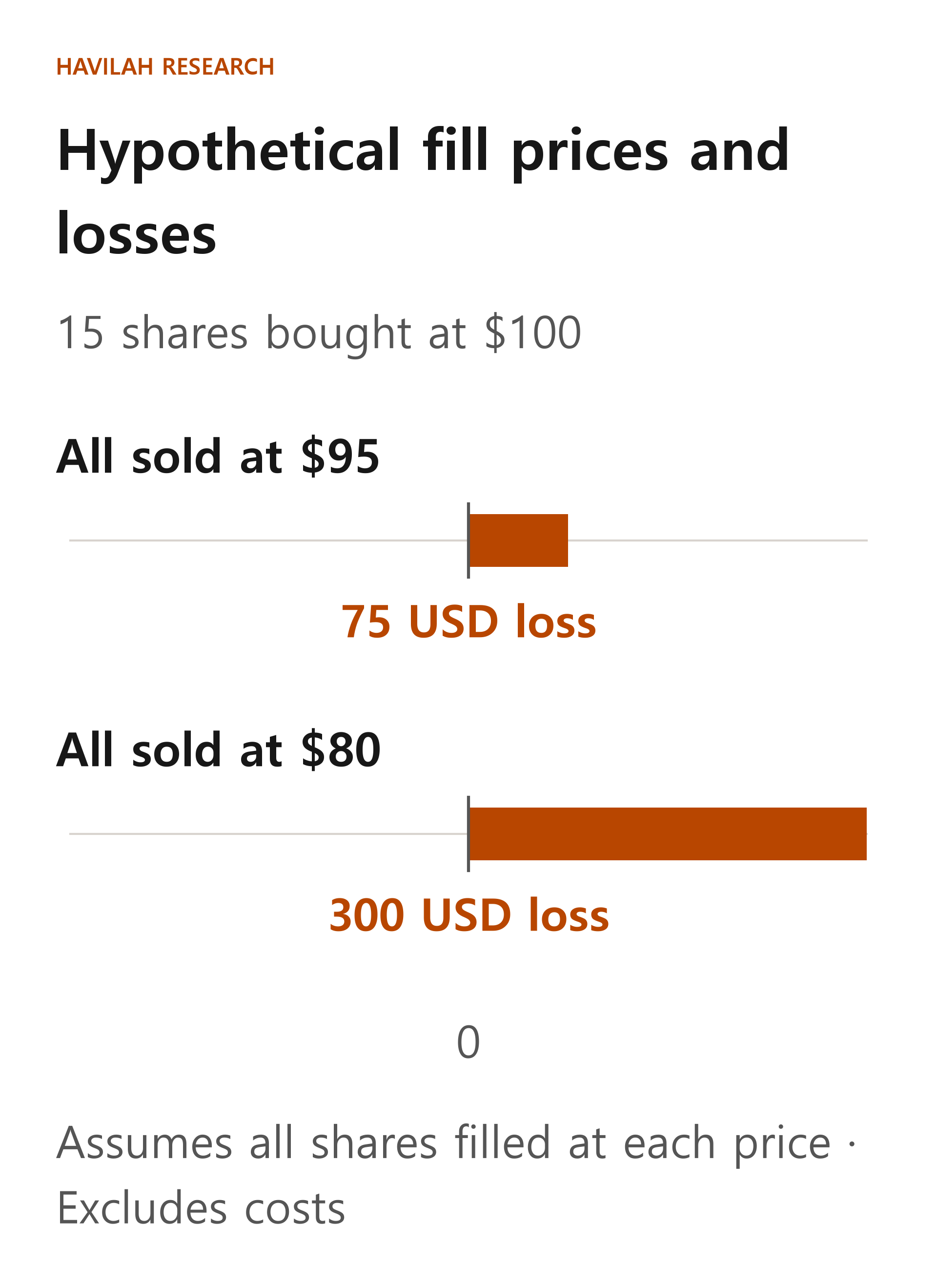
In reality, the buyers and the prices they offer keep changing, so some of your shares may be filled at different prices. The share-count calculation in Lesson 186 was a way to plan your loss; this example shows the difference that arises when you are not filled at that planned price.
A stop-limit order leaves a different problem
A stop-limit order becomes a limit order once it is triggered. For example, if you set the sell trigger price at $95 and the sell limit price at $94, then after the trigger the order carries a price condition: it can only sell at $94 or higher.
If, after the trigger, the only buyers in the market are bidding around $80 and no one is willing to pay $94 or more, the order may not be filled. In that case you have not locked in a $300 loss. Instead, the 15 unsold shares show a paper (unrealized) loss of $300 at a price of $80. From there, the price may fall further or rise.
With a stop order, the fill price can turn out worse than you planned; with a stop-limit order, your shares may not be sold unless your price is available. Neither one keeps your loss within a set amount in every situation. Even if the price recovers right after reaching the trigger level, whether your order is filled depends on the buyers and prices available at that moment.
What to check before you place the order
First, check whether your broker offers stop or stop-limit orders for the foreign stock you hold. Even when order names are similar, they can differ in whether the trigger uses the last traded price or the quoted bid and ask, and in the hours during which they work.
Also check how long the order stays valid. Whether it is valid for one day only or stays in place until you cancel it decides whether it will still be there the next day. Even an order that is valid until canceled may have a maximum duration set by your broker. Orders outside regular hours can face less liquidity and a wider gap between bid and ask prices, so they may trade at a worse price than you expected or not trade at all.
Once you have set a stop-loss price, also calculate what happens if you sell far below it or cannot sell at all. If that loss is more than you could bear, rather than only changing the order type, you need to go back to the start and rethink how many shares you buy and how much weight the position has in your account.
In the next lesson, we will look at maximum drawdown, which shows how far an account has fallen from its highest point, and how it relates to recovering from a loss.