
Even if you spend the same amount on two stocks, the amount they move your account in a day can differ. That is because one stock usually rises and falls more than the other.
Let's add the size of recent price moves to the share-count calculation you learned earlier. Keep in mind, though, that past moves do not tell you how large future losses can get.
Compare price moves on the same basis
ATR (average true range), which we looked at in Lesson 165, is an indicator that averages a stock's price moves over a recent period. Its calculation also takes into account any gap from the previous day's closing price. ATR does not tell you whether the price is heading up or down.
Because ATR is stated as a dollar amount, comparing the raw numbers for two stocks with different prices can be misleading. If you also look at ATR as a percentage of the share price, you can see how large recent moves have been relative to each stock's own price.
Assume hypothetical Stock A trades at $50 with an ATR of $1, and Stock B trades at $100 with an ATR of $5. Relative to price, A's ATR is 1 ÷ 50 = 2%, and B's is 5 ÷ 100 = 5%. This means B's recent moves have been larger relative to its own price. Assume both ATRs were calculated over the same period and in the same way.
How many shares for the same planned loss?
The following is a hypothetical rule for illustration. You buy both stocks at their current price and set the price at which you will consider selling at twice the ATR below that. This does not mean twice the ATR is the right answer or that it suits every stock. The two trades are not made at the same time but compared one at a time, and commissions and taxes are left out.
In effect, A's review price is $48, which is $2 per share below, and B's is $90, which is $10 per share below. If you set the planned loss on each trade at $100 and assume every share is filled at the set price, A gives 100 ÷ 2 = 50 shares and B gives 100 ÷ 10 = 10 shares.
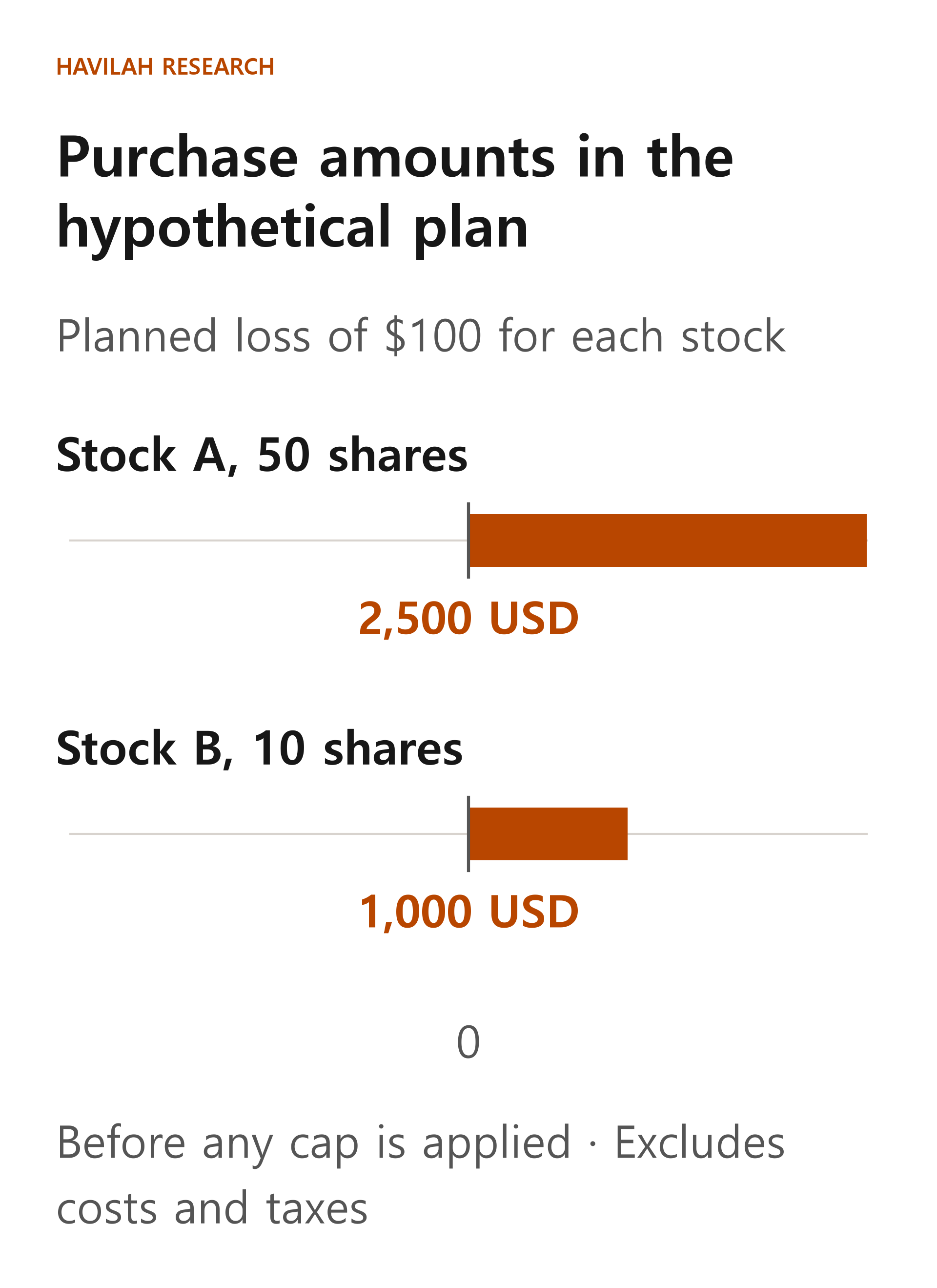
Buying those quantities costs 50 × 50 = $2,500 for A and 10 × 100 = $1,000 for B. The planned loss is the same in both calculations, but the money and the number of shares needed are different.
Apply your cash and investment cap too
Assume your account holds $10,000 and you have decided that the most you will invest directly in any one stock is 15%, or $1,500. This percentage is also for illustration, not a recommended level.
For A, the calculated 50 shares cost $2,500, which is over this cap. Cutting it to fit the cap gives 1,500 ÷ 50 = 30 shares. B's 10 shares cost $1,000, which is within this hypothetical cap. If you have less cash available to order, you need to cut the quantity further.
If you buy 30 shares of A at $50 and sell all of them at exactly $48, the loss is 30 × 2 = $60. If you buy 10 shares of B at $100 and sell all of them at exactly $90, the loss is 10 × 10 = $100. These figures simply assume that every share is filled at the price you set.
What is different about stocks that are hard to trade?
The buy and sell prices you see on screen each apply to a set number of shares. If you want to trade more shares than that, or if the price moves quickly, your order may be filled in pieces at several different prices. If trading is light and the gap between the bid (the price buyers offer) and the ask (the price sellers want) is wide, your real trading cost can also rise.
A limit order lets you set a price condition, but there is no guarantee that all the shares you want will be filled. Check with your broker not only prices, quantities and order types, but also whether it supports trading outside regular market hours and on what terms.
Remember the limits of the numbers
ATR only summarizes past moves; it does not guarantee a limit on how far the price can fall in the future. If an overnight filing or a market event makes the price jump past your review price, your loss can be larger than planned. Even a stock that has had low volatility can suddenly make a big move.
Once you have set a quantity for each stock, also check whether the same companies or industries overlap across your other stocks and ETFs. In the next lesson, we will look at why several stocks can fall at the same time.