
Even if you buy the same stock at the same price, the amount you lose depends on how many shares you bought. Before you buy, deciding both the price at which you will recheck your investment decision and the loss you can bear helps you calculate how many shares to buy.
However, this calculation rests on the assumption that you can actually sell at the price you set. It is not a safeguard that holds your loss to that amount.
Start by writing down three numbers
The following is a hypothetical calculation, not a recommended rule. Assume your investment account holds $10,000 and that you have decided the loss you plan to accept on a single trade is $100, or 1% of the account. Your purchase price is $100 per share, and the price at which you will recheck your decision is $95. Commissions, taxes and exchange-rate changes are left out.
The difference between your planned purchase price and your review price is 100 − 95 = $5 per share. If you could buy and sell at exactly those two prices, you would lose $5 on each share.
Divide the planned loss of $100 by $5 per share: 100 ÷ 5 = 20 shares. Buying 20 shares at $100 costs $2,000. If you sold all of them at exactly $95, the loss would be 20 × 5 = $100.
Check a separate cap on how much you invest
In the calculation above, 20 shares make up 20% of the account. But if the investor has decided to keep direct holdings in any one company within 15% of the account, the cap is 10,000 × 15% = $1,500.
At $100 per share, that buys 1,500 ÷ 100 = 15 shares. You have 20 shares from the loss limit and 15 shares from the investment cap. If you choose the smaller number, 15 shares, you stay within both hypothetical rules. You also need to check the cash actually available to order in your account and the units in which you can order shares.
If you buy 15 shares at $100 and sell all of them at exactly $95, the loss is 15 × 5 = $75. Even so, that $75 is only a hypothetical plan that assumes your order is filled at that price.
What if the actual fill price is lower?
Suppose the price falls quickly and you end up selling all 15 shares at $90. The loss per share is 100 − 90 = $10, and the total loss is 15 × 10 = $150. That is $75 more than the $75 you planned.
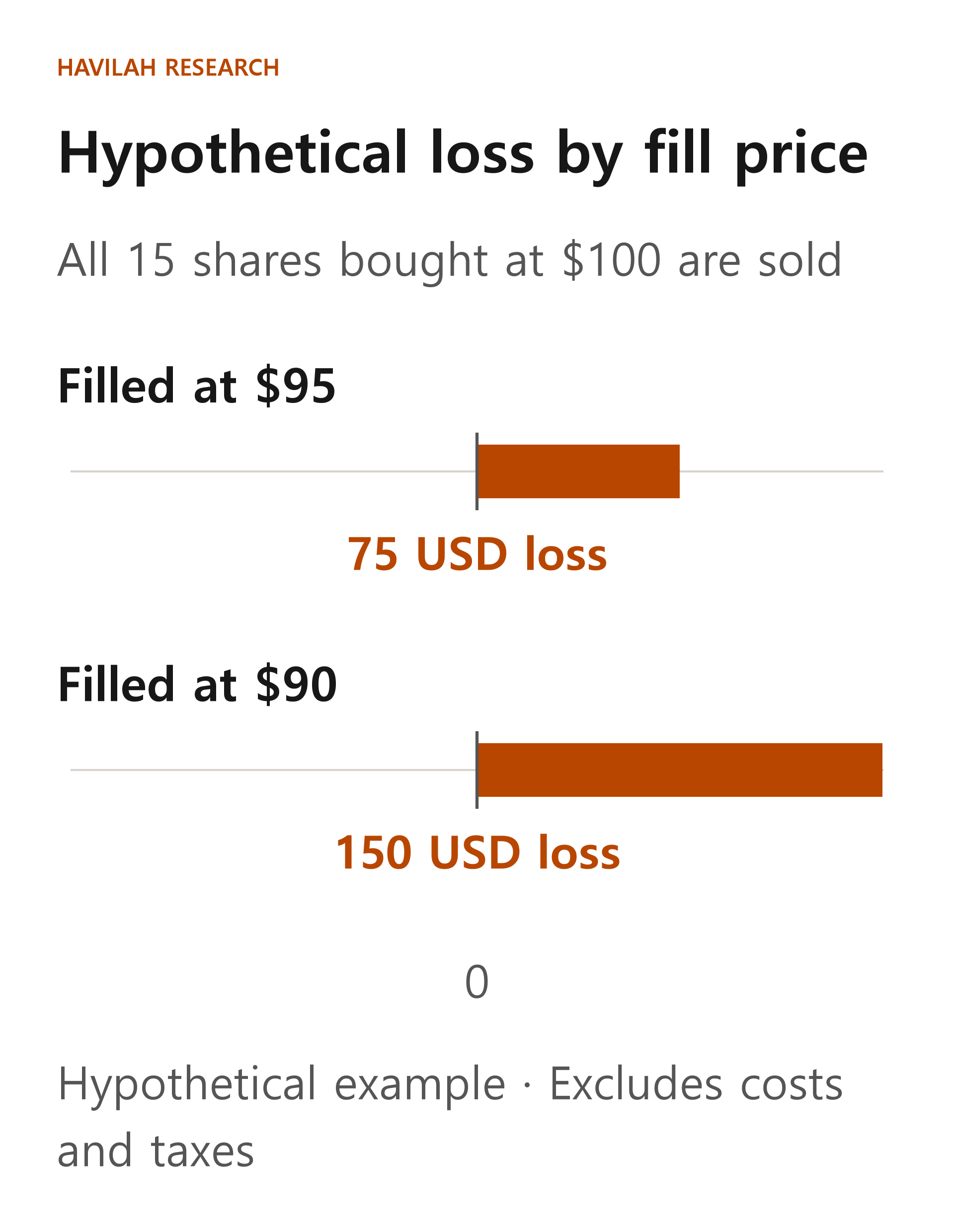
This figure is also a simplified comparison: it assumes all 15 shares are filled at $95 in one case and all at $90 in the other. Real orders may be filled in parts or not filled at all, and extra costs may apply.
Stop orders versus a set limit price
How you carry out a stop-loss depends on your broker and the product. One type of stop order used in the U.S. market turns into a market order once the stock reaches a trigger price you set. After that, the price at which you are actually filled can differ from the trigger price.
A stop-limit order, once the trigger price is reached, places an order with the limit price you chose. It can keep you from selling below your sell limit price, but if no one is willing to buy at that price, your shares may not be sold. Check with your broker which order types it offers and what triggers them.
A single price cannot explain every risk
Do not just place your review price wherever it fits your loss amount. Set it by thinking about what your investment is based on and how much the price usually moves from day to day. The share price may dip briefly and then rise again, and important facts about the company may change even if the price does not reach your review price.
Also, besides holding a company directly, you may own the same company through an ETF. Look separately at the chance that losses on several trades happen at the same time.
In the next lesson, we will look at how to compare the number of shares to buy when stocks differ in how widely their prices move.