
When you study a company for a long time, there may come a moment when you feel, "There is almost no chance I am wrong this time." But how likely your view is to be right and how much money you would lose if it turned out wrong are two separate questions.
An investment decision covers not only what to buy but also how much to buy. The stronger your conviction, the more important it is to work out first how much your account would shrink if things went the other way.
The same drop does different damage depending on your allocation
This is a hypothetical example for illustration. Assume your investment account holds $10,000 and that there are no commissions, taxes or exchange-rate changes. Assume also that while the share price of the company you are interested in falls 50%, the value of everything else you own stays the same.
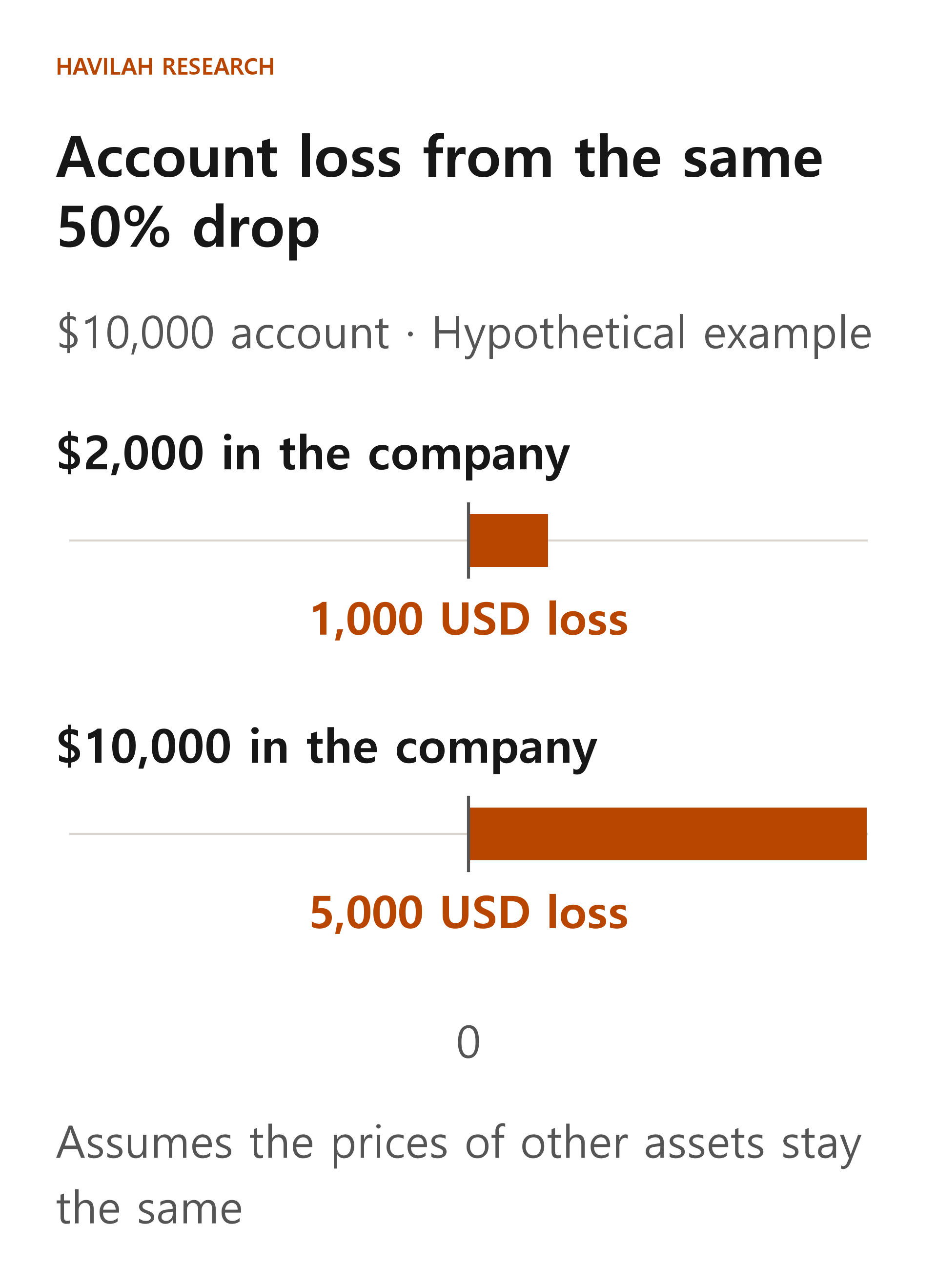
The first investor put $2,000 into this company. If the share price falls 50%, the loss on that stock is 2,000 × 50% = $1,000. Measured against the whole $10,000 account, that loss is 10%.
If a second investor had put the entire account, $10,000, into the company, the same drop would mean a loss of $5,000, or 50% of the account. The company's share price moves in exactly the same way, but the effect on the account depends on how much money is in the position.
This rests on the simple assumption that your other assets do not move. In reality, your other holdings may fall at the same time. In particular, if the same company is also held inside an ETF, or several of your stocks are concentrated in the same industry, it is hard to judge your risk by looking only at the weight of the individual stock.
The probability of being right is not enough
Suppose an investment has a 60% probability of rising, and if it rises, it gains 20%. Assume that with the remaining 40% probability it loses 30%. These probabilities are made-up numbers for illustration, not figures you could actually know in real investing.
Multiply each outcome by its probability and add the results: 0.60 × 20% + 0.40 × (−30%) = 0%. In this calculation, a rise is more likely, but the loss is larger, so the average result is 0%. This does not mean that a single investment will actually return 0%. It is only an average calculated from the outcomes and probabilities you assumed.
In real life, it is hard to know probabilities and the size of possible losses precisely. So rather than trusting a single number, look at the reasons your view could be wrong and at the situations that could lead to a larger loss.
A large loss needs a large gain to recover
If $100 falls 50%, you are left with $50. To get back to $100, the remaining $50 has to gain another $50, so you need a 100% rise measured from the amount that is left.
This happens because the loss percentage and the gain needed to recover are measured from different starting amounts. While you wait for a recovery, you may need the money for something else, and the price may not return to its earlier level.
A loss limit is not a guarantee either
Before you buy, you can write down a rule such as, "If the price reaches this level, I will check my thinking again." If it helps, you can also look at the order types your broker offers.
But you will not always be able to sell at the price you set. If the price moves sharply or there are few buyers and sellers, the price at which your order is actually filled may be lower than you expected. Do not treat your expected loss and your worst-case loss as the same number.
Think about an upper limit that fits you
First, ask whether you could keep up your daily life and your long-term plans even after a large loss on this company. Next, check how much of the same company or industry you already hold through other ETFs. Then write down the conditions under which you would conclude your view was wrong, and the conditions under which you would stop buying more.
The upper limit on a position's weight depends on your investment horizon, your wealth and the size of loss you can bear. In the next lesson, we will calculate how many shares to order using your purchase price, your review price and the amount you can afford to lose.