
What if you want to keep investing steadily in the market as a whole, but also want to hand-pick companies that interest you? Instead of treating your investment money as one lump, you can split it into a core part that you keep for a long time and a part that you manage separately.
This approach is called core-satellite investing. The core is the assets you keep for your long-term goals, and the satellites are investments you take a closer interest in, such as particular companies or industries. The core is not necessarily safe. If your core holds stock ETFs, it can lose money when the market falls.
Start by giving each part of your money a role
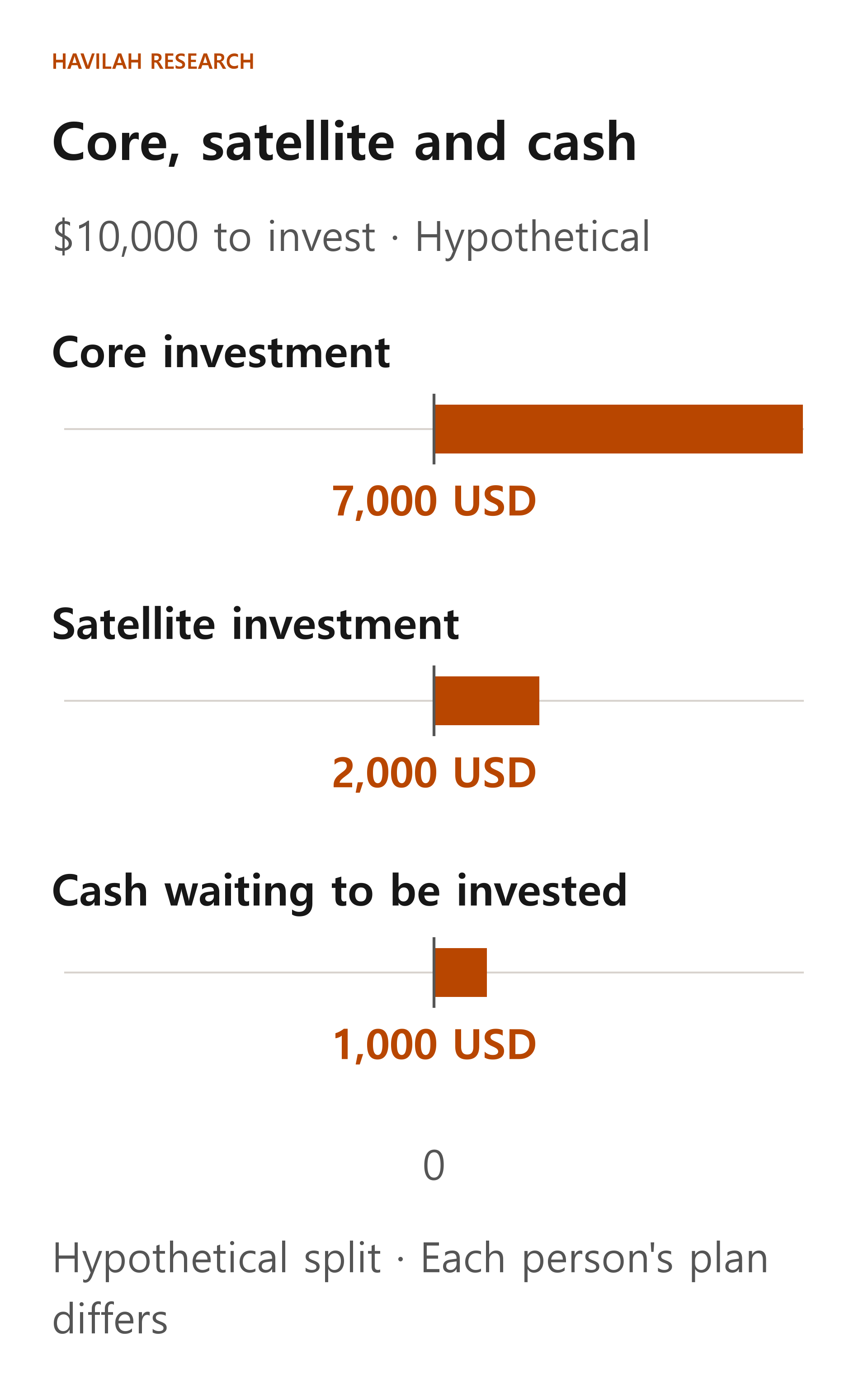
The following is a hypothetical example for illustration, not a recommended split. Assume that out of $10,000 in total, you put $7,000 into an ETF that holds many companies and $2,000 into specific companies or a theme ETF, and you keep $1,000 as cash waiting to be invested.
| Role | Hypothetical amount | Share of total |
|---|---|---|
| Core investment | $7,000 | 70% |
| Satellite investment | $2,000 | 20% |
| Cash waiting to be invested | $1,000 | 10% |
Cash waiting to be invested and an emergency fund you may need for day-to-day living have different jobs. Where to keep an emergency fund, and how much, should be decided separately, taking into account your living costs and how stable your income is. The $10,000 in this example means only the money you have decided to put into your investment account.
How much goes to the core and to the satellites depends on how long you plan to invest, how much loss you can bear and the other assets you already have. The split used at the start of this example cannot be applied to everyone.
Check whether the core and the satellites overlap
A company you pick as a satellite may also be inside your core ETF. That means that, besides the $2,000 you hold in that company directly, you are also indirectly affected by it through the ETF. Look at the core ETF's top holdings and industry weights, then combine what you hold through the ETF with what you hold directly to see how exposed you are to a single company.
Even if you have several satellites, they may be concentrated in the same industry or in similar risks. What your holdings actually contain matters more than how many product names appear in your account.
How should you read a change in weights?
Suppose that after some time, the core is worth $7,700, the satellites $1,600 and the cash $1,000. The three amounts add up to $10,300. If your target is still 70% core, 20% satellites and 10% cash, you can recalculate the target amounts based on this same total.
The target for the core is 10,300 × 70% = $7,210, for the satellites 10,300 × 20% = $2,060 and for cash 10,300 × 10% = $1,030. By this simple calculation, the core is $490 over its target, while the satellites are $460 short and cash is $30 short.
Assume prices do not change while you trade, and that every order is filled for the amount you want, with no costs or taxes. If you reduce the core by $490, add $460 to the satellites and keep the other $30 as cash, you match the target amounts. This is not a recommendation to trade. In practice, the units in which shares trade, trading costs and taxes make it hard to match the targets exactly, and adjusting right now may not be the right choice. If you have new money to invest, you can also consider putting it toward the parts that are short.
Look at costs across your whole investment too
Let's go back to the original hypothetical split. Assume the core ETF has annual management costs of 0.05% and the satellite ETF 0.30%. If we simplify by assuming the amounts do not change for 1 year and the cash has no costs, the core costs 7,000 × 0.05% = $3.50 and the satellites 2,000 × 0.30% = $6. Together, that is $9.50 a year.
This is a hypothetical calculation, not the costs of real products. Management costs are reflected in the fund's assets, and trading commissions, the bid-ask spread, currency conversion costs and taxes can come on top. If the actual amounts you hold or the holding period change, the effect of the costs changes too.
Questions to settle in advance
Write down what your core investment is for and how long you plan to hold it, and why you picked each satellite investment. You can also decide when you will check your weights regularly, and what conditions will make you take another look if your thinking changes. But this does not mean you must trade every time prices move.
In the next lesson, we will look at how to think about a limit on how much you invest, and about your possible losses, even when you feel confident about a particular company.