
When an ETF pays you money every month, it is easy to feel that the whole amount is investment profit. But if you look only at the distributions you receive in cash, it is hard to tell whether your account actually made money. That is because the ETF's price changes at the same time.
With covered call ETFs in particular, you need to look not only at the dividends that come from stocks but also at how the fund uses options.
Distributions are not the same as your total return
An ETF's distributions are money paid out to investors from sources such as income earned on the fund's assets or gains from selling assets. Depending on the product, part of a distribution may simply be paying back some of the money you invested. To find out what a distribution is actually made of and how it is classified for tax, check the product's documents and your personal situation.
When a distribution is paid, that amount of assets leaves the fund. If nothing else changes, the fund's net asset value falls by the same amount. The actual market price is also affected at the same time by other factors, such as the stock market and supply and demand. So you cannot assume that new profit equal to the distribution was created just because a distribution came in.
Suppose you bought a hypothetical ETF for $100. While you hold it, you receive a $3 distribution in cash, and at the end of the period the ETF's price is $96. How did you do? Assume you did not reinvest and that there were no fees or taxes.
The ETF you still hold, worth $96, plus the $3 in cash you received adds up to $99. That is $1 less than the original $100, so your total return is −1%. You received a distribution, but the drop in the ETF's price was larger, so overall you lost money.
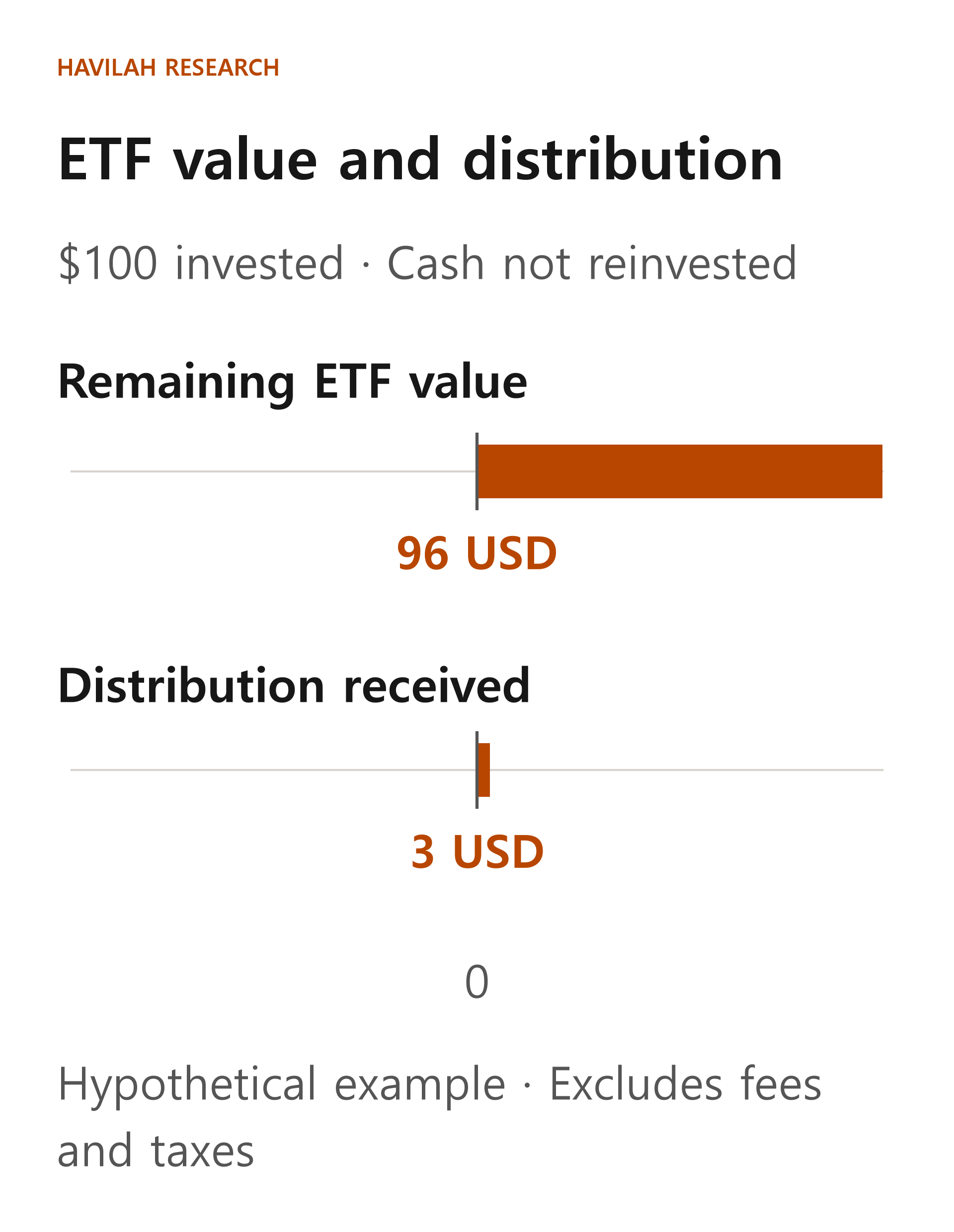
On the other hand, if the price is $99 after you receive the distribution, the remaining ETF and the cash come to $102. The same distribution can go with a different total return, depending on the price. If you reinvested the distribution, you would need to count the additional shares you now hold instead of the cash.
What does a covered call do?
A call option is the right to buy an asset at a set price under certain conditions. A covered call is a strategy in which you sell this kind of right to someone else, backed by an asset you own, and receive a payment for it. The money you receive for selling the right is called the option premium.
In exchange for that payment, you may not get the full benefit of a rise above the agreed price. If the share price falls, the premium you received offsets part of the loss, but it cannot protect you from a large drop.
Gains and losses in numbers
The following is a simple hypothetical example for a single share of stock, not the actual performance of an ETF. Assume that when the share price is $100, you sell the right to buy it at $105 and receive a $2 premium. Assume you hold until the option expires, there are no dividends, fees or taxes, and you sell at the agreed price if the price goes above $105. Real options may differ in contract size and settlement method.
If the stock is at $115 when the option expires, you sell it at the agreed price of $105 and add the $2 premium, so you receive $107 in total. Compared with the original $100, your profit is $7. If you had held the stock without selling the right, your gain from the price rise would have been $15.
Now suppose the stock is at $90 when the option expires and the right is not exercised. The share you still hold, worth $90, plus the $2 premium you received comes to $92. That is an $8 loss from where you started. The premium cushioned part of the drop, but it did not remove the loss.
Which options an ETF actually uses, on which assets and to what extent, differs from product to product. Do not treat this one-share example as the exact return structure of every covered call ETF.
What to look at together before you invest
Check not only how often distributions are paid but also where they come from, and how the ETF's price and total return changed before and after each payment. For a covered call product, also look at which assets the options are applied to and to what extent, the costs, and the conditions under which gains may be capped.
There is no guarantee that distributions will be paid in the same amounts in the future as in the past. If you plan to use them for living expenses, think about whether your plan still works if the payments shrink or the ETF's price falls.
In the next lesson, we will look at how to divide your money between a core investment that you keep for the long term and satellite investments that you choose separately.