
If an index rose 10% over a month, did a 2x leveraged ETF rise 20%? Not necessarily. Many leveraged ETFs set their target based on the index's return for a single day, not for the whole month.
What "2x" and "opposite direction" mean
For example, a 2x leveraged ETF is a product managed so that its daily return is about 2% when its underlying index rises 1% in a day. When the index falls 1% in a day, it aims to fall about 2%. Because of costs and differences in how the fund is actually run, it may not hit the target exactly.
An inverse ETF aims for a return in the opposite direction to its underlying index over a set period. A 1x inverse ETF with a daily target aims to fall about 1% when the index rises 1% in a day, and to rise about 1% when the index falls 1%.
The underlying index is what the ETF aims to follow. Start by checking in the product documents what the index is, what the target multiple is, and whether the target is set for a single day.
Working it out yourself over two days
The following is a hypothetical example, not a real product. The index and each ETF all start at 1,000. Assume both ETFs hit their target return exactly every day and that there are no costs or taxes.
On the first day, the index rises 10%, and on the second day it falls 10% from the day before. On the first day, the 2x ETF rises 20% and the 1x inverse ETF falls 10%. On the second day, the 2x ETF falls 20% and the inverse ETF rises 10%.
| Item | Start | After the first day | After the second day |
|---|---|---|---|
| Underlying index | 1,000 | 1,100 | 990 |
| 2x leveraged ETF | $1,000 | $1,200 | $960 |
| 1x inverse ETF | $1,000 | $900 | $990 |
After the first day, the index is at 1,100, so a 10% fall takes away 110 and leaves 990. The 2x ETF loses 20% of $1,200, or $240, which leaves $960. The inverse ETF gains 10% of $900, or $90, which brings it to $990.
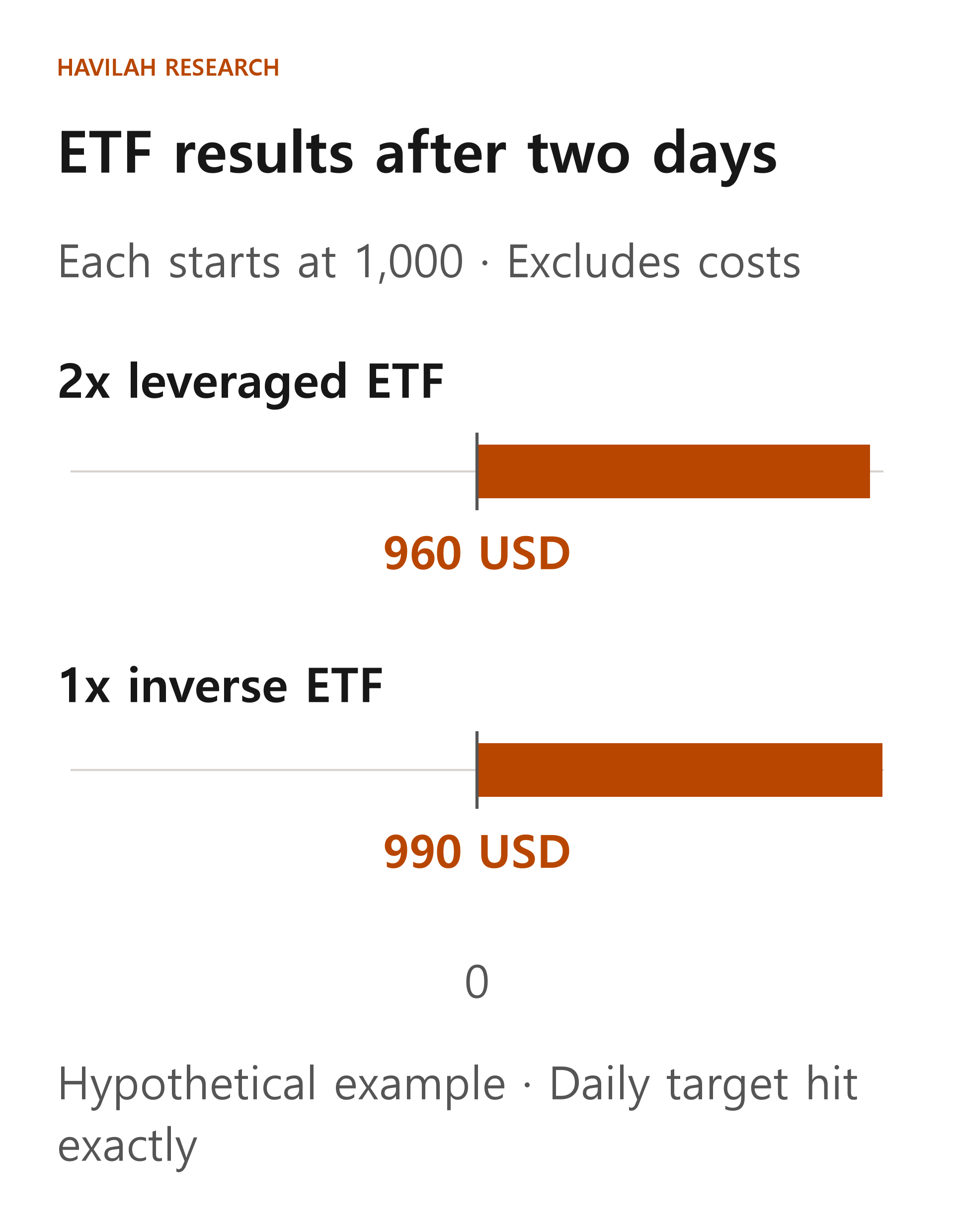
Over the two days as a whole, the index fell 1% from its starting point. The 2x ETF fell 4%, and the inverse ETF also fell 1%. Even when the daily target is met every day, the return over the whole period is not simply 2x the index's return, or its opposite.
The same ending index level can give different results, depending on the path
For comparison, suppose the index fell 1% in a single day, from 1,000 to 990. A 2x ETF that hit its target exactly with no costs would fall 2% to $980, and a 1x inverse ETF would rise 1% to $1,010.
In both cases the index ends at 990, but the ETF results are different. That is because each day's return is applied to the amount left after the previous day's change. When a result depends on the path that prices took to get there, as it does here, this is called path dependence.
What to check before you invest
In a market that swings a lot, losses can also grow quickly. A leveraged ETF multiplies your gains, but it multiplies the declines as well. An inverse ETF can also lose money when the index rises.
Real products can behave differently from the calculation above because of management costs or a gap between the market price and the net asset value. There is also no guarantee that they will hit the daily target return exactly every time.
Do not go by the product's name alone. Check the underlying index, the target multiple and the period it applies to, the management costs and how long you plan to hold. If you cannot tell which paths could make your losses grow, it is a good idea to first work through a calculation with small hypothetical numbers.
In the next lesson, we will look at how to consider option income and share price changes together when you look at ETFs that pay large distributions.