
Suppose you bought U.S. stocks and the share price, quoted in dollars, went up. Yet your return calculated in your home currency may be smaller than you expected, or even a loss. That is because the exchange rate moved along with the share price.
When you invest abroad, you need to look separately at which countries' companies you invest in and which currencies' movements you are exposed to.
What changes when you invest across countries?
Companies in your own country, the United States, Europe and Japan operate in different industries and market conditions. Because other markets may move differently when one country or industry runs into trouble, you can choose to spread your investments across several regions.
But spreading your money across countries does not make losses disappear. When something happens that affects the whole world economy, stocks in many countries can fall together. When you invest, look not only at the country where a company is listed but also at the regions where its main businesses earn money and the industry it belongs to.
You can buy shares of foreign companies directly, or use ETFs that hold companies from several countries. For each account and service, check which markets your broker lets you trade, the hours when you can place orders, and how currency conversion works and what it costs.
Your return in dollars and your return in your home currency differ
All the numbers here are a hypothetical example for illustration, not real exchange rates or product returns. Currency conversion fees, trading commissions, dividends and taxes are also left out. Suppose your home currency is the Korean won (KRW).
Assume you bought $1,000 of U.S. stocks when $1 was worth KRW 1,300. In won, your investment was 1,000 × 1,300 = KRW 1,300,000.
Next, assume the shares rose 10% in dollar terms to $1,100, but the exchange rate fell, so that $1 is now worth KRW 1,170; in other words, the dollar weakened against the won. Converted into won, the holding is now worth 1,100 × 1,170 = KRW 1,287,000. That is KRW 13,000 less than the original KRW 1,300,000, so your return in won is −1%.
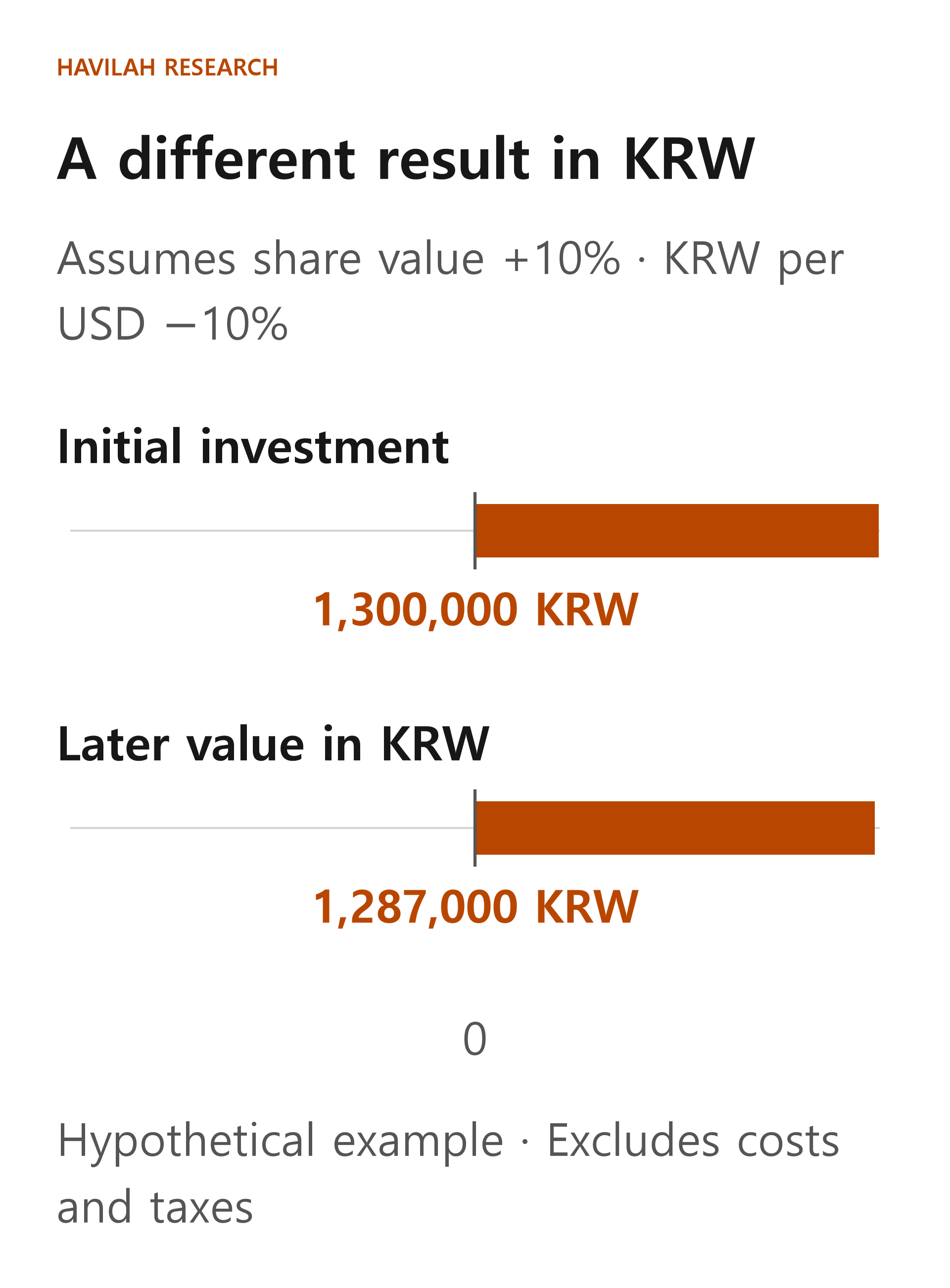
In dollar terms the shares rose 10%, but the exchange rate used to convert them into won fell 10%. You cannot simply add the two changes together; you have to multiply them: 1.10 × 0.90 = 0.99. The result is 99% of the starting amount in won, which is a 1% loss.
The reverse can happen too. Even if the share price falls in dollars, your loss in your home currency could shrink, or even turn into a gain, if the dollar strengthens against your home currency. Nobody can know in advance how exchange rates and share prices will actually move.
The currency an ETF trades in versus the currencies of what it holds
An ETF traded in dollars on a U.S. exchange does not necessarily hold only U.S. companies. For example, if an ETF holds European or Japanese companies, the fact that you buy and sell it in dollars does not remove the effect of changes in the currencies of its underlying assets.
An ETF's trading currency is the currency in which its buying and selling prices are shown. The currency exposure of its underlying assets depends on what the fund holds and on whether it is designed to reduce the effect of exchange-rate changes. If a company does business in several countries, its revenue and costs can also be affected by several currencies.
Some products aim to reduce the effect of exchange-rate changes. This is called currency hedging. But you cannot assume that hedging removes all currency risk, and the currencies covered, the method and the costs differ from product to product. For example, even if a fund hedges the currencies of its foreign assets against the dollar, that does not remove changes in the exchange rate between the dollar and your home currency. Check the product documents to see which currency the hedge is based on.
Where is your money really spread?
Do not look only at an ETF's name; check the regional and industry weights of the companies it holds. If it holds the same companies as other ETFs you already own, your exposure to a particular company can grow, even if it looks as though you bought products from several countries.
When you will need the money in your home currency also matters. When you look at the return on foreign assets, write down both the return in the trading currency, such as dollars, and the return converted into your home currency. Check conversion costs and taxes separately, based on your own account and situation.
Diversifying across countries and currencies is a way to examine risk, not a way to guarantee returns. In the next lesson, we will look at how leveraged and inverse ETFs apply a daily target.