
Looking at the same stock, one investor says, "This company is going to grow," while another says, "The price is too high right now." The two are starting from different questions.
Growth, value, quality and momentum are criteria that people often use to pick stocks. None of them is a formula that always wins. Knowing what each criterion looks at helps you understand an ETF's name and what it actually holds.
Growth: how much bigger will the company get?
Growth investors look at how much a company's revenue and profits will increase in the future. When new products sell or the number of customers rises, the company can grow larger.
But a good company and a good buying price are not the same thing. If high growth expectations are already built into the share price, the price can fall even when profits rise, because the results fell short of those expectations. On the other hand, the share price of a company with low expectations can rise when its results turn out better than expected.
Value: cheap compared with what?
Value investors compare the share price with the company's earnings or assets. For example, if the share price is $20 and the annual earnings for each share are $2, dividing the share price by earnings per share gives 20 ÷ 2 = 10x. This ratio is called the price-to-earnings ratio (P/E).
Under the same conditions, if the share price is $40 and earnings per share are $2, the P/E is 20x. But you cannot conclude that the first company is a cheap stock just because its number is lower. Its price may be low because its earnings are temporarily inflated or are expected to shrink. If earnings per share are 0, the P/E cannot be calculated, because you cannot divide by 0. If earnings are negative, the result is negative, so it is hard to read in the same way as an ordinary positive P/E.
Quality: how sound are the business and its finances?
Quality is a criterion that looks at how good a company is. It checks things such as whether earnings are steady, whether debt is excessive compared with shareholders' equity, and how much profit the company earns on its capital. How much weight each measure gets differs from index to index and from fund manager to fund manager.
Earnings that were stable in the past will not necessarily stay stable. Even with a sound company, you can lose money if you pay too high a price or if the competitive landscape changes.
Momentum: how has the price moved recently?
Momentum looks for share prices that have been stronger than other stocks over a set period. For example, you can compare returns over the past 6 or 12 months. What the comparison is based on, and when the holdings are changed, differ from product to product.
A stock that has risen a lot recently is not guaranteed to keep rising. If the mood in the market changes, the trend can reverse quickly. If a strategy trades often, you also need to look at trading costs and taxes.
Why do valuations change when interest rates change?
When you compare money you will receive from a company in the future with money today, you lower its value to account for the time you have to wait and for the risk. The rate used to do this is called the discount rate. The discount rate is not set by the central bank's policy rate alone.
As a hypothetical example, assume you will receive $100 in 2 years and the same discount rate applies each year. At a discount rate of 5% a year, the present value is 100 ÷ 1.05 ÷ 1.05 = about $90.70. At 10% a year, it is 100 ÷ 1.10 ÷ 1.10 = about $82.64.
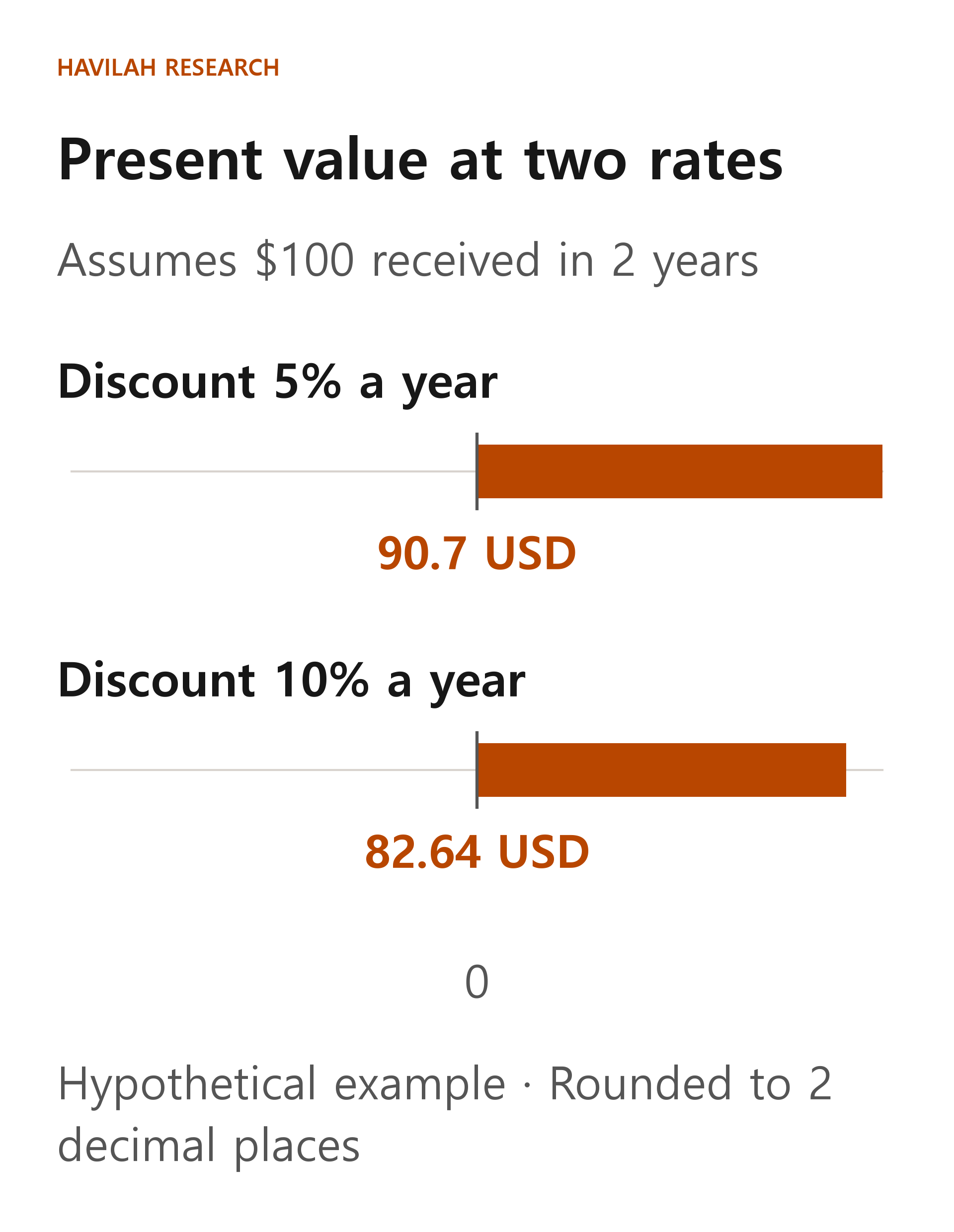
For the same future amount, a higher discount rate means a lower present value. With real companies, the outlook for future earnings and the risks change at the same time, so you cannot be sure which way a particular strategy or share price will go just because interest rates have risen.
In practice, you look at them together
A single company can offer both growth and financial stability, or show both a low price and a strong recent trend. When you invest, check the company's business and finances, and look at what expectations the current price already reflects. For an ETF, check not only its name but also its selection criteria, holdings, weights and costs.
In the next lesson, we will go beyond the criteria for picking companies and look at how countries and currencies affect your investment results.