
You bought shares of a semiconductor company and then added a semiconductor ETF. If you also bought a U.S. large-cap ETF, it looks as if you have spread your money across three investments. But if the same company is inside all three, your real exposure to that company may be bigger than you think.
In an earlier lesson, we saw how one ETF can overlap with shares you hold directly. This time, we will look at two ETFs together with an individual stock, and calculate how concentrated you are not only in one company but also in one industry.
The same company can show up in three places
Everything here is a hypothetical example for illustration. Assume a total investment of $10,000 is split as follows.
| Holding | Amount invested | Company A's weight |
|---|---|---|
| Company A shares | $2,000 | 100% |
| Semiconductor theme ETF | $4,000 | 25% |
| U.S. large-cap ETF | $4,000 | 5% |
The weights of the two ETFs were checked on the same day. Cash, debt, costs and any gap between an ETF's market price and the value of its holdings are left out of the calculation. Assume A is a semiconductor company.
The A shares you hold directly are worth $2,000. Your exposure to A through the theme ETF is 4,000 × 25% = $1,000, and through the large-cap ETF it is 4,000 × 5% = $200. Adding the three amounts, your exposure to A is $3,200.
That is $3,200 out of a total of $10,000, so A accounts for 32% of your money. Holding three differently named products does not split your risk in A three ways and make it disappear.
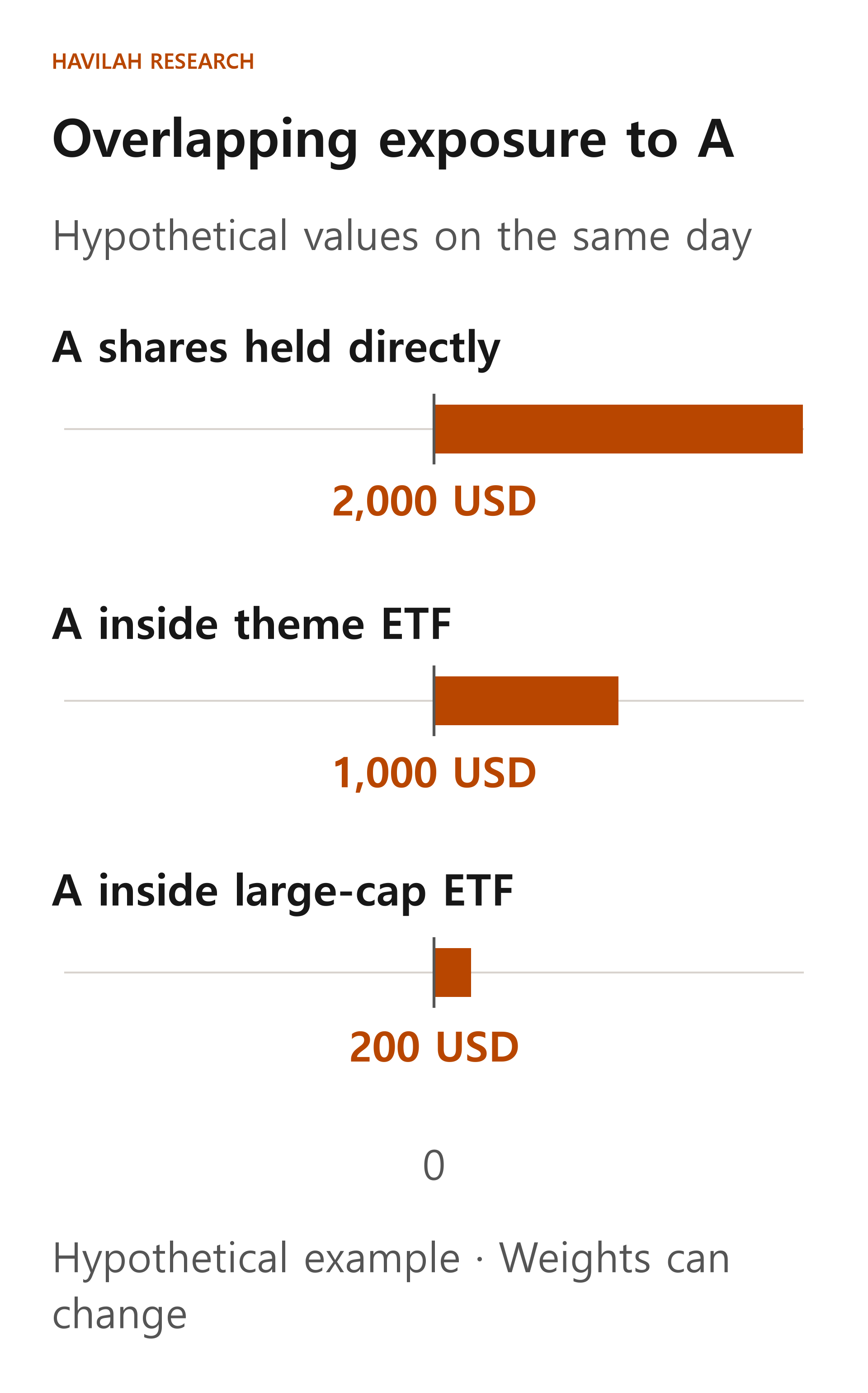
The amounts inside the ETFs do not mean you hold A shares directly in your account. They mean that, to the extent each ETF holds A, you are indirectly affected by changes in A's share price. The actual price of an ETF can also vary with market conditions, its other holdings, costs and so on.
Concentration in a company is different from concentration in an industry
Now let's look at all the semiconductor companies inside the ETFs. Assume semiconductor companies make up 80% of the theme ETF and 15% of the large-cap ETF. These figures already include A's weight from the calculation above.
Take the $2,000 of A held directly, add the theme ETF's semiconductor exposure of 4,000 × 80% = $3,200 and the large-cap ETF's semiconductor exposure of 4,000 × 15% = $600, and you get $5,800. In other words, 58% of the total is exposed to the semiconductor industry.
Adding A's exposure inside the ETFs to the $5,800 again would count it twice, because A is already included in each ETF's semiconductor weight. The 32% is your weight in a single company, while the 58% is your weight in the whole semiconductor industry, A included.
The share prices of companies in the same industry do not always move in exactly the same way. But a change that affects an industry can hit several of your holdings at once, so it is better to look at your weights by company and by industry together.
Applying the numbers to your own account
First, write down the products held in each account and their values at the same point in time. Next, in the holdings data published by each ETF's fund manager, find the weights of the company and the industry you want to check. Multiply the amount invested in each ETF by that weight, then add the amount you hold directly.
When you bring accounts held in different currencies into a single currency, use exchange rates from the same point in time. If you want to measure against your total assets, cash and other assets also need to go into the denominator. The example above assumes that the $10,000 shown is all of the assets being compared.
If the data shows only the top holdings, do not assume the same company is missing from the remaining holdings you cannot see. ETF weights and the value of your holdings change, so the result is only a rough picture as of the date you checked. For ETFs that use derivatives or leverage, it is hard to explain the real exposure fully from simple holding weights alone.
How can you use what you learn about overlap?
Overlap does not automatically make an investment a mistake. You may choose to hold more of one company or industry on purpose. What matters is knowing how concentrated you are and checking whether you can bear the losses that could come with it.
If a weight turns out to be larger than you thought, you could stop buying more or review how your money is allocated across other assets. If you adjust your weights, also check the trading costs and taxes. In the next lesson, we will look at what different investment styles, such as growth and value, focus on.