
When you search for U.S. stock ETFs, you will see similar-looking names such as S&P 500 and Nasdaq-100. Both invest in many companies, but they differ in what they hold and in the rules that set each company's weight.
The starting point for a comparison is not the ETF's name but the index the ETF aims to track.
First, look at which companies it holds
The S&P 500 is an index that tracks the share price movements of large U.S. companies. It includes about 500 companies from major U.S. industries. It is not simply a mechanical list of the 500 companies with the largest market capitalization. Market capitalization (market cap) is the value of all of a company's shares at the market price.
The Nasdaq-100 is built around 100 large non-financial companies listed on the Nasdaq exchange. It can include companies from other countries as well as U.S. companies. It is not an index of technology companies only; other industries, such as consumer businesses and healthcare, are included too. It does not include financial companies.
The two indexes can hold some of the same companies. Also, an index with many companies does not give each one the same influence. Companies with larger weights have a bigger effect on the index when their share prices move. Holdings and industry weights change over time, so when you compare, use data as of the same date.
Tell the index apart from the ETF's name
An index is a number that shows how a market is moving, while an ETF is a product you buy and sell on an exchange. You cannot buy an index itself, but you can buy an ETF designed to track it.
For example, VOO and IVV are ETFs from different fund managers, but both aim to track the S&P 500 index. QQQ aims to track the Nasdaq-100 index. These are only examples, not recommendations of any particular product.
Even ETFs that track the same index can differ in their management costs, the bid-ask spread (the gap between the highest price buyers are offering and the lowest price sellers are asking) when you trade, the way they pay out distributions and more. For an actual comparison, check each fund manager's product documents and list of holdings. Buying two products that track the same index does not add any new companies to what you hold.
Compare management costs on the same amount
Imagine investing $10,000 in each of two hypothetical ETFs. Assume the first ETF has an annual expense ratio (the fund's yearly management costs as a percentage of its assets) of 0.05% and the second 0.20%. These are not the costs of real products.
If we simplify by assuming the investment stays at $10,000 all year, the first costs 10,000 × 0.05% = $5 and the second 10,000 × 0.20% = $20. The difference between the two is 20 − 5 = $15.
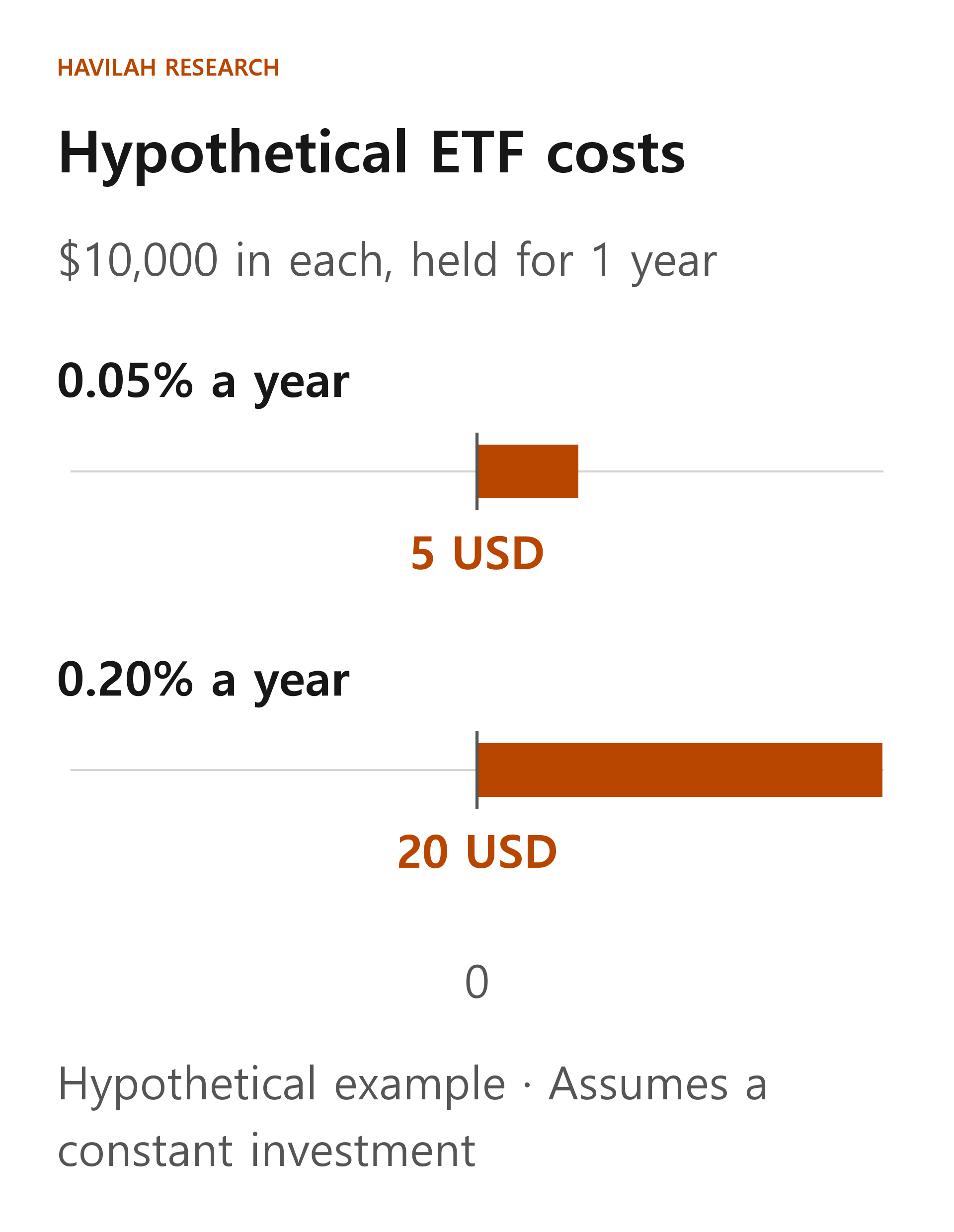
In practice, these costs are taken out of the fund's assets, so you do not receive a separate bill for them. If asset prices or the holding period change, the actual effect changes too. This calculation leaves out trading commissions, the bid-ask spread, currency conversion costs and taxes.
Compare the index's return with the ETF's return too
Suppose that over the same period the index rose 10%, while the ETF's return based on its net asset value (NAV) was 9.8%. The difference is 9.8% − 10% = −0.2 percentage points. In other words, the ETF trailed the index by 0.2 percentage points.
Apart from the return gap in a single period like this one, tracking error is a measure of how much that gap varies over many periods. You cannot calculate tracking error from the single-period gap above. Check the calculation period and basis that each source uses.
Do not jump to the conclusion that this gap comes from costs alone. The ETF may hold only some of the stocks in the index, and differences in management costs, trading costs and other factors can also play a part. When you compare an index with an ETF, first make sure both cover the same period, check whether dividends are included, and check whether the ETF's return is based on its market price or on its NAV.
So which one should you choose?
First decide whether you want to invest across the broad market of large U.S. companies, or focus more on large non-financial companies listed on Nasdaq. Then compare each ETF's top holdings and industry weights, its management costs and its actual trading costs. Do not assume an ETF will do better in the future just because its past returns were high.
If you already hold other ETFs or individual stocks, also check which companies overlap. In the next lesson, we will look at how concentrated you can become in one company when a theme ETF and individual stocks overlap.