
If several companies look good, do you have to buy their shares one at a time? You can pick them yourself, but you can also buy an ETF that holds several assets together.
An ETF (exchange-traded fund) is a fund that pools money from many people and invests it, set up so that you can buy and sell it on an exchange like a stock. When you buy one share, you own your portion of the whole fund. You do not receive shares of each company the fund holds directly in your account.
What is inside one share of an ETF?
To explain, let's imagine a hypothetical ETF that holds shares of only three companies: A, B and C. Assume that A makes up 40% of the fund's assets, B 30% and C 30%. The fund has no cash and no debt, and for now we also leave out costs and price changes.
If you invest $800 in this ETF, the part of your money that corresponds to A is 800 × 40% = $320. The parts for B and C are 800 × 30% = $240 each. Together, they add up to 320 + 240 + 240 = $800.
Real ETFs differ in how many holdings they have and in their weights, and they may also hold cash or other assets. The weights can also change as share prices move or as the fund is managed, so when you invest, check the date of the published holdings data.
ETFs that track an index and ETFs that pick their own holdings
When people look at how the stock market is moving, they sometimes express the prices of many stocks as a single number. This number is called an index. Each index has its own rules for which stocks it includes and how much weight it gives each one.
An index ETF is managed to follow the movements of a given index. For example, it may buy every stock in the index, or pick some of them to get a similar result. There are also ETFs whose managers choose the holdings themselves to fit an investment objective.
Even an index ETF does not always earn exactly the same return as its index. Differences can come from management costs, the timing of changes to its weights, actual trading costs and so on. Do not judge an ETF by its name alone; look at what it holds and which index it follows.
How much overlap do you really have?
Suppose the same investor puts $800 into the ETF above and also buys $200 of Company A's shares separately. The total investment is $1,000.
The amount that corresponds to A inside the ETF is $320, and the A shares bought directly are worth $200. Adding the two, the economic exposure to A is $520. That is $520 out of $1,000, so your exposure to A is 52% of the total.
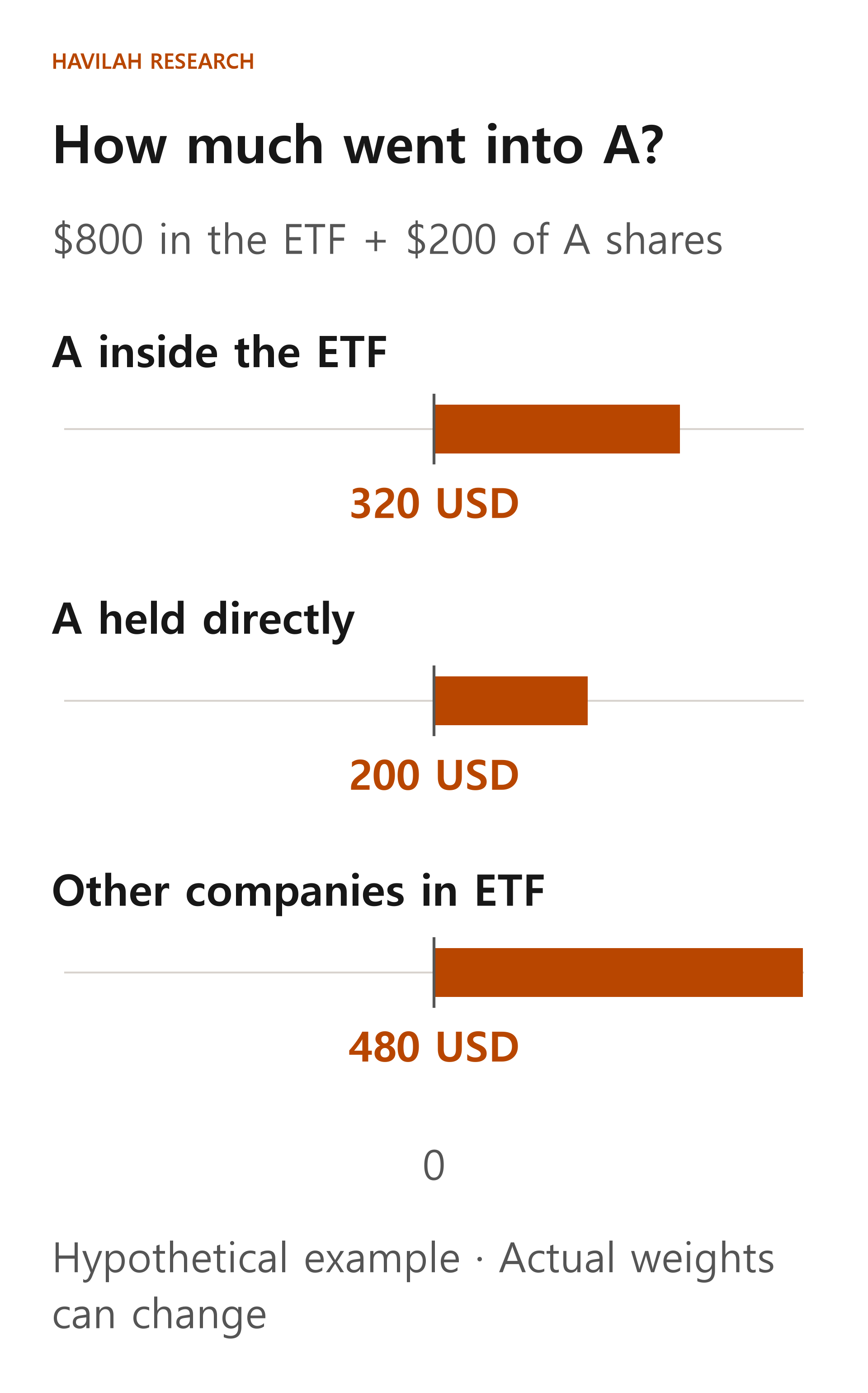
Here, exposure is a way of describing how much changes in A's share price affect your money. It does not mean that you own $320 worth of A shares directly in your account. This calculation is simplified: it assumes that both investment amounts and the ETF's weights are checked at the same point in time, and that there are no costs and no gap between the ETF's price and the value of what it holds.
If only A's share price fell 10% and nothing else changed, the hypothetical calculation says you would lose 10% of the $520 linked to A, or $52. The actual ETF price is also affected by changes in its other holdings, exchange rates, costs and the price at which it trades in the market.
Buying one product does not make risk disappear
An ETF that holds many companies can help reduce how much a problem at one company affects your whole investment. But if many companies' share prices fall together, the ETF can lose money too. An ETF concentrated in one industry, or an ETF based on a single stock, may offer only limited diversification.
An ETF trades on an exchange at prices agreed between buyers and sellers. This price can differ from its net asset value (NAV), which is the value of the fund's assets minus its liabilities, worked out per share. Management costs are deducted from the fund's assets, and you may also pay trading commissions or currency conversion costs on top.
What to check before you buy
First, look at which assets and companies the ETF holds and how large the weights of its top holdings are. If you already own some stocks directly, also check how much of those same companies the ETF holds. Then consider whether it fits your investment goal and what its management and trading costs are.
An ETF is a tool for holding many investments at once, not a device that removes losses. In the next lesson, we will look more closely at ETF indexes and how ETFs are actually put together.