
You have decided to buy a stock at $100. When you press the order button, will you definitely buy it at $100?
The price you see on screen may be the price of the last trade. Whether anyone is willing to sell at that price right now, and whether you can buy as many shares as you ordered, are separate questions. Depending on the type of order, the actual fill price, or whether the trade happens at all, can differ.
The price buyers offer and the price sellers ask
The bid is the price at which someone has offered to buy a stock, and the ask is the price at which someone has offered to sell it. The highest bid and the lowest ask are usually different. The gap between them is called the bid-ask spread, or simply the spread.
Suppose that for a hypothetical stock, the highest bid is $100 and the lowest ask is $100.10. The spread is 100.10 − 100 = $0.10. Only a limited number of shares is available at these prices, and the quotes can change the moment you place your order.
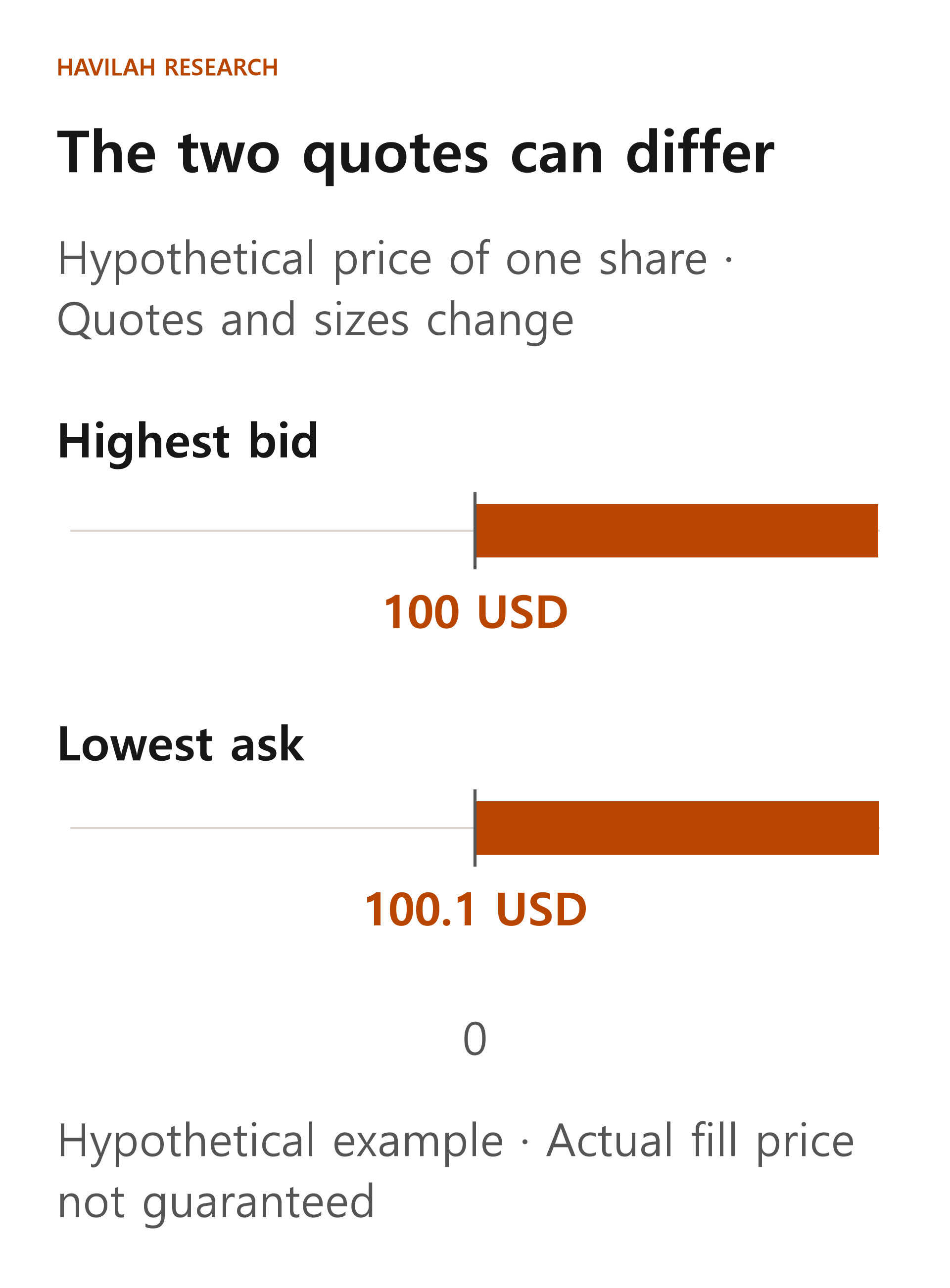
If a buyer actually gets all 100 shares filled at $100.10, the purchase costs 100.10 × 100 = $10,010. This is a hypothetical calculation that leaves out commissions and currency conversion costs. A real order is not guaranteed to be filled entirely at this price; it may be filled at a lower or a higher price.
Market orders: when getting filled matters more than the price
A market order is an order to buy or sell at whatever market price is available at that moment. It usually aims for a quick fill, but the exact price is not guaranteed. Depending on the situation, for example when trading has been halted or the market is closed, it may not be filled right away.
For example, even if you see an ask of $100.10 on screen and place a market buy order, you may end up paying more than $100.10 if other orders are filled first or the price changes quickly. If you order a large number of shares, some may be filled at one price and the rest at another.
Limit orders: when you set the price and wait
A limit buy order means you will buy only at the price you set or lower. If you set $100, you will not pay more than $100 even when the order is filled. But if no matching order exists on the other side of the market, or your order's turn does not come, it may not be filled.
A limit sell order works the other way around. It sells only at the price you set or higher, but again, a fill is not guaranteed. Keep in mind that in exchange for controlling the price, you may miss the trade.
You can also split an order into several smaller orders instead of placing it all at once. The later orders may be filled at different prices from the first one, and some may not be filled at all. As the number of orders grows, your costs may also change depending on your broker's commission terms, so check them in advance.
The gap between the expected price and the actual price
Suppose an investor planned to buy 100 shares based on a price of $100, but actually bought all of them at $100.10 per share. The planned amount was $10,000 and the actual purchase amount was $10,010, so the difference is $10.
This difference between the price you used as your reference and the actual fill price is called slippage. The result also depends on which price you use as the reference. Here, $100 was the reference, so if you also added the same bid-ask spread on top of this difference as a separate cost, you would be counting it twice.
The actual fill can be better or worse than your reference price. Commissions, currency conversion costs and taxes are not included in the $10 in this example.
What to check before you place an order
First, think about how quickly you need to trade and what price you are willing to accept. Check with your broker the bid and ask prices and the number of shares offered at each, how long an order stays valid, and which order types are available outside regular trading hours.
After placing an order, check whether it was only partly filled, is still waiting or has been canceled. If you place the same order again without checking whether the first one was filled, you may end up trading more than you intended.
When you evaluate a trading plan, too, do not rely only on the prices on the chart; record the actual fill prices and costs as well. In the next lesson, we will look at how to mark your plan for entering and exiting a position on a chart.