
A company you are interested in reports its earnings tomorrow. Is it enough to check the news that revenue grew?
In an earnings release, you look not only at how much the company earned in the past period, but also at what investors were expecting and what the company expects for the future. If you set out your reference points before the release, it is easier to compare calmly once the numbers come out.
When is it released, and where can you check it?
First, check the date and time of the release on the company's investor relations page. U.S. companies often report earnings before the regular market opens or after it closes. U.S. time is likely to differ from your local time, so convert it and check the date as well as the hour; the time difference can shift when the U.S. changes to or from daylight saving time.
After the release, you can read the company's earnings press release and investor presentation. U.S. companies may also file an 8-K that contains the earnings release. The detailed financial statements and explanations come later, in the quarterly report (10-Q) or the annual report (10-K). Foreign companies listed in the United States may use different reporting forms.
Do not rely only on the headlines that appear right after the release; check in the original documents which period each number covers. A number compared with the same quarter a year earlier also means something different from one compared with the quarter just before.
What were people expecting?
Before the release, start with any outlook the company gave earlier. This is called guidance. Guidance is the company's forecast, not a confirmed result. Not every company gives an outlook for the same items.
You can also look at the average of revenue or earnings-per-share estimates made by analysts at brokerage firms. This is called the market estimate, or the consensus estimate. However, the figure can vary depending on who made the estimates and as of which date, and not every market participant expects exactly that average.
The same revenue, compared against different bases
Suppose a hypothetical company had revenue of $9 billion in the same quarter last year, and the estimate for this quarter's revenue was $10 billion. The actual revenue reported is $11 billion. These are all numbers for illustration, not a real company's results.
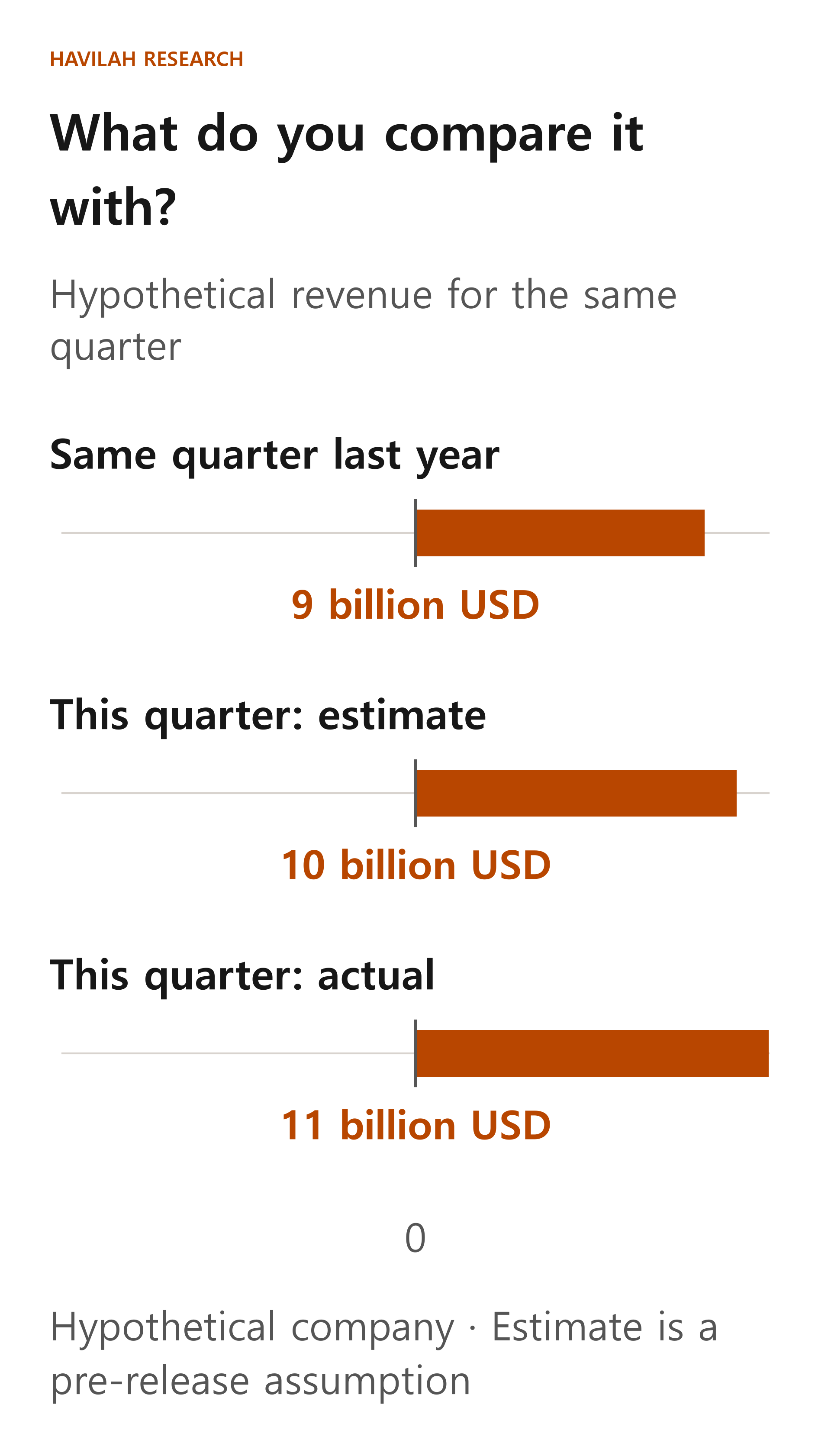
Growth compared with the same quarter last year is ($11 billion − $9 billion) ÷ $9 billion × 100, or about 22.22%. By contrast, the percentage by which revenue beat the estimate is ($11 billion − $10 billion) ÷ $10 billion × 100 = 10%. Both use the actual revenue of $11 billion, but they compare it with different things and use different denominators.
Whether the company grew compared with last year and whether it did better than expected are different questions. Do not assume that a number that answers one also answers the other.
The share price can fall even after good results
Even if actual revenue comes in above the estimate, other items can disappoint. For example, if margins fell, or if the company's outlook for the next quarter was lower than hoped, investors may see things differently.
Conversely, even if results are weaker than expected, the share price can rise if the outlook improves or if investors had expected something even worse. No single number can tell you for certain which way the share price will move after the release.
You also need to look at any adjusted earnings the company reports. Adjusted earnings are a figure the company presents after adjusting certain items, and they can differ from earnings calculated under accounting standards. When you compare estimates with actual results, check that the numbers cover the same period and use the same basis, and see which items were adjusted.
What to decide while you wait for tomorrow
If you already own the stock, check its weight in your portfolio and how large a loss you could bear before the release. If you are planning to buy, one option is to decide only after you have looked more closely at the results and the company's explanation. Around a release, prices can move quickly or jump between one regular session and the next, so you may not be able to trade at the price you want.
After the release, look at how far revenue and earnings differed from expectations, and whether the company's explanation and its outlook change the reasons you invested in the first place. In the next lesson, we will see how the actual result of a trade can differ depending on the type of order, even when the decision behind it is the same.