
A stock you bought has risen a lot. Should you sell now and lock in the profit, or keep holding it?
The fact that the share price has gone up cannot settle the answer on its own. You need to look at the company's outlook, the current price, how much of your total investment money this stock makes up, and when you will need the money.
Separate why it rose from what you expect next
The share price may have risen because the company's revenue and profits improved more than you first expected. Or the company's results may not have changed much, and the price rose because investors' expectations grew.
So along with "What price did I pay?", ask "What do I expect from here, at today's price?" If the growth and risks you first expected have changed, revisit your estimate of value too. Holding instead of selling now is also a choice: it means you keep investing at the current price.
That said, a higher share price does not automatically mean the stock has become expensive. The company's earnings outlook may have improved as well, and it may keep growing for longer than expected. On the other hand, even with a good company, you may judge that the price already reflects too much optimism.
If one stock's weight has grown
Even if you first put only part of your investment money into one stock, its share of the total grows if it rises more than your other assets. The effect that one company's fortunes have on your total assets can grow just as much.
For example, suppose that out of hypothetical investment money of $10,000, you put $2,000 into Stock A and $8,000 into your other assets. Stock A's weight starts at 20%.
Now suppose Stock A's price doubles, so your holding is worth $4,000, while your other assets stay at $8,000. Your total assets are $12,000, and Stock A's weight is 4,000 ÷ 12,000 × 100, or about 33.33%. This is a case made up for illustration, not an actual market result, and costs and taxes are left out.
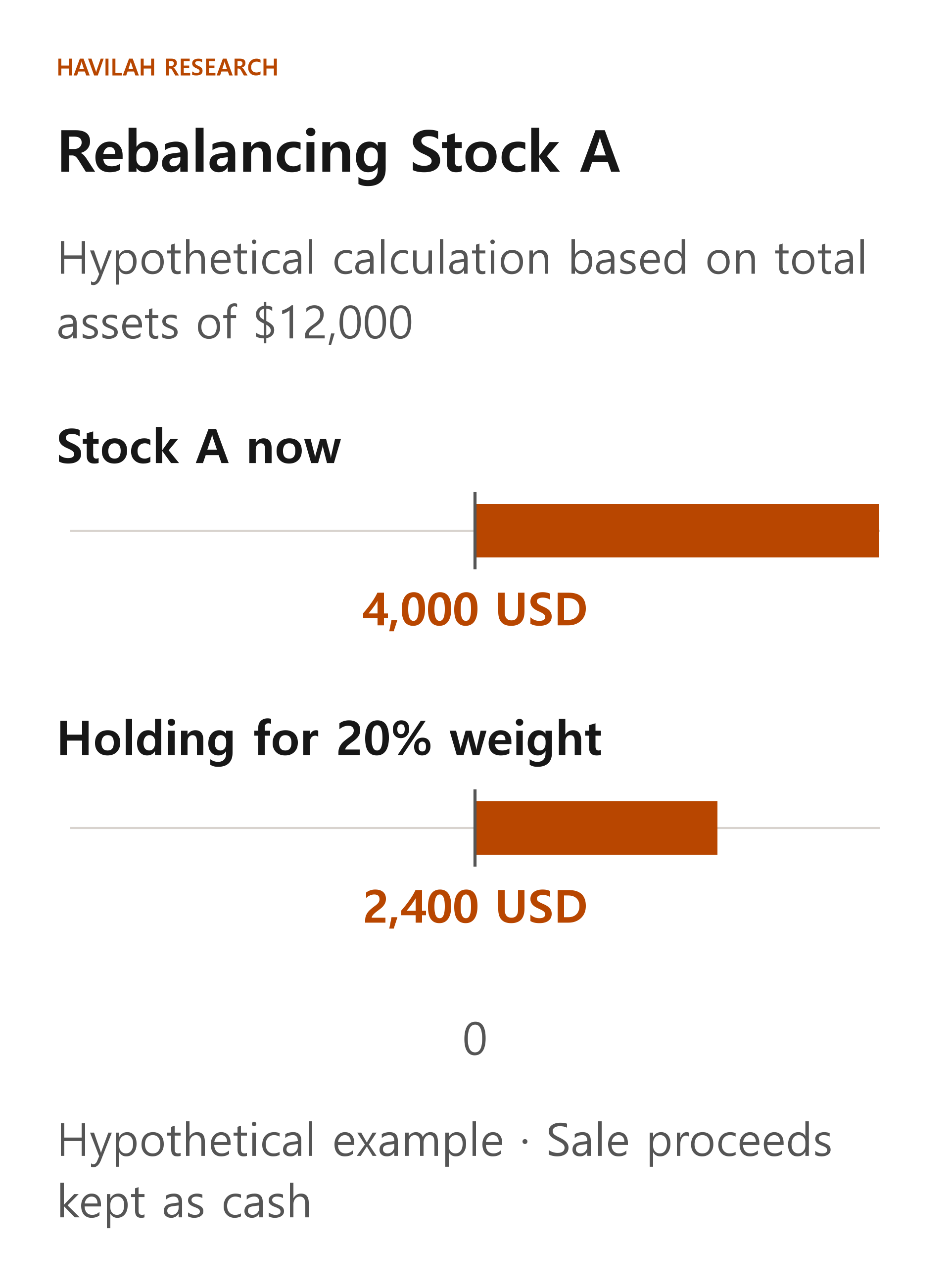
If you want to return to the 20% weight you first set, you could keep 20% of your current total assets of $12,000, which is $2,400, in Stock A. That means selling 4,000 − 2,400 = $1,600 worth. Assume the $1,600 from the sale stays in your account as cash and your other assets stay the same. With no costs or taxes, your total assets are $12,000 both before and after the sale.
Bringing your weights back in line like this is called rebalancing. You can adjust just part of a position instead of selling all of it, or you can put new money into your other assets instead. For actual orders, check the commissions and taxes. You should also check how many shares you can trade and what currency conversion will cost.
The price may rise further after you sell
After you sell some or all of your shares, the price may rise further. In that case, you miss the extra gains you would have made by holding on. Conversely, if you keep holding and the price falls, your unrealized gain, the gain on paper you have not locked in by selling, may shrink or turn into a loss.
Because you cannot know in advance which will happen, a sale is not necessarily a wrong decision just because the price rose afterward. It is better to review your decision in light of the price at the time, your reasons for investing and the risk you could bear.
Questions to ask before you sell
Have the company's business and earnings outlook changed from what you first thought? Have you recalculated what expectations are built into the current price? Has this stock's weight grown so large that you are carrying too much of one company's risk?
It also matters whether you will need the money soon, or whether the investment period you originally set is coming to an end. Depending on your situation, you can choose among holding, selling part and selling all. None of these choices guarantees a profit.
Before you decide, write down your reasons in a few lines. In the next lesson, we will look at what to check ahead of an earnings release.