
A stock you bought at $100 is now at $80. Were you wrong, or is the share price just wobbling for a while?
The fact that the price has fallen is something you can confirm. But why it fell, and whether the idea behind your original investment still holds, are questions you have to look at separately. In the same way, a rising share price does not prove that every part of your analysis was right.
Write down what you expected at the start
The reasoning behind an investment is called the investment thesis. It does not have to be complicated. For example: "This company will grow its revenue as it gains new customers, and it will increase its profits by keeping costs under control."
A thesis like this should, however, contain things you can check. Decide which items you will compare against later, such as whether the number of customers and revenue actually grew, and whether costs came in higher than expected. Do not record only your original idea; also write down what you would need to see to change your mind.
Let's look at a hypothetical company
Suppose an investor expected a company's revenue to grow and its profit margin to hold steady. In the previous period, revenue was $10 billion and the operating margin was 20%. The operating margin is operating income as a percentage of revenue.
If the revenue reported for the next period of the same length is $9 billion, it has fallen by $1 billion. The rate of decline is ($10 billion − $9 billion) ÷ $10 billion × 100 = 10%. If the operating margin is now 12%, it is 8 percentage points lower than 20%. Percentage points measure the simple difference between two percentages.
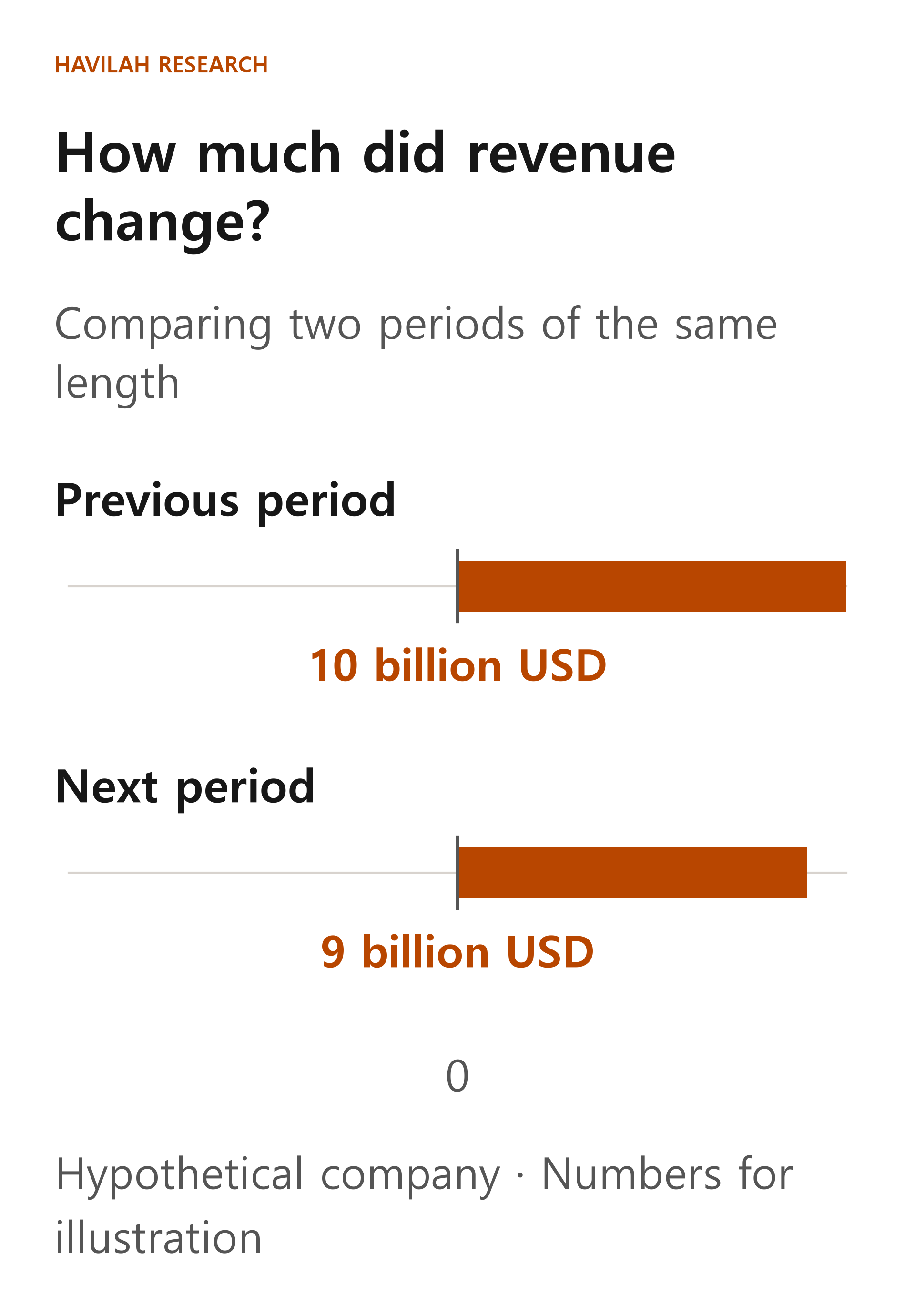
These numbers are a hypothetical case made up for illustration. The result clearly differs from the original idea that revenue would grow and margins would hold. But one result alone is not enough to conclude that things will keep getting worse.
Check the reasons, then revise your thinking
Your view of what comes next can depend on whether revenue fell because of a temporary supply delay or because customers moved to a competitor. With the lower margin, too, you need to check whether it came from a one-time cost or from a cost increase that repeats every period.
Read the company's explanation, but do not stop at simply believing it. Check the related items in the financial statements and filings, and whether things actually improve in later releases. If the information you need is not available yet, writing down "not yet confirmed" is also a judgment.
For U.S. companies, the annual 10-K and the quarterly 10-Q are the starting point for looking at the business, its risks and its financial results for the period. Foreign companies listed in the United States may use different reporting forms.
A falling share price and a wrong analysis are different things
If a share price falls from $100 to $80, the decline is 20%. To get from $80 back to $100, it has to rise by $20, so it needs to gain 20 ÷ 80 × 100 = 25%. This is because the starting price is different for the fall and for the recovery.
A loss like this is a real risk that you have to bear. But a falling price on its own does not reveal whether the business has changed. You need to check both why the price moved and whether your original expectations have changed.
Even if your original idea still seems sound, the share price can keep falling. Conversely, the share price can rise for a while even though the company's situation has gotten worse. Either way, do not draw firm conclusions about the company from the price alone.
What should you decide?
Once you have confirmed new facts, look at the changed outlook together with the current price, how long you can stay invested and how much money you have in this one stock. You can keep holding, reduce the position or sell, or you can wait for now because you need more information. Buying more is also an option, but it is not something to do automatically just because the price has fallen.
Finally, write a short note on what you first expected, what actually happened and what you will check next. Rather than helping you make excuses about whether you were right or wrong, this note helps you decide what to look at next time. In the next lesson, we will think about when to sell a stock that has made a profit.