
You have found a company you like. Its products are good and its revenue is growing. Should you just buy it right now?
Whether a company is good and what price you should pay for its stock are connected, but they are different questions. If you buy a good company at too high a price, the share price may not rise as much as you hoped, or may even fall, even while the company keeps growing.
Start by checking why you like the company
First, look at what products or services the company sells and who pays for them. Next, check why revenue is growing, and look at profits, debt and cash flow. Also write down the reasons you could be wrong, such as a competitor taking market share or a major customer leaving.
The 10-K, the annual report that U.S. companies file, contains a description of the business, the main risks and the financial statements. Foreign companies listed in the United States may report on different forms. As you learned in earlier lessons, it is important to look at both the fact that the numbers improved and the reasons why.
Even for a good company, the price changes the decision
Consider a hypothetical company whose share price is $80 and whose earnings per share over the last 12 months are $4. Earnings per share (EPS) is the net income that belongs to common shareholders, expressed per share. The price-to-earnings ratio (P/E) is the share price divided by earnings per share: 80 ÷ 4 = 20x.
A P/E of 20x means the current share price is 20 times earnings per share over the past year. That alone cannot tell you whether the stock is expensive or cheap. You need to look at whether earnings are likely to grow, whether recent earnings include one-time gains, and what P/E companies with similar businesses and risks trade at.
Comparing the price with an estimate of value
Suppose an investor studies this company's future and estimates that one share is worth $100. This is a number for illustration only, not the company's real value or a price target. The difference between the current price of $80 and the estimated value of $100 is $20.
Dividing that difference by the estimated value of $100 gives (100 − 80) ÷ 100 × 100 = 20%. This cushion, which comes from buying below your estimate of value, is sometimes called the margin of safety.
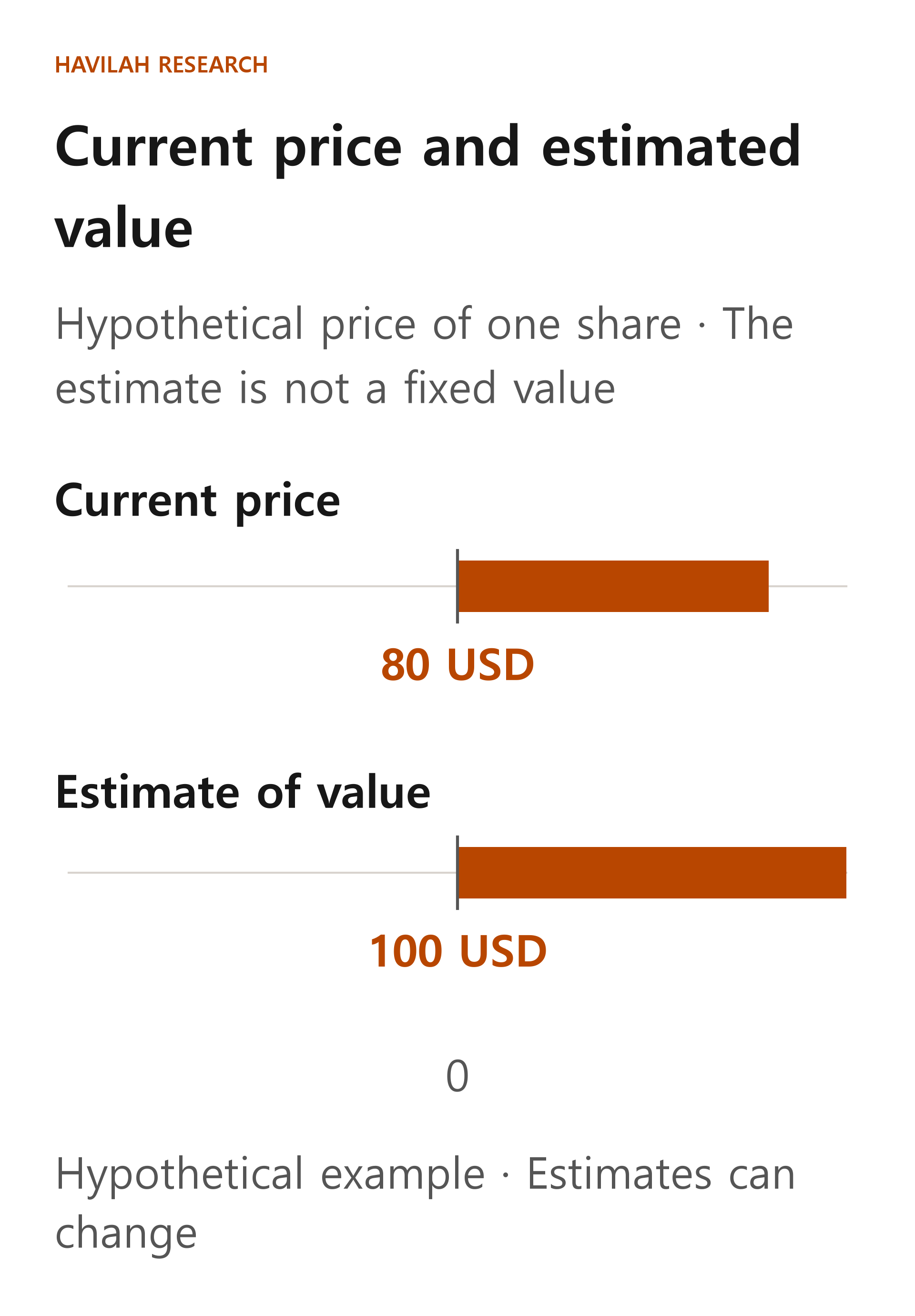
But $100 is only the investor's estimate. It does not mean the true value is fixed at a single number. If the assumptions about revenue growth or costs are wrong, the estimate can change too. A 20% margin of safety also does not mean your loss is limited to 20%.
For example, if you buy a stock at $80 and later sell it at $60, your loss, leaving out costs and exchange-rate changes, is (80 − 60) ÷ 80 × 100 = 25%. The 20% calculated from the estimated value and the actual loss calculated from your purchase price do not even share the same denominator.
What role do charts and earnings dates play?
Once your company analysis has told you what you want to buy, a price chart can help you plan when to buy. For example, you can check whether the price has risen steeply recently, and where the price ranges with heavy trading have been in the past. A particular shape on a chart does not necessarily mean a buying opportunity.
Also check the dates of upcoming earnings releases and important filings. If the results differ from what the market expects, the share price can move sharply. Some people buy part of their position before the release and wait with the rest; others decide only after seeing the results. You cannot know in advance which approach will work better.
What to think about before and after you buy
Before you buy, write down why you are choosing this company, at what price and with how much money you will buy, and what you will recheck if the business develops differently from what you expect. Also check that one stock's weight is not getting too large, and that this is not money you will need soon.
After you buy, do not watch only the share price. Check whether the evidence behind your original decision, such as revenue and profits, debt and the competitive situation, has changed. There is no need to treat your analysis as finished just because the price went up, or to buy more automatically just because the price fell.
No one can know the perfect time to buy in advance. What matters is keeping your view of the company separate from your view of the price, and making a plan you can change if your expectations turn out to be wrong. In the next lesson, we will compare buying when the price breaks above a certain range with waiting for a pullback after a rise.