
The questions you ask to pick a good company are similar in every country. You look at what it sells, how much it earns, and whether those profits can continue.
But the language and currency the numbers are written in, the timing of reports and the way shares are traded differ by country and by company. Numbers that look alike can lead you astray in a comparison if they are prepared on different bases.
First, check what kind of report it is
A company report contains a description of the business, financial statements, risk factors and more. Some foreign companies that have reporting obligations in the U.S. securities market file Form 20-F as their annual report. Information they publish during the year can sometimes be found in a document called Form 6-K.
However, not every foreign company files these documents in the U.S. First check whether the company is subject to U.S. reporting. Nor should you assume that a 6-K always comes out on the same schedule and with the same content as a U.S. company's quarterly report (10-Q). You should also look at the reports the company files with its local exchange and regulator.
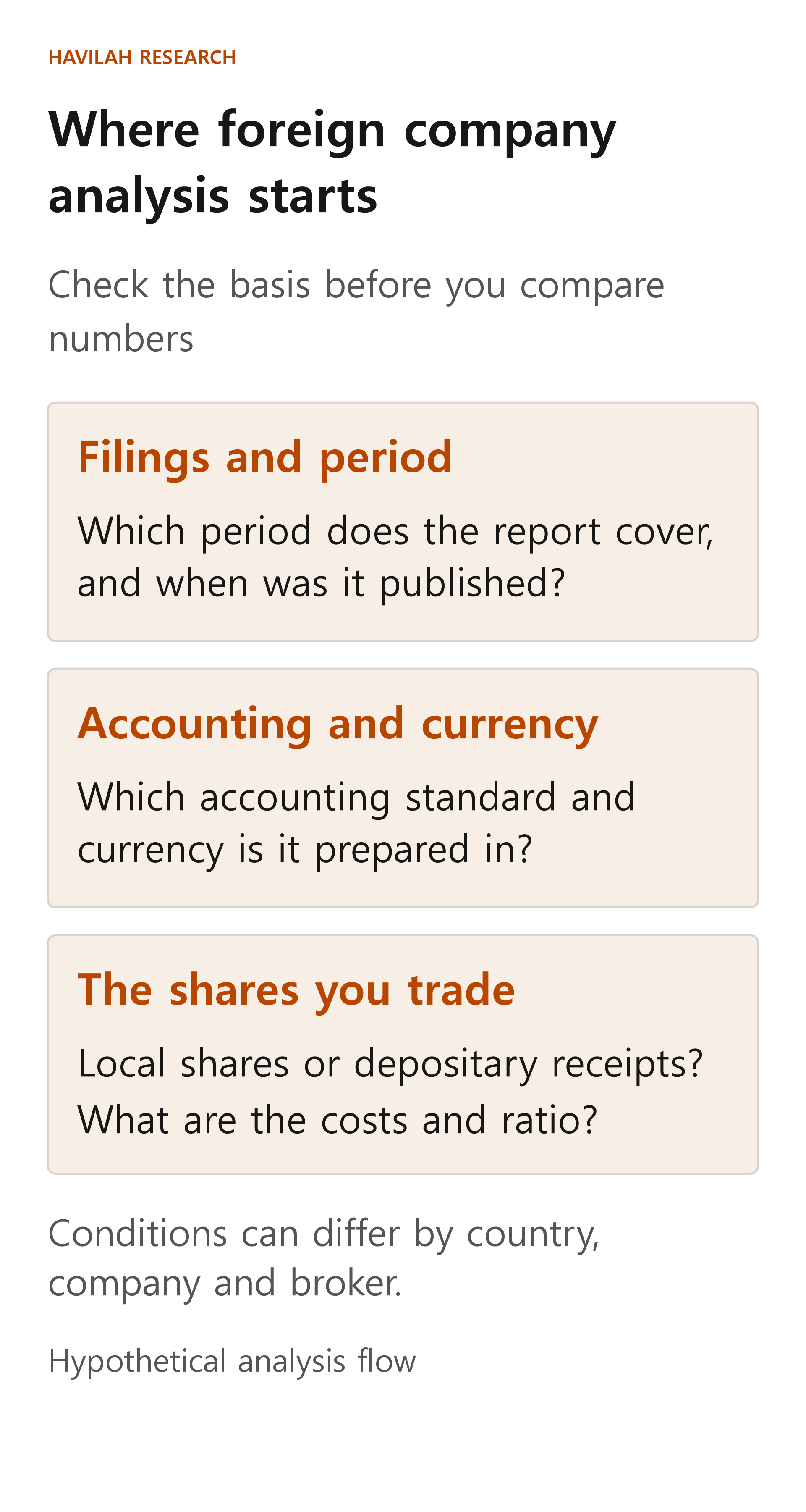
When you open a report, check three things first: which period the results cover, which currency they are presented in, and which accounting standard they are prepared under. The date the company published the report and the period in which the results were earned are also different things.
Toyota's report for fiscal 2025 covers the year that ended in March 2025, and it states that its consolidated financial statements are presented in yen and prepared under International Financial Reporting Standards. So even results labeled "2025" may not match the calendar year from January to December.
What should you watch for when accounting standards differ?
Accounting standards are the rules that set out how revenue, expenses, assets and liabilities are recorded in the financial statements. International Financial Reporting Standards (IFRS) and U.S. accounting standards (U.S. GAAP) are both widely used, but they do not treat every item in the same way.
For example, a cost that one company records as an expense may be recorded by another company as an asset and then turned into expenses over several years. In that case, this year's profit can look different even if the actual spending happened at about the same time. To see which items differ, check the rules the company applied and the notes to its financial statements yourself.
In connection with its 2025 reporting, ASML stated that it uses both U.S. GAAP and IFRS as adopted by the European Union, and that there are differences in areas such as the treatment of certain development costs. This is an example of why, even for the same company, you need to know which standard the numbers you are reading follow.
Do not assume a company's accounting standard from the name of its country. Not every Japanese company uses the same standard, for example. Check the basis on which each company prepares its financial statements and the scope of consolidation before you compare.
Even when the share price rises, exchange rates can cause a loss
When you buy foreign stocks, your return depends not only on the share price but also on the exchange rate between the currency you live on (your home currency) and the currency the stock trades in. An exchange rate is the rate at which one currency is exchanged for another.
Let's look at a hypothetical example. Suppose your home currency is the Korean won (KRW), and when you buy one share of a Japanese stock for JPY 10,000, JPY 100 can be exchanged for KRW 1,000. The purchase amount is JPY 10,000 ÷ 100 × KRW 1,000 = KRW 100,000.
Later the share price rises to JPY 11,000, a 10% gain in the local currency. But if JPY 100 is then worth KRW 900, the sale amount is JPY 11,000 ÷ 100 × KRW 900 = KRW 99,000. In won, that is a loss of KRW 1,000, or 1%.
This is a hypothetical calculation that leaves out commissions, taxes, dividends and differences in conversion timing. The rate you actually get when you convert can vary with your broker's conversion terms and the time of the trade. In this example, the exchange rate moved against you by about as much as the share price rose, so the result changed once it was converted into won.
The currency a company reports in can also differ from the currencies in which it actually earns revenue and pays its costs. To understand how exchange rates affect a company's results, look at the regions where it earns its revenue and the currencies in which it pays its production costs. Keep your own return, converted into your home currency, separate from the effect of exchange rates on the company's business.
What are the shares of foreign companies traded in the U.S.?
Some foreign companies traded in the U.S. trade in the form of American depositary receipts, or ADRs. You can think of an ADR as a certificate linked to foreign shares held by a depositary. One ADR can represent one original share, several shares or a fraction of a share.
For example, suppose one ADR of a hypothetical company represents 2 local shares, the local share price is JPY 1,000, and the exchange rate is 150 yen per U.S. dollar. The simple converted amount is 2 × 1,000 ÷ 150 = about $13.33. This calculation takes the exchange rate and the price at the same moment and leaves out fees and other factors that cause differences. The actual trading price can differ because of market conditions, differences in trading hours and other factors.
Even though an ADR trades in dollars, the effects of the underlying shares and the exchange rate do not disappear. Depositary fees may also be charged, so check the ratio and the costs in the product description and your broker's information. Not all U.S.-traded shares of foreign companies are ADRs.
If you actually compared three companies
| Company | Documents to check first | What to watch for |
|---|---|---|
| Toyota | Form 20-F and financial statements for fiscal 2025 | Check the March year-end, reporting in yen and the use of IFRS. |
| ASML | 2025 annual report and financial data under each standard | Check the differences between U.S. GAAP and IFRS as adopted by the EU. |
| Novo Nordisk | 2025 Form 20-F and the ADR information | Check the ratio between ADRs and the original shares. |
Novo Nordisk's 2025 Form 20-F states that one ADR represents one B share. This is what that document says, and you should not apply the same ratio to all ADRs. The ratio can also change, so check the latest documents before you trade.
When you compare companies, first line up the period, the currency and the accounting standard. Then check the local market's trading hours and liquidity, taxes and fees, whether you can convert the currency, and the country's rules and its political and economic risks. These conditions vary by country, investor and broker, so it is hard to sum them up in a single number.
Analyzing foreign companies starts not with hunting for unfamiliar company names but with matching up where the numbers come from and the conditions behind them. Understand the business on a common basis, and look separately at how much a different basis changes the result.