
When you look at a REIT that pays dividends every month or every quarter, owning it can feel like becoming a landlord. But a high dividend yield alone does not tell you that its buildings are reliably leased or that the dividend will be maintained.
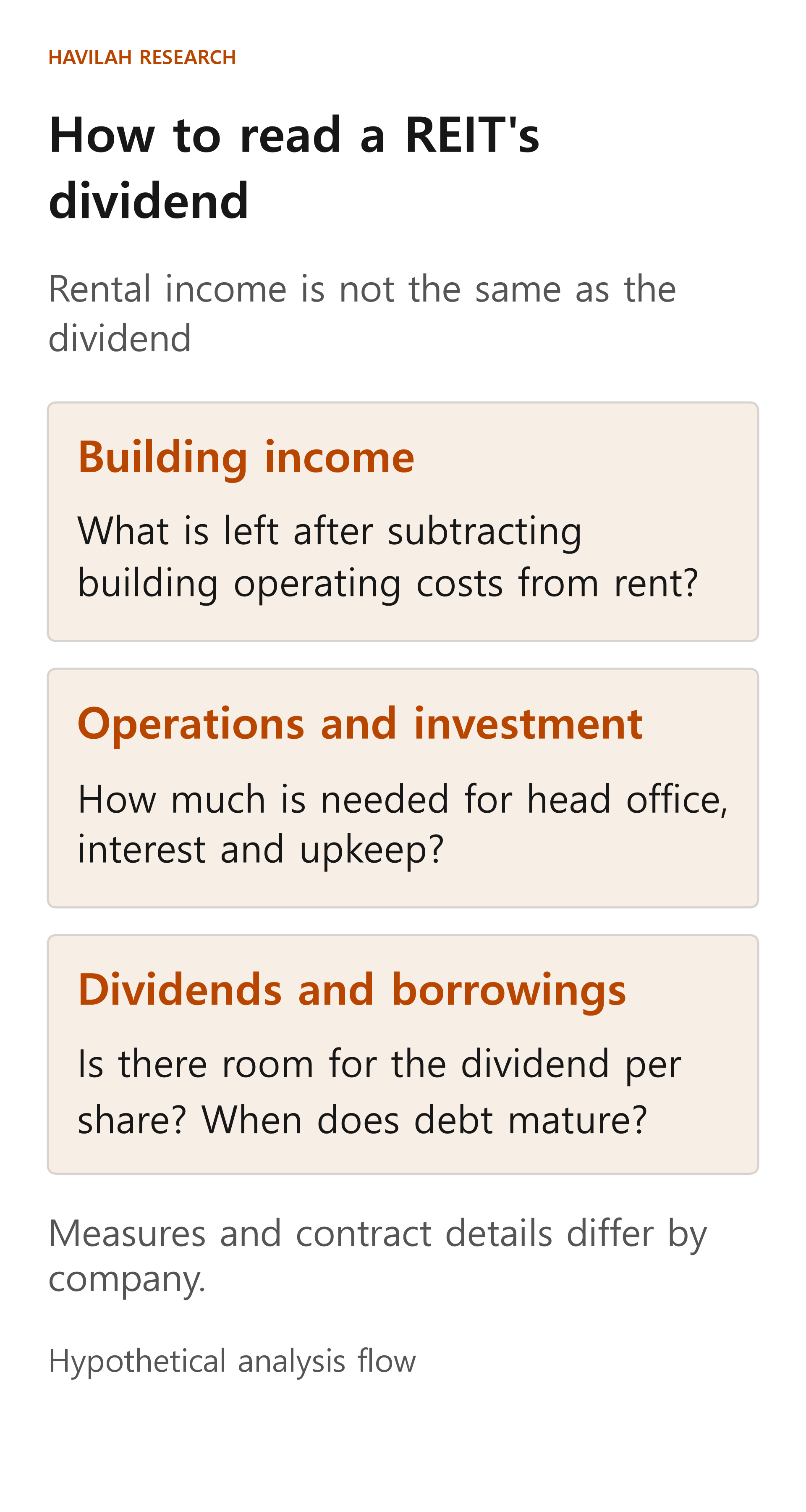
You need to look at which properties the REIT earns money from, how much it spends on running and maintaining them, and when it has to repay the money it borrowed. Let's follow, step by step, how a dividend is produced.
What kind of company is a REIT?
A REIT (real estate investment trust) is a company that invests in real estate or real estate-related assets. Here we look at REITs that own buildings and other properties and earn income by leasing them. When you buy shares in a REIT, you become a shareholder of that company instead of owning a building directly.
REITs invest in many kinds of property, such as apartments, logistics warehouses, retail space and hospitals. Even when rent comes in, the money left over can shrink if tenants leave and space sits empty, or if repair costs rise. The share price also changes, so you can lose money on your overall investment even while receiving dividends.
Non-listed REITs and REITs listed on an exchange can differ in how they are traded and in how hard it is to turn them into cash. Here we focus on REITs whose shares you can buy and sell on an exchange.
How much does a building actually earn?
Subtract the costs of running a building from the operating income it brings in, such as rent and parking fees, and you get net operating income, or NOI. Which costs are included, such as management fees, insurance and property-related taxes, depends on the contracts and on how the company defines the measure, so check both.
Suppose a hypothetical building collects $1 million in rent over one year and spends $300,000 on running the building. The building's NOI is $1 million − $300,000 = $700,000. This number is the operating result at the building level. It is not the profit left for shareholders after interest on the company's debt, head-office costs, taxes, major renovation spending and so on have all been subtracted.
The capitalization rate, or cap rate, is a building's annual NOI divided by the building's price. For example, if you bought a building with annual NOI of $700,000 for $10 million, the cap rate is $700,000 ÷ $10 million × 100 = 7%. This ratio is a starting point for comparing a building's price with its operating income.
Working the other way, if NOI stays the same, the building's value at a 7% rate is $700,000 ÷ 0.07 = $10 million. At 8%, it becomes $8.75 million. The higher the rate applied to the same income, the lower the calculated building price. This formula is for illustration and does not guarantee an actual sale price or a REIT's share price.
A building's value is not the same as shareholder value. You also need to take into account the debt the company must repay, its head-office costs, and its other assets and liabilities. And because buildings differ in location, tenants, lease length and growth potential, there is no single appropriate cap rate.
Why is net income not enough?
A real estate company records depreciation, an accounting expense, as it uses its buildings. Generally, the company takes the acquisition cost, allows for the value it expects to remain after use, and spreads the expense over several periods. Recording this expense in a year does not mean that the same amount of cash goes out that year.
FFO (funds from operations) is a measure that tries to show operating performance by adding real estate depreciation back to net income and adjusting for certain items, such as gains and losses on property sales. For the actual calculation, check the adjustments the company itself lists. FFO is not cash itself, and it does not mean that maintaining the buildings costs nothing.
Suppose a hypothetical REIT recorded net income of $300,000 for one year, and this included $200,000 of real estate depreciation and a $50,000 gain on the sale of a building. Simplifying by assuming no other adjustments, FFO is $300,000 + $200,000 − $50,000 = $450,000. This is a hypothetical calculation for illustration, not a real company's numbers.
AFFO (adjusted funds from operations) is a measure that makes further adjustments to FFO for items such as the recurring investment needed to keep the properties leased. For example, if you subtract only $50,000 of maintenance spending from the REIT's FFO of $450,000 above and assume no other adjustments, AFFO is $400,000.
In reality, companies calculate AFFO in different ways. There may be further adjustments, for example for spreading rent over accounting periods or for tenant improvement costs. So read the company's reconciliation from net income to AFFO together with its actual cash flow statement.
Let's check whether the dividend has room to spare
Suppose the hypothetical REIT above has 100,000 shares and all $400,000 of AFFO belongs to these shares. AFFO per share is then $400,000 ÷ 100,000 = $4. If the annual dividend per share is $3, the dividend is 3 ÷ 4 × 100 = 75% of AFFO per share. That does not mean the remaining 25% is always cash the company can use freely.
Compare measures for the same period, and check whether the number of shares has grown. Even if the company's total AFFO grows, the amount per share can fall if the number of shares grows faster. If the dividend equals AFFO or is larger, look more carefully at why, and at whether it can be sustained.
Nor does the AFFO ratio alone guarantee a safe dividend. The cash actually left to spare can differ because of unpaid rent, large repair costs, asset sales, additional borrowing and the terms on which the REIT can raise money.
Look at the interest rates and maturities of the debt
REITs sometimes borrow money to buy or develop properties. The maturity of a loan is when the principal has to be repaid. If there is not enough cash to repay at maturity, the REIT may have to sell properties, issue shares, or borrow again to repay the existing debt.
Suppose a hypothetical REIT borrowed $2 million at 5% a year, and calculate only simple interest. Interest for one year is $100,000. If it borrows the same amount again at 7% a year after the loan matures, interest for one year becomes $140,000, an increase of $40,000. This example assumes the same terms for the principal and interest payments and no other fees.
In reality, the rates on all of a company's debts do not change at the same time. Look separately at whether the debt has a fixed or a floating rate, whether maturities are bunched together, and whether there are contracts that reduce the effect of interest rate changes. Rents may also rise along with higher interest rates, but not always by the same amount or by enough.
Comparing different REITs
| Company | Main type of property to look at | Question to check |
|---|---|---|
| Realty Income | Commercial single-tenant properties and others | How able are the tenants to pay, and when do the leases expire? |
| Prologis | Logistics properties | What are the vacancy, rents and lease renewal terms for its warehouses? |
| Welltower | Senior housing-related properties and others | How do occupancy, operating costs and the business structure affect income? |
This comparison is an example based on the businesses described in each company's 2025 report. It is not an assessment of current results or an investment recommendation. Because REITs differ in the properties they own and how they run them, the same dividend yield can carry different risks.
When you look at a REIT, first check what it leases. Next, read the buildings' NOI, the company's FFO and AFFO per share, its actual cash flows and its debt maturities together. Finally, consider not just the dividend but also the share price to judge the expected return and the possibility of loss.