
When oil prices rise, people filling up their cars feel the pinch. Companies that produce oil, on the other hand, may welcome it, because they can sell the same amount at a higher price. But it does not follow that every energy company's profit rises equally just because the oil price has gone up.
Start by looking at what a company produces, what price it sells at and how much production costs. Even among energy companies, a business that extracts crude oil and a business that buys crude oil to make gasoline are affected differently by price changes.
How commodity prices affect profit
Commodities are basic materials, such as oil, natural gas and copper, that are used to make many other products. Their prices move with many factors, including supply and demand, production disruptions, inventories and the economy. It is hard for an individual producer to set the market price as it wishes.
Suppose a hypothetical oil producer sold 1 million barrels in a year at $70 per barrel. A barrel is a unit for measuring quantities of crude oil. Revenue is 1 million barrels × $70 = $70 million.
Assume that producing and selling the oil costs $40 per barrel, and that the year's operating costs that do not depend on output are $10 million. The amount simply left over is $70 million − $40 million − $10 million = $20 million. Taxes, interest, depreciation and other costs have not yet been taken into account, so this is not net income or full operating income.
Assuming the same volume is sold and the same costs are incurred, if only the selling price falls to $60, the amount left over is $10 million. If it rises to $80, it becomes $30 million. The price moved only from $70 to $60, a fall of about 14%, yet in this simple example the amount left over is cut in half.
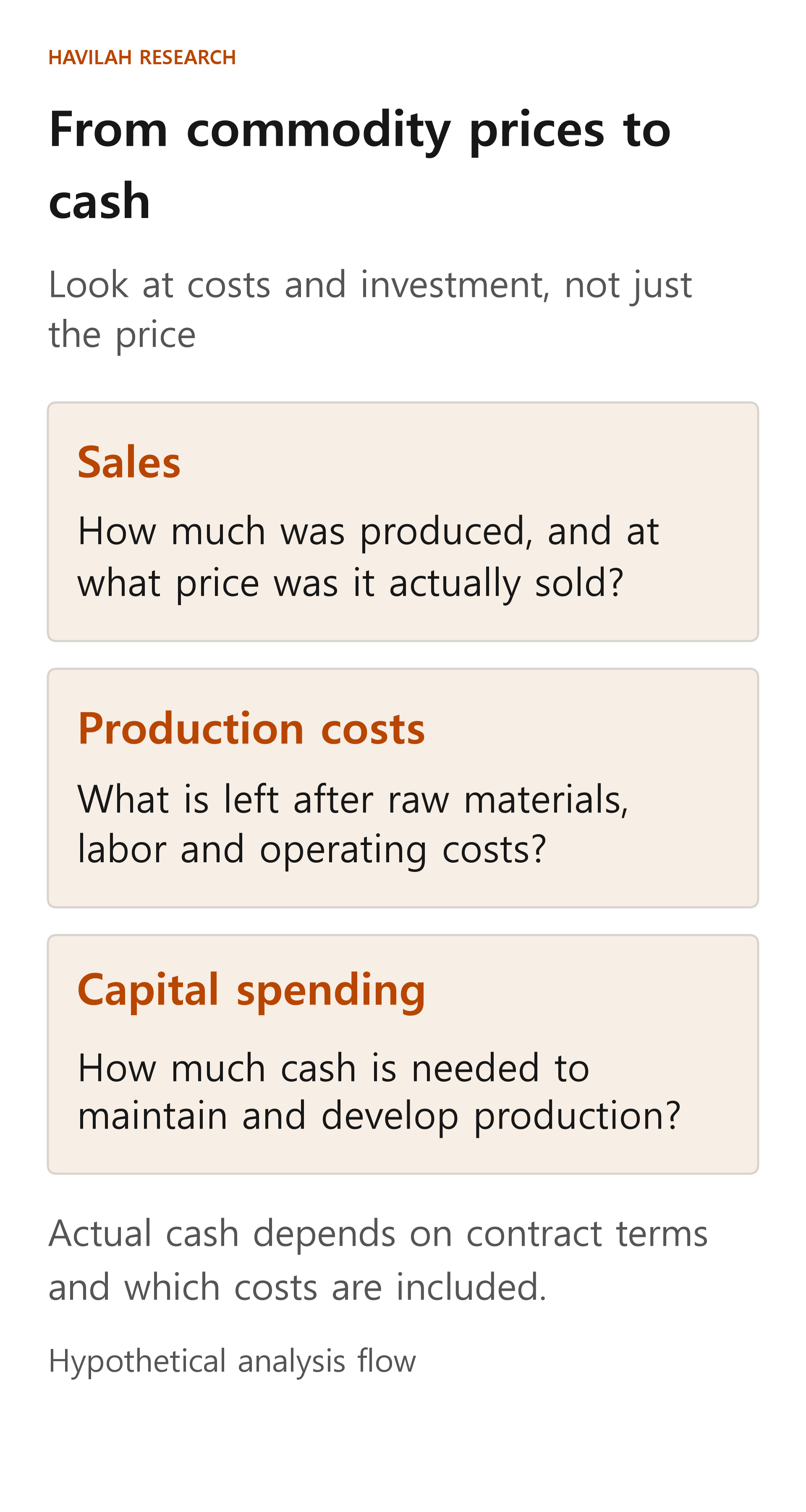
This is not any real company's earnings or outlook. In reality, sales volumes and costs change too, and the price a company actually receives varies with where it produces, the quality of its product and its contract terms. If a company has contracts that reduce price swings, changes in the market price may not show up in its income immediately or in full.
What a company produces and what it buys
The business of finding, developing and producing crude oil or natural gas is called the upstream business. If a company sells the crude oil it produces, the selling price is a key variable. In its 2025 report, ExxonMobil explained that its cash flow is strongly affected by crude oil and natural gas prices.
A refining business, by contrast, buys crude oil and turns it into products such as gasoline and diesel, which it then sells. Here, what matters is not only the price of crude oil but also how much is left between the price at which the products are sold and the cost of raw materials and operations. If crude oil prices rise but product prices do not rise as much, the refining segment's profitability can get worse.
If one company does both production and refining, you need to look at the effect on each business separately. In its 2025 report, Chevron explained that earnings from its downstream businesses, such as refining, are closely tied to the margins earned on refining and selling products. You cannot assume that the company's overall results always move in the same direction as oil prices.
Is a low production cost always safe?
Unit production cost is the cost of producing a given quantity divided by the number of units. With a low cost per unit, a company may have relatively more room to cope when selling prices fall. But check which costs are included in the unit cost the company reports. Transportation, taxes, investment in new facilities or interest on debt may be left out.
At a copper mine, how much copper the ore taken out of the ground contains also matters. Even when the same amount of ore is processed, if the copper content falls, the mine may have to process more ore to get the copper it sells. Energy costs, wages and equipment breakdowns also change the actual cost.
In its 2025 report, Freeport-McMoRan cited lower ore grades at its South American operations as one of the reasons its copper and gold sales volumes fell from the previous year. This is an example from a single year. It does not mean that every mine, or future results, will be the same.
Reserves are not finished goods in a warehouse
An oil and gas company's proved reserves are an estimate of the quantity of known underground resources that it is reasonably certain it can recover under the economic and operating conditions at the time, among other factors. They are not something that has already been extracted and stored. Actually recovering them can take time and capital spending.
Large reserves do not mean they can all be sold next year. The U.S. Energy Information Administration explains that estimates of proved natural gas reserves can rise or fall as prices and production costs change. This does not mean the amount underground suddenly changed that day. It means the assessment of how much can be recovered economically under the given conditions can change.
When you compare companies' reserves, check the units used for oil and gas, the share the company actually owns, whether the reserves have already been developed, and why earlier estimates changed. Mineral reserves use separate standards and terms, so do not simply apply the oil and gas definitions to them.
Money earned that has to go back into facilities
Commodity companies spend money on facilities to keep production going or to develop new deposits. This is called capital expenditure. Because this spending is for future production, you must not ignore it by looking only at this year's results.
Suppose the hypothetical company above received $70 million in cash from customers in the same year and paid $50 million in cash for production and operations. On the simple assumption that there are no other cash inflows or outflows, the cash left from operations is $20 million. If it then pays $15 million in cash for capital expenditure, the cash left is $5 million.
This $5 million is a simple calculation for this hypothetical case. For a real company's free cash flow, check the definition the company discloses and the cash flows in its financial statements. The result varies with taxes, interest, changes in working capital, spending on acquisitions and the timing of cash payments.
Even if profit is large while prices are good, do not assume that level will continue. Check whether the company has the cash and financial capacity to cover production and essential investment even if prices fall.
When you look at a real company
| Company | Business to look at | Question to check |
|---|---|---|
| ExxonMobil | Oil and gas production and product businesses | How do changes in commodity prices show up in each business and in cash? |
| Chevron | Oil and gas production and refining | Why do profits in production and in refining move differently? |
| Freeport-McMoRan | Mines for copper, gold and other metals | How have sales volumes, ore grades and production costs changed? |
The table compares the businesses described in each company's 2025 report. It says nothing about current share prices and is not an investment recommendation. Companies differ in their business mix and in what their reported unit costs cover, so you cannot rank them on a single number.
First, check what the company sells and which prices it is exposed to. Then look at sales volumes, cost per unit, investment to maintain and develop production, debt and cash on hand. It is important to think separately about whether a company can survive only when commodity prices are high, or whether it can still meet its funding needs when prices fall.