
Sometimes the share price of a biotech company that does not yet sell any drugs moves sharply. That is because investors are focusing on the future potential of the drugs in development rather than on current revenue.
But news that a clinical trial is going smoothly is not enough to be sure that the drug will be approved and earn large profits. You need to look separately at the chance that development succeeds, the returns after the drug goes on sale, the money the company will need and the current share price.
What stages does a new drug go through?
A new drug first goes through basic research, such as laboratory and animal studies, and only after that can it be tested in people. A study that checks a drug's effectiveness and safety in people is called a clinical trial.
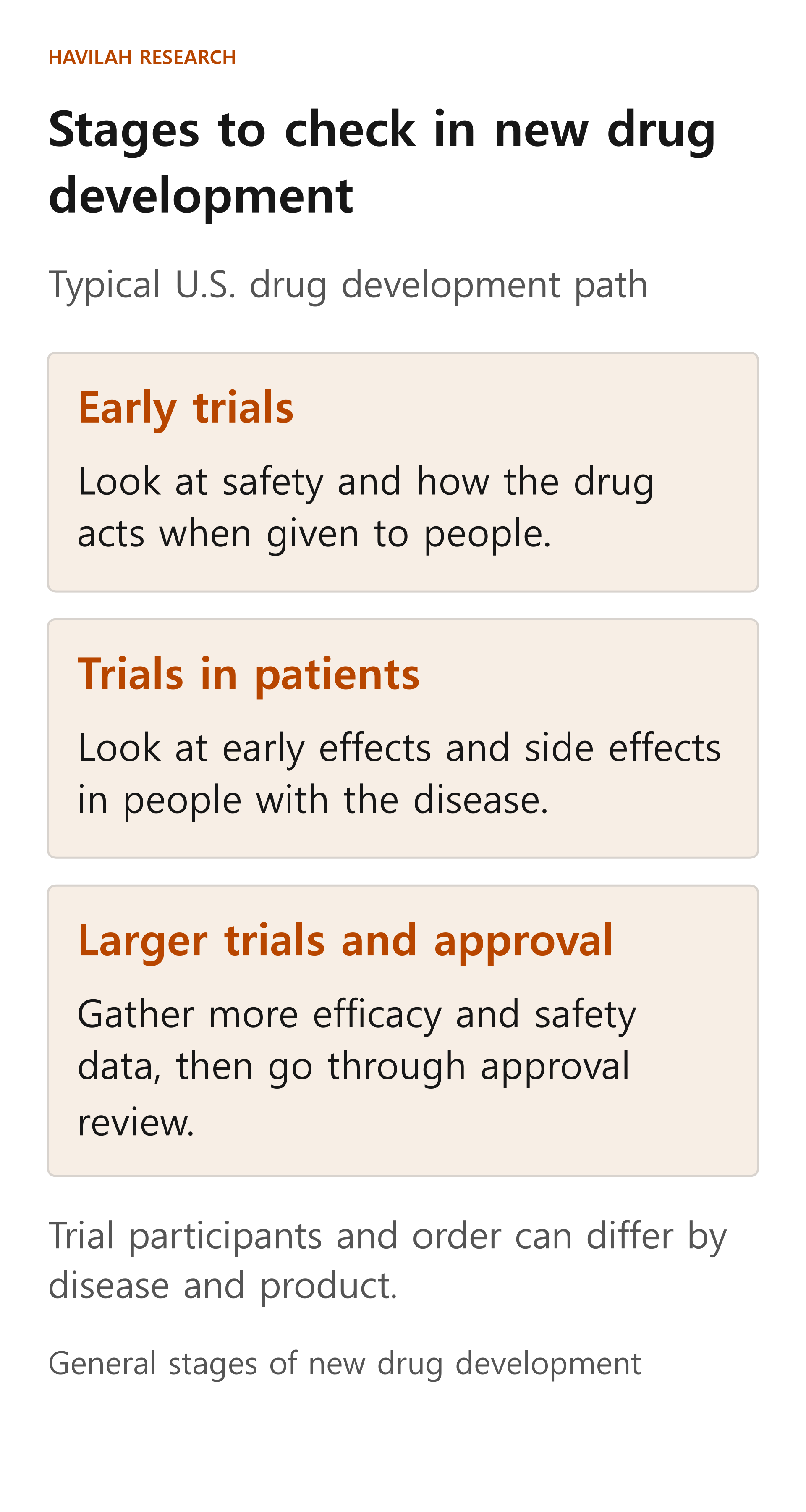
According to the U.S. Food and Drug Administration (FDA), Phase 1 generally looks at safety and at how the drug acts when it is given to people. Phase 2 looks at early data on whether the drug works in patients who have the disease, and at side effects. Phase 3 gathers more data to assess effectiveness and safety.
However, not every trial follows the same order or has the same size. The participants and the design can differ depending on the disease and the drug. For some drugs, such as cancer treatments, early trials are run in patients rather than in healthy people.
If the company applies for approval after seeing the trial results, the regulator reviews the data it submits. Even after approval, newly discovered safety problems and the results of further studies have to be watched.
Read what an announcement says, not just its headline
The sentence "the clinical results are positive" on its own is not enough to judge a drug's value. You need to read who took part, what the drug was compared with, and which outcomes were defined in advance and then checked.
For example, even if patients who took a drug got better, without a comparison group it can be hard to tell whether the drug helped or they simply improved naturally over time. If a trial is short or has few participants, it may also fail to fully check for rare side effects or long-term effects.
An endpoint is the measure that defines what a trial is assessing. Some trials directly measure improvement in patients' symptoms or how long patients survive. Others use a different measurement that is believed to predict real improvement in health. Which endpoint is appropriate depends on the disease and the purpose of the trial.
Records in a clinical trial registry can include information such as the trial phase, the participants, how the comparison is made and the endpoints. Check the company's announcements, the registry records and the results published later together. But do not take the mere fact that a trial is registered as proof that its results or an approval have been verified.
After approval, the drug still has to sell
Even when a regulator approves a drug, revenue depends on how much hospitals and patients actually use it, what advantages it has over competing drugs, and how insurance coverage and pricing work out.
You also need to look at patents and marketing exclusivity. The U.S. FDA explains that patents and exclusivity granted by law are different systems, and that their duration and scope may not match. Here, marketing exclusivity is a system that restricts things such as the approval of certain competing drugs for a set period. It does not mean that every competing product is blocked from sale. Prices and sales volumes can change depending on when protection ends or when competing products appear.
If the company developed the drug together with another company or shared the sales rights, not all of the product's revenue belongs to the developer. Check the contracts and filings for any amounts it must pay the partner and for any payments tied to sales.
Let's break the possibilities down into numbers
What follows is a hypothetical example, not a forecast for any real drug or company. For illustration, assume the chance that the drug is approved and also sells successfully is 30%. This number is not an actual clinical success rate or an FDA statistic.
Assume that, if the drug succeeds, the cash it will earn in the future, minus the costs of selling it and running the business, comes to $100 million once that future money is converted into present value. Because this number has already been discounted to present value, we do not discount it again in this calculation. Assume the product is worth $0 if it fails.
The expected value of the product, taking both success and failure into account, is $100 million × 30% + $0 × 70% = $30 million.
Assume the present value of the development costs still to come is $15 million, and that all of it will be spent whether or not the drug succeeds. These development costs are not yet included in the $100 million above. So the expected value of the product after development costs is $30 million − $15 million = $15 million.
If you simplify further and assume the company has $10 million in cash today and $5 million of debt to repay, with no other businesses, assets or liabilities, the estimated value left for shareholders is $15 million + $10 million − $5 million = $20 million.
This calculation is a tool for comparing assumptions. It does not mean that the 30% chance of success, the cash value if the drug succeeds or the development costs are accurate. If you change only the probability of success to 10%, the estimated value under the same conditions is $0; at 50%, it is $40 million. The result changes a lot depending on the assumptions.
In reality, stopping a trial partway may mean the remaining costs are never spent, some assets may remain even after a failure, and sales after approval may fall short of expectations. In cases like these, you need to calculate the cash flows separately for each stage and outcome. Do not automatically set the costs or the asset value on failure to 0.
Is there enough cash to reach the next trial?
A company that is still developing drugs spends cash on clinical trials, staff and other costs even before it sells a drug. Check its current cash and short-term investments, its expected spending, and when its debts have to be repaid.
If you make the simple assumption that the cash it uses each quarter stays the same, and divide its cash on hand by that amount, you get a rough idea of how long it can keep going. However, spending can change a great deal when trials move to a larger phase or new contracts are signed, so do not treat that number as a firm end date.
If money runs short, the company may issue new shares or borrow. When new shares are issued, existing shareholders' percentage ownership of the company can fall. Even if the value of the whole company stays the same, the value per share changes when the number of shares outstanding rises.
When you look at a real company
First, check whether the company already has products on sale or depends mainly on drug candidates still in development. Then look at which trial phase each candidate is in, when results are due and what risks remain.
The number of patients if the drug is approved, the actual selling price, competing products, how rights are shared, and the costs of making and selling the drug also matter. Do not assume you know the exact terms of contracts or costs that the company has not disclosed.
Finally, think about what expectations are already built into the current share price. Even when good trial results come out, the share price may react differently if the market had already expected even better results.
Key points to remember
To value a new drug, you have to take into account the uncertainty of trials, approval and sales together. You cannot judge the value of the whole company only from the large revenue a candidate drug might bring if it succeeds.
Check the trial data, the rights, the development costs and the cash on hand, and look at an optimistic case and a less optimistic case separately. Which assumptions you used matters more than how precise the numbers are.