
When you buy car insurance, you pay a premium, and the insurer promises to pay for covered losses under the contract if an accident happens.
An insurer does not keep the whole premium as profit the moment it receives it. It has to take into account the coverage period still ahead, the claims it may have to pay and its operating costs. The money it makes or loses by investing the assets it holds also needs a separate look.
Receiving premiums is not the same as earning them
Suppose a customer pays a one-year car insurance premium of $1,200 in full on the first day of the policy. For illustration, assume the insurer provides the same share of coverage each month and there are no other adjustments.
The premium for one month is $1,200 ÷ 12 = $100. After 3 months, the premium for the period that has passed is $100 × 3 months = $300. The remaining $900 relates to the 9 months of coverage still to be provided.
The insurer has already received the premium in cash, but it still has a coverage obligation that has not ended. With real insurance products, the treatment can differ depending on the contract terms, the way coverage is provided and the accounting standards.
The property and casualty insurer RLI states in its filings that it recognizes its premiums evenly over the policy term. Its policies are mostly short-term, and it usually recognizes premiums over one year.
So you need to separate the premiums recorded when new policies are written (written premiums) from the premiums for the part of the coverage already provided as time passes (earned premiums). This difference matters when you look at how much revenue an insurer has recognized.
The cost of claims may only become clear later
When an insured car is in an accident, the insurer pays a claim according to what the policy covers. After the accident, it can take time to investigate the damage and decide how much to actually pay.
For claims it has not yet paid, the insurer estimates the future payments and records reserves for them. The estimate can also include claims for accidents that have already happened but have not yet been reported to the company.
In its filings, AIG explains that its loss reserves include estimates for unpaid claims and for claims that have not yet been reported, among other items. Estimates can change later as new information arrives, so the amount recorded at the time is not necessarily the same as the final payment.
Even if an insurer collects a lot of premiums, its profit can fall if accidents happen more often than expected or payments are larger. On the other hand, if premiums are set at an adequate level and there are few accidents, the insurance business itself can make a profit.
The combined ratio in property and casualty insurance
In property and casualty insurance, the combined ratio is used to see how large the costs of the insurance business, called underwriting, are compared with premiums. Let's work through it with an example from property and casualty insurance, such as car and fire insurance.
The insurer RLI explains that it calculates its combined ratio by adding two ratios: one for losses incurred and the costs of handling them, and one for the costs of acquiring and running its policies. In this company's formula, both ratios are based on net premiums for the coverage period already provided.
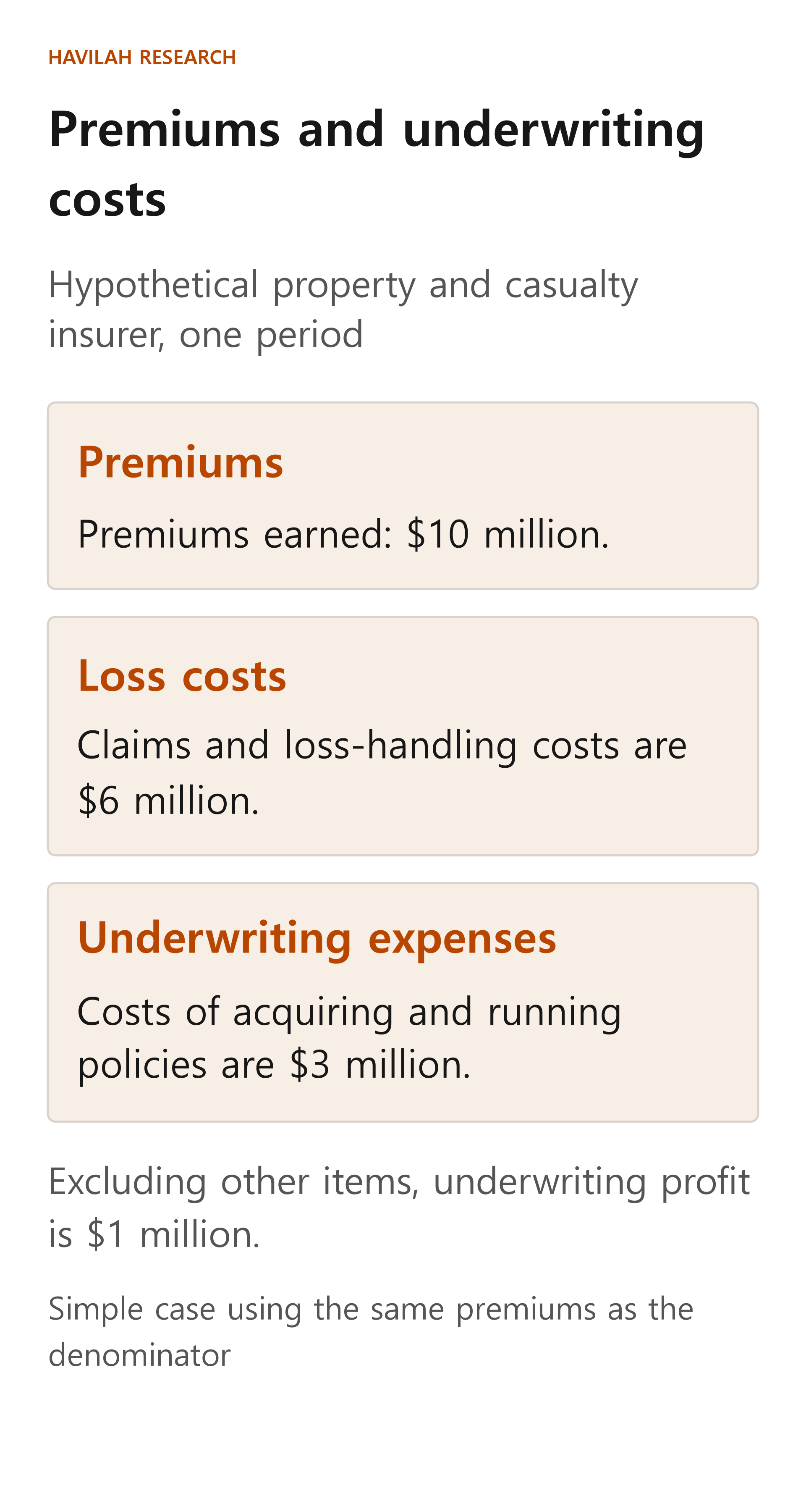
Suppose a hypothetical insurer recognizes $10 million of premiums in a period. In the same period, claims incurred and the costs of handling them come to $6 million, and the costs of acquiring and running policies come to $3 million. Assume both costs are divided by the same premiums and there are no other underwriting items.
Loss ratio: $6 million ÷ $10 million × 100 = 60%.
Expense ratio: $3 million ÷ $10 million × 100 = 30%.
Combined ratio: 60% + 30% = 90%.
In this simple example, underwriting profit is $10 million − $6 million − $3 million = $1 million. A combined ratio of 90% means these costs are $90 for every $100 of premiums recognized.
On this basis, a combined ratio below 100% means the insurer makes an underwriting profit, and a combined ratio above 100% means it makes an underwriting loss. However, the measures that real companies report, or that are used for regulatory purposes, can differ in which premiums the expenses are divided by and which items are included. Even when the name is the same, check the formula in the filing.
Nor can you apply this figure as it is to other insurance businesses, such as life insurance. In its filings, the insurer Chubb explains that it uses the combined ratio to evaluate its property and casualty segments and does not calculate the same measure for its life insurance segment.
Investment results need a separate look
Until it pays claims, an insurer can invest part of the money it holds in bonds and other assets. Along the way, it may receive interest and dividends, and gains or losses may arise on its investments.
Suppose the hypothetical insurer above has net investment-related income of $500,000, with no other income, expenses or taxes. Adding this to the underwriting profit of $1 million gives a pre-tax result of $1.5 million.
$1 million + $500,000 = $1.5 million.
On the other hand, if the underwriting profit is the same but there are investment-related losses of $2 million, the pre-tax result, leaving out other items, is $1 million − $2 million = −$1 million. A combined ratio below 100% does not guarantee that the company as a whole makes a net profit.
The money an insurer holds may be needed to pay future claims. Do not assume that, just because its invested assets are large, all of that money can flow freely to shareholders.
When you look at a real insurer
First, check what kinds of insurance the company sells. Car insurance, fire insurance and life insurance differ in their coverage periods, their risks and the measures used to evaluate them.
For a property and casualty insurer, look at premiums and the combined ratio, but also check whether there were any major disasters that year and whether the company revised its expected payments for past accidents. You cannot simply assume that results from a year in which accidents happened to be few will be repeated.
Also look at the types of investment assets and how changes in interest rates affect them, as well as the size and timing of the claims to be paid. Only by separating underwriting profit from investment results can you see which one moved the company's results.
Key points to remember
An insurer provides coverage to customers and receives premiums in return. The cash it receives can differ from the premiums it recognizes over the coverage period, and future claims have to be estimated.
In property and casualty insurance, the combined ratio is the starting point for looking at underwriting. To understand the profit and the risks of the company as a whole, check underwriting results, investment gains and losses, and changes in reserves together.