
A manufacturer makes and sells products, and you look at what is left after subtracting the costs. A bank also has revenue and expenses, but the deposits it takes from customers and the money it lends to customers make up a large part of its financial statements.
Before you analyze a bank stock, there is one thing to understand first. Deposits are not revenue the bank has earned. They are money it must give back to customers. Loans are money the bank will get back from customers later.
Deposits are liabilities, loans are assets
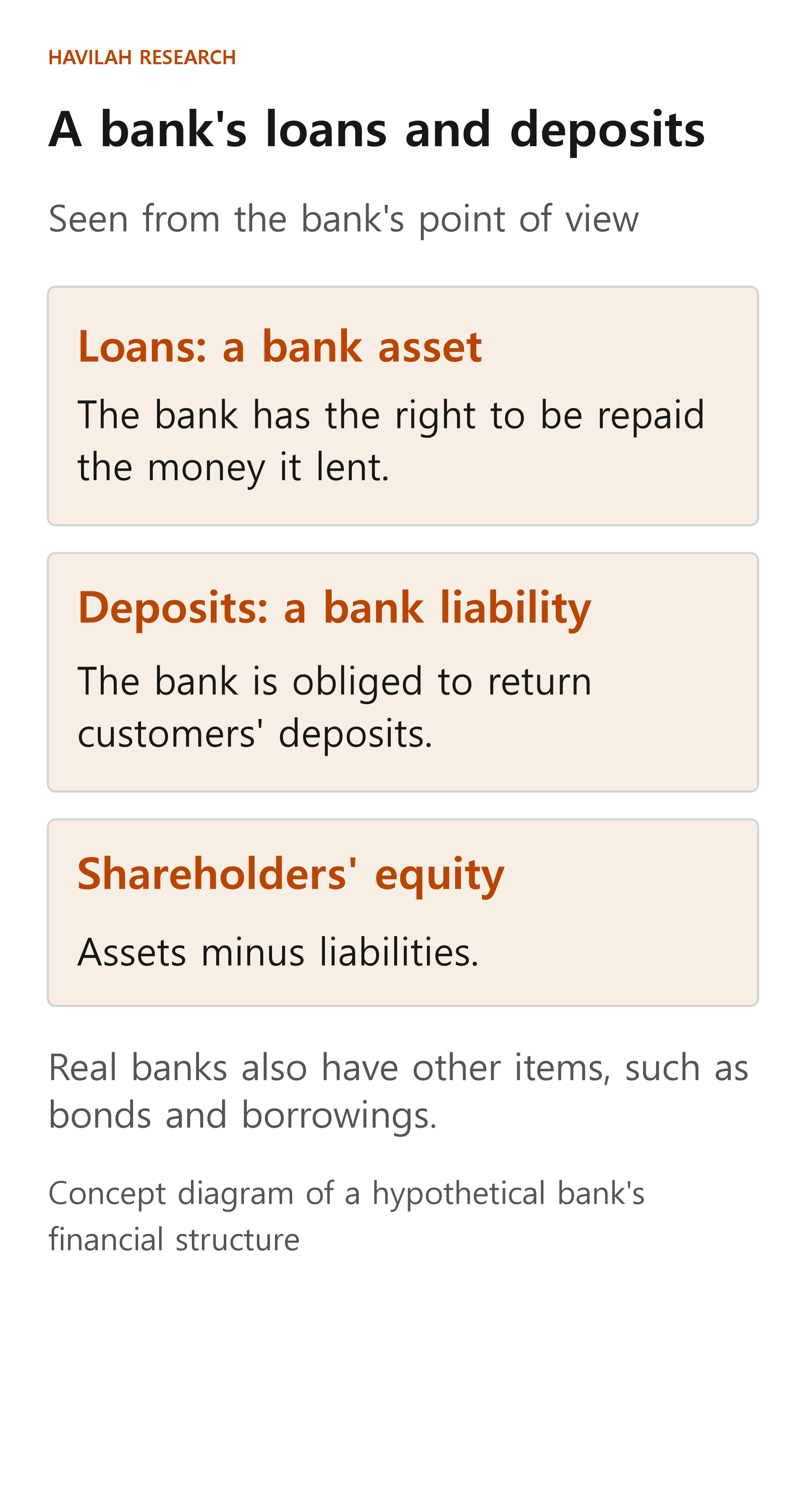
When a bank receives $100 from a customer as a deposit, the customer has the right to get that money back. For the bank, this is an obligation to repay, so it is a liability.
On the other hand, if the bank lends $80 to another customer, it gains the right to receive the principal and interest later. So a loan is one of the bank's assets. But if the borrower cannot repay, the value of the loan can be impaired.
Besides taking deposits, a bank can borrow money or raise capital from shareholders. It puts the money it raises to work in loans, bonds, cash and so on. A real bank's assets and liabilities include many more items than these.
How much does a bank keep from interest?
A bank receives interest on loans, bonds and similar assets, and it pays interest on deposits and borrowings. The interest it receives minus the interest it pays is its net interest income.
The U.S. Federal Reserve describes net interest margin as net interest income divided by average interest-earning assets. Interest-earning assets are assets that earn interest, such as loans and interest-paying bonds. When you calculate the return for a period, you use the average assets over the same period as the denominator.
Suppose that at a hypothetical bank, average loans over one year are $8 million and the loan interest rate is 6% a year. The interest on the loans is $8 million × 6% = $480,000.
If average deposits over the same period are $9 million and the deposit rate is 3% a year, the interest paid is $9 million × 3% = $270,000. Assuming there is no other interest income or interest expense, net interest income is $480,000 − $270,000 = $210,000.
If the only average interest-earning asset is the $8 million of loans, the net interest margin is $210,000 ÷ $8 million × 100 = 2.625%, or about 2.63%.
This is not the same as the 3 percentage points you get by subtracting the 3% deposit rate from the 6% loan rate. The $8 million of loans and the $9 million of deposits are different sizes, and net interest margin divides net interest income by interest-earning assets. A real bank holds many kinds of assets and uses various sources of funding at the same time.
Net interest income is not net income
A bank also spends money on staff salaries, computer systems, running its branches and so on. It also has to watch the risk that loans will not be repaid on time.
The allowance for credit losses is an amount set aside so that the accounts reflect the losses expected on loans and similar assets. If expected losses rise and the bank builds up a larger allowance, the related provision expense increases, and profit for the period can fall. Because the allowance is based on estimates, it does not have to match actual losses in timing or amount.
At the hypothetical bank above, suppose net interest income is $210,000, and in the same year the provision expense is $50,000 and other operating expenses are $100,000. If there is no fee income and there are no other items, pre-tax income is $210,000 − $50,000 − $100,000 = $60,000.
You still have to subtract taxes to get net income. Even if deposit and loan rates look favorable, a bank's profit can turn out lower than expected if loan losses or operating costs grow.
Why does a bank's capital matter?
Capital, or shareholders' equity, is assets minus liabilities. If the value of a bank's assets falls, the capital that absorbs losses can shrink too. Whether a bank has enough capital is an important question when you evaluate it.
Suppose that at a hypothetical point in time, the bank has $8 million in loans, $1.8 million in cash that earns no interest, and $200,000 of goodwill from an acquisition. Goodwill is an asset that arises when the price paid for an acquired business exceeds the fair value of its identifiable net assets; it is that excess. Total assets are $10 million.
If deposits are $9 million and there are no other liabilities, assets of $10 million − liabilities of $9 million = capital of $1 million. This balance sheet is for illustration only, and to keep things simple we assume the one-year average balances above are the same.
Banks also manage regulatory capital so that they can absorb losses. One such measure is a ratio that compares capital with risk-weighted assets, which are calculated to reflect how risky each asset is. The simple ratio of capital to assets you calculated above is not the same as a regulatory ratio. The actual rules, and which banks they apply to, vary by country and by bank.
Comparing a bank's share price with its tangible equity
When looking at a bank's share price, investors sometimes use a measure called P/TBV, which compares the price with tangible book value. Put simply, tangible book value is the equity that belongs to shareholders after adjusting for goodwill, intangible assets and similar items. In practice, each company may use its own detailed method, such as adjustments for preferred stock or for taxes.
At the hypothetical bank above, assume that all $1 million of capital belongs to common shareholders and that the only intangible item to adjust for is the $200,000 of goodwill. Tangible book value is $1 million − $200,000 = $800,000.
If there are 100,000 common shares, tangible book value per share is $800,000 ÷ 100,000 = $8. If the share price is $12, P/TBV is 12 ÷ 8 = 1.5x.
You cannot conclude that a stock is cheap just because this number is low. Future losses may be hidden in the loans, and banks differ in how well they generate profit and in how much capital they need. When tangible book value is 0 or below, this ratio is hard to interpret in the usual way.
When you look at a real bank
Check which customers and industries the loans are concentrated in, and how late payments and loss estimates are changing. Deposits also differ in their mix of customers and products, and when interest rates change, money can move elsewhere or the interest the bank pays can change.
Rising interest rates do not automatically increase every bank's profit, either. How quickly loan rates change, how quickly deposit rates change, and changes in the number of borrowers who cannot repay all have an effect.
Check net interest margin, provision expense, capital ratios and the share price one by one, then connect them. What matters more than any single number is what risks the bank takes on to earn its return.
Key points to remember
Deposits are a bank's liabilities and loans are its assets. Net interest margin compares net interest income with interest-earning assets. It is different from net income, which is what remains after provision expense and operating costs.
With a bank stock, look not only at profit but also at the quality of the loans, the stability of the deposits, the capital available to absorb losses, and the share price, all together.