
When a company announces that it will buy AI servers in large numbers, revenue at the companies that make the chips can rise. But whether the company that bought the servers can earn back the money it invested, and how much profit the chip companies keep, are separate questions.
When you look at the AI industry as an investor, follow the money all the way through. In this lesson, we separate the amount customers paid, the amount suppliers received, the profit and cash left at each company, and the expectations already reflected in share prices.
Start with the customers who use AI services
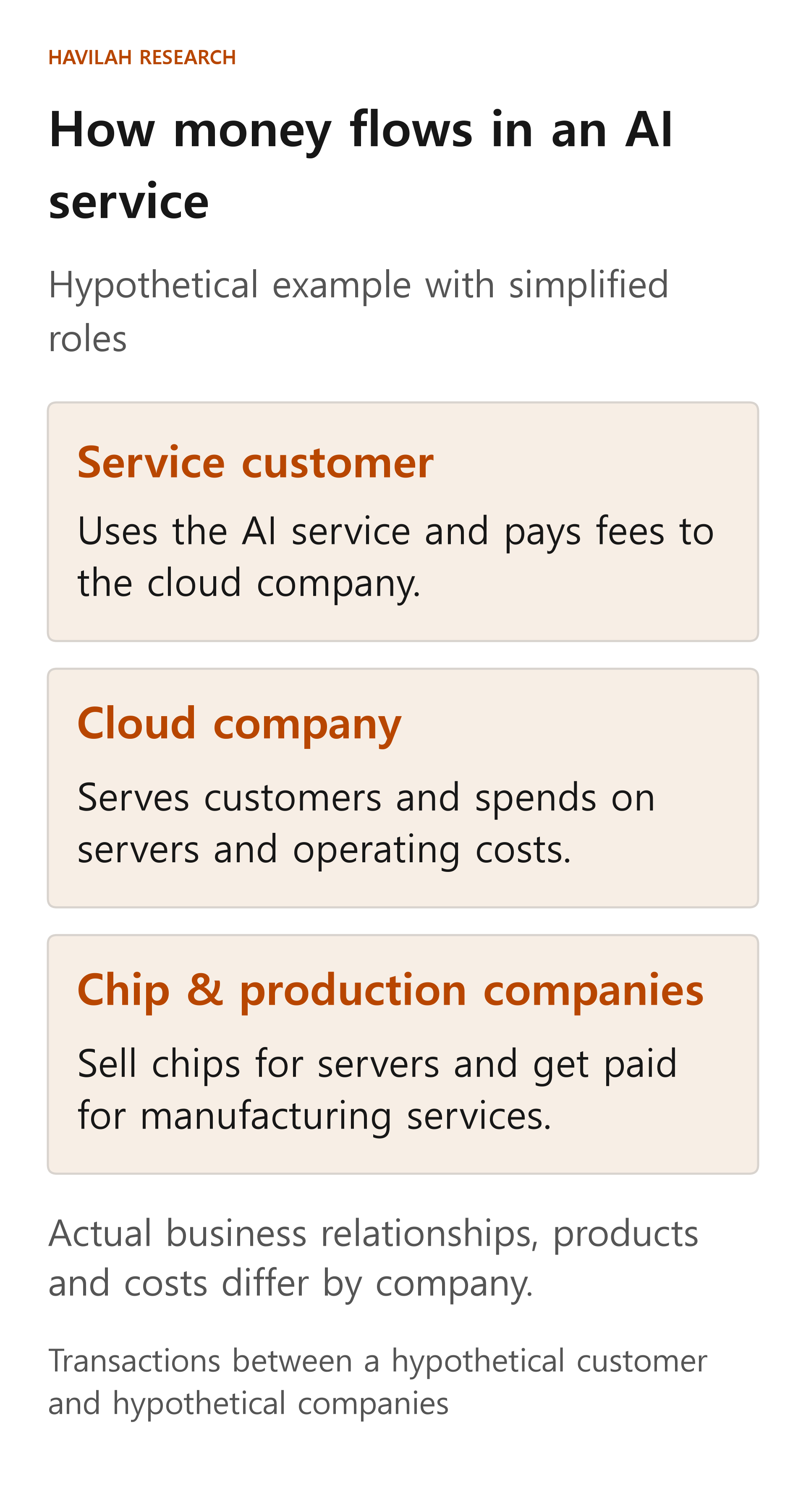
A business may pay a cloud company fees to use AI models or to process data. The cloud company provides the service by buying servers and chips and spending money on electricity and cooling.
The company that designed the chips may pay companies that produce semiconductors or supply memory. Producing semiconductors requires equipment and materials, so even more companies are linked in.
TSMC explains that it makes semiconductors on silicon wafers based on designs provided by its customers. This is an example of a real business structure in which several companies make one product together.
However, which company is whose customer, and in which period revenue is recorded, can only be confirmed from contracts and filings. Do not treat transaction amounts that companies have not disclosed as settled figures on your own.
The same money can show up in several companies' revenue
Suppose hypothetical cloud company A buys chips for its AI service from Company B for $80,000. In making those chips, B pays production company C $30,000 and spends $20,000 on other product costs.
If B has delivered the chips and met the conditions for recognizing revenue, its chip revenue is $80,000. B's gross profit is $80,000 − $30,000 − $20,000 = $30,000. If C has provided its service and met the conditions for recognizing revenue, C's revenue is $30,000. C's costs and profit cannot be known from this example.
B's and C's revenue add up to $110,000, but you should not think of this as $110,000 of new spending by A. The $30,000 C received is part of the $80,000 B received, paid out as a production cost. This example simplifies a single transaction and does not use any real company's figures.
Also, gross profit is the amount left after subtracting product costs; it is not the final net income. You also need to look at B's research and development costs, sales expenses, taxes and so on.
What is left for the company that bought the servers?
Separately from the chip transaction above, let's look at one year of hypothetical cloud company D. Assume D buys servers for $80,000 in cash, starts using them immediately, and expenses them evenly over 2 years with no residual value. This server price has nothing to do with the chip transaction amount above. Actual useful lives and investment amounts may differ.
Depreciation for one year is $80,000 ÷ 2 years = $40,000. If service revenue from customers is $100,000 and cash operating costs, such as electricity and salaries, are $50,000, then, assuming no other costs and no taxes, profit is as follows.
$100,000 − $50,000 − $40,000 = $10,000.
If, in the same year, D received all $100,000 of revenue from customers in cash and paid the $50,000 of operating costs and the $80,000 for the servers in cash, the change in cash from those three transactions is $100,000 − $50,000 − $80,000 = −$30,000.
Profit is $10,000, yet cash fell by $30,000. This is because the payment for the servers goes out when they are bought, while depreciation is spread over the period of use. This example assumes no taxes, no borrowing, no changes in working capital and no other investment or cash flows.
Alphabet explains in its filings that it invests in servers, network equipment and data centers. It also states that it begins depreciating an asset when the asset is ready for use. When you read filings, check not only the amount of capital spending but also when the assets actually go into use and the costs that follow.
Good results and a good share price do not mean the same thing
Now assume that D's hypothetical profit of $10,000 is its annual net income attributable to shareholders, and that it has 10,000 shares. The profit for each share, or earnings per share (EPS), is $10,000 ÷ 10,000 shares = $1.
If the share price is $10, the price-to-earnings ratio (P/E), the share price divided by EPS, is 10x. With the same profit and a share price of $15, it is 15x. These two numbers are examples to show the calculation, not a formula that tells you the right price.
If investors expect strong future growth, the share price can be high relative to current profit. Later, even if profit grows, the share price can fall if it falls short of expectations or if the valuation level investors apply comes down. On the other hand, the share price can also rise if expectations about the outlook and risks beyond profit change.
Applying this ratio mechanically to a loss-making company, or to a company with large one-time gains, makes it hard to interpret. Do not look only at one year's profit; also consider whether it can last, the company's debt and the additional investment it will need.
Where expectations can go wrong
If the forecast that customers will use AI services heavily turns out to be wrong, server usage fees may come in lower than expected. On the other hand, even if service usage grows, electricity, labor costs or spending on new servers may grow faster.
Chip suppliers, too, have to adjust inventory and production plans if customer orders fall or are delayed. Nvidia explains in its filings that customer order cancellations or delays, among other things, can be risk factors related to excess inventory or purchase commitments.
Conversely, if usage fees grow faster than expected and costs are well managed, profit and cash flow may improve. Rather than settling on one conclusion in advance, write down which numbers would have to change for you to change your view.
When you analyze a real company
First, check what end customers pay for and how much. Second, look at what products the company you are analyzing sells within that flow and what costs it bears. Third, check not only revenue and profit but also the cash spent on equipment and the company's debt.
Finally, think about how much growth the current share price already expects. Whether a business is growing and whether the current share price is reasonable relative to that growth must be judged separately.
Summary
In AI investment, customer spending can turn into revenue for several suppliers, but if you simply add up the transactions along the way, you can count the same money more than once. Because each company's costs and the timing of its investments differ, profit and cash also show up differently.
If you connect end demand, supplier results, cash flow and the expectations built into share prices in turn, you can tell stories about industry growth apart from real investment decisions.