
Think of a business program you pay a fixed amount for every month. Instead of buying the program once up front, the customer pays a subscription fee for as long as it needs the service.
When you judge the growth of a company like this, the number of new customers matters, but just as important are whether existing customers keep using the service, whether they expand how much they use it, and how much it costs to keep and grow customers.
What is SaaS?
SaaS (software as a service) is a way of delivering software over the internet as a service. Picture customers logging in to a program the company provides and paying fees under monthly or annual contracts.
For customers, it reduces the burden of installing their own servers and managing the program. On the other hand, running the service so that it does not go down and customers' information does not leak is still important.
Subscription revenue can repeat for as long as customers keep using the service. That does not mean every subscription renews automatically or that every customer's spending grows. Customers can leave when a contract ends, or switch to a cheaper plan.
ARR is not the same as a year's revenue
To describe the size of the subscription contracts it currently has, a company may use a metric called annual recurring revenue, or ARR. Think of it as the recurring contracts at one point in time converted to a one-year basis.
For example, if there are currently 100 subscription contracts that each pay $100 a month, ARR, simplified on the assumption that the same amount continues for a year, is as follows.
$100 × 100 contracts × 12 months = $120,000.
This is a hypothetical number that converts the contracts at a particular moment into an annual figure. It does not mean $120,000 of accounting revenue actually earned over the past year, or $120,000 of cash deposited in the bank. Actual revenue differs depending on when customers signed up, contract changes and when the service is provided.
The software company Box defines ARR in its filings as the annualized value of recurring revenue from customer contracts in effect at the end of the reporting period. For each company, check which contracts and fees are included.
How much of existing customers' money remains?
If many existing customers leave even as the customer count grows, the company has to keep finding new customers to fill the gap. A number you can look at here is net revenue retention, or NRR.
NRR compares the amount that a group of existing customers paid at a starting point with the amount that the same group pays later. Additional purchases by existing customers are added, and cancellations and downgrades are subtracted. In this example's calculation for existing customers, customers who signed up during the comparison period are not included.
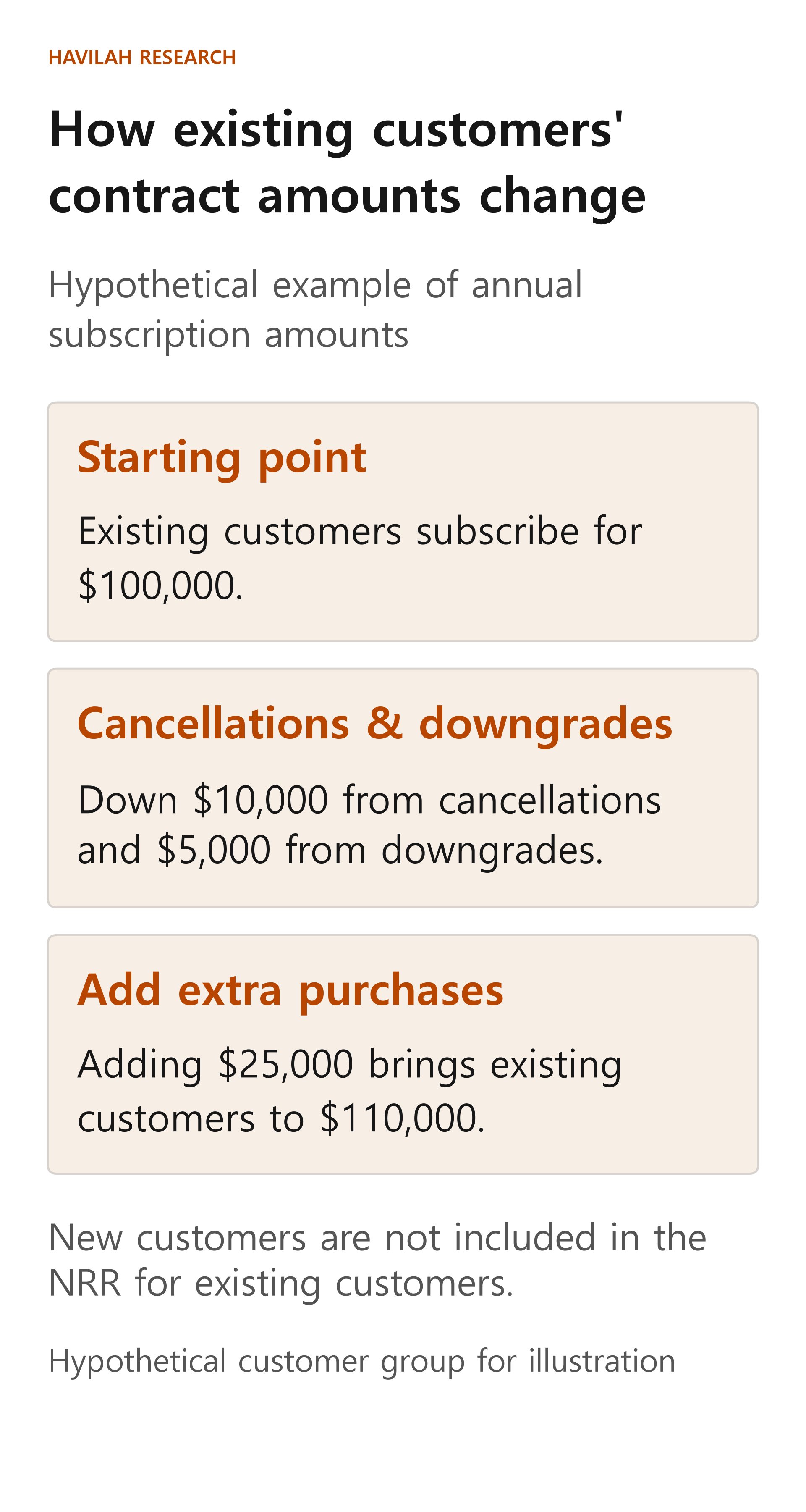
Suppose 100 hypothetical existing customers each subscribe for $1,000 a year, for a total of $100,000. The following year, these changes occur.
| Change among existing customers | Change in annual subscription amount |
|---|---|
| 10 customers cancel | −$10,000 |
| Some customers downgrade their plans | −$5,000 |
| Some customers buy more | +$25,000 |
The annual subscription amount of the existing customer group that remains is $100,000 − $10,000 − $5,000 + $25,000 = $110,000.
NRR is $110,000 ÷ $100,000 × 100 = 110%. This means the subscription amount of the existing customer group grew by 10% overall.
But you should not conclude from the 110% figure alone that every customer was satisfied. In this example, 10 customers left, but other customers' additional purchases were larger than that decline. If new customers' subscriptions in the same period total $15,000, the total annual contract amount is $110,000 + $15,000 = $125,000. New customers were not included in the numerator of NRR.
The NRR that companies actually disclose can differ in which customers it covers, the period, how exchange rates are handled and whether usage fees are included. Even when numbers share the same name, read the definitions before you compare them. Vertex, a U.S. tax software company, discloses that its NRR calculation reflects existing customers' additional purchases, reduced usage, churn and other factors.
Look at customer retention and costs together
Another approach looks at how much was lost to cancellations and downgrades on existing contracts, leaving additional purchases out. In the hypothetical example above, taking $10,000 of cancellations and $5,000 of downgrades from $100,000 leaves $85,000. Compared with the original $100,000, that is 85%.
A metric like this, which measures how much of the existing amount was kept without counting additional purchases, is sometimes called gross revenue retention, or GRR. Real companies may differ in how they reflect downgrades or price changes, so check the definition they disclose.
For example, Vertex describes its GRR as subtracting churn and reduced usage, without including additional purchases. Its metric is based on monthly recurring amounts, and it also makes a separate exception related to the migration of a particular product.
In the example above, by customer count, 90 of 100 customers remained, but by amount, 85% was kept. The number of customers and the amount customers pay tell you different things.
Also look at whether the company spends a lot on advertising and sales to win new customers. If customers stay for a long time and costs are reasonable, there is room to recover the upfront costs. If customers leave quickly, on the other hand, the cost burden can grow even if the company looks like it is growing.
Even when revenue grows, check profit separately
Providing a subscription service costs money for server usage, customer support, developers' salaries and sales. Whether a cost is booked as cost of revenue or as an operating expense depends on the company's accounting treatment, so check it.
Also, do not look only at an adjusted profit that excludes the cost of paying employees in shares; check the accounting operating income and actual cash flow as well. Stock-based compensation may not require the same amount of cash to go out right away, but it can be linked to dilution of existing shareholders when shares are issued.
Vertex explains that when it calculates a supplementary metric called adjusted EBITDA, it excludes stock-based compensation expense and other items. When you look at this number, also check how it differs from the accounting profit the company reports alongside it.
Investors should ask at least three questions together. Do existing customers stay? How much does it cost to win new customers? As a result, how do revenue and cash flow change? You cannot conclude that something is a good investment from any one number.
Summary
ARR is a metric that converts current contracts into an annual figure, and NRR is a metric that tracks the change in the amount paid by a group of existing customers. Both must be kept separate from actual accounting revenue and profit.
Check that customer churn is not hidden behind additional purchases, and read sales costs, development costs and cash flow together. You can only understand lasting growth by looking at revenue growth and the cost burden together.