
What if a company could rent computers over the internet instead of buying them? It would use as many servers and as much storage as it needed and pay a fee for it. This kind of service is called the cloud.
When you look at a cloud company's results, consider together how much customers use, when long-term contracts become revenue, and how much the company invested to provide the service.
How do cloud companies make money?
Suppose a company runs an online store. On most days it needs the equivalent of 10 computers, but on the day of a big sale it may need the equivalent of 100. With the cloud, it can rent the resources it needs and pay according to its contract.
Fees are set in several ways. A customer may pay based on the computing time or storage it used, or it may pay a subscription fee to use a service for a set period. Real contracts can include discounts, minimum usage commitments and bundles of several services.
Alphabet explains that it provides its cloud services on a consumption basis or as subscriptions. It states that revenue from consumption-based services is recognized when customers use the services, and that revenue from subscription services is recognized over the contract period during which customers receive them.
The total written in a contract is not the same as this month's actual revenue. Services the customer has not yet received can remain as revenue for later periods, depending on the contract and the accounting standards.
Contract backlog is a clue to future revenue
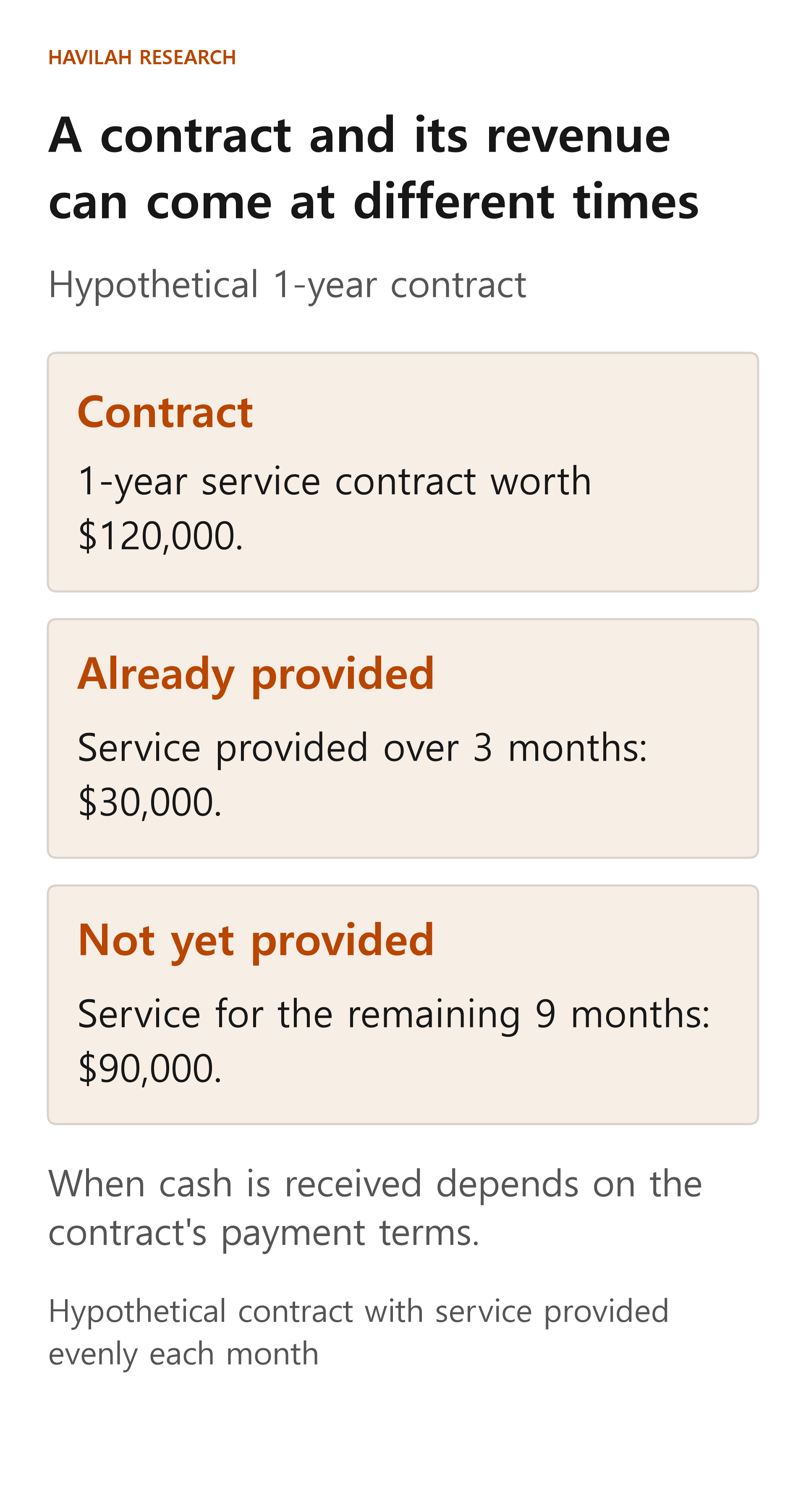
Suppose a hypothetical company signs a non-cancelable, 1-year cloud service contract for $120,000. Assume the service is provided at the same rate every month and there are no other conditions.
Monthly revenue is $120,000 ÷ 12 months = $10,000.
If the service has been provided for 3 months, $30,000 has become revenue, and the remaining $90,000 corresponds to service not yet provided. Whether the company has already received all the cash or will receive it later is a separate question; you need to check the payment terms.
The remaining contractual obligations that a company discloses are called remaining performance obligations, or RPO. Put simply, this is the amount for services that are included in contracts but have not yet been provided, and so have not yet been recognized as revenue. In actual filings, however, which contracts are included or excluded, and when the amounts are expected to be recognized, differ from company to company.
Alphabet explains that the contract backlog it discloses excludes contracts with an original expected term of one year or less and contracts that can be canceled. So when you compare it with another company's figure, check not only the amount but also what the disclosure covers.
A large contract backlog is a clue to future revenue, but when it is recognized can change depending on when customers use the services and whether the company can deliver as contracted. You also should not add the backlog to revenue already recognized as if they were revenue for the same period.
If usage grows, does profit grow too?
Suppose a hypothetical cloud company can provide 72,000 hours of server time a month. Of these, 60,000 hours are usage it can bill customers for, and the fee is $0.20 per hour.
60,000 hours × $0.20 = monthly revenue of $12,000.
The billed usage hours are about 83.3% of the total hours available. The calculation is 60,000 ÷ 72,000 × 100. This is a paid-usage rate set for the purpose of explanation. You cannot treat it as the same as the actual utilization rate a company discloses.
Assume that the cash operating costs for this period, such as electricity and operating staff, are $8,000, and that depreciation on the equipment is $2,000. If we simplify by assuming there are no other costs, revenue minus these costs is $2,000.
$12,000 − $8,000 − $2,000 = $2,000.
This calculation leaves out taxes, financing costs and other expenses. It does not represent a real company's net income. If the servers are used more, revenue can rise, but electricity and customer support costs can rise too. Price discounts and capacity expansion also affect profit.
The money spent on servers is not the same as the accounting expense
Suppose a company buys servers for $120,000 in cash and uses them for 5 years. With a simple method that assumes no residual value and spreads the same amount of expense over each year, annual depreciation is $24,000.
$120,000 ÷ 5 years = $24,000 a year.
Divided by 12 months, this is $2,000 a month, the same hypothetical depreciation figure used in the calculation above. The $120,000 in cash went out at the time of purchase, but the accounting expense is spread over the period of use.
Actual useful life, residual value and the date use begins vary with each company's estimates and accounting treatment. Amazon disclosed that in 2025 it changed the expected useful life of some of its servers and networking equipment. Even for the same equipment, a change in expected useful life can change the depreciation recognized in a period.
What should you look for in filings?
First, check which revenue you are comparing. Numbers grouped under the name "cloud" can include not only fees for computing but also other services, such as business software. If you directly compare the growth rates of two companies whose figures cover different things, you can reach the wrong conclusion.
Next, look at usage together with customer contract backlog, contract terms and when the backlog is expected to be recognized as revenue. If a company does not disclose usage for individual services, do not write down estimates as if they were facts.
Finally, look at the cash invested in servers and data centers, depreciation, operating costs and cash flow. Even if customer usage grows, profit and cash flow can move in different directions if capital spending and costs grow faster.
Summary
Cloud revenue comes in several ways, including usage-based fees and subscription contracts. Contract backlog is a clue to services that will be provided in the future, and you should keep it separate from revenue already earned and cash already received.
The payment for servers and the depreciation expense are also recorded at different times. Reading customer usage, contract terms, equipment costs and cash flow together helps you judge the quality of revenue growth better.