
Imagine you are opening an online marketplace for the first time. If no one is selling anything, buyers have little reason to come, and if there are no buyers, sellers hesitate to join.
On the other hand, if buyers and sellers can find the deals they want with each other, people may keep coming back. When you analyze a platform company, look less at the number of users itself and more at whether these connections actually turn into transactions and income.
What does a platform connect?
A platform is a service that helps different groups of people meet to trade or exchange information. An online marketplace can connect sellers with buyers, and a delivery service can connect restaurants, customers and delivery workers.
When there are more sellers and it becomes easier to find what you want, buyers can benefit. When there are more buyers and more chances to sell, sellers can benefit too. This effect, where participation on one side affects the value of the service to the other side, is called an indirect network effect.
The U.S. Federal Trade Commission explains that in markets that connect two groups, participation by one side can increase the value the service offers users on the other side. However, the mere fact that more people have joined does not mean this effect is always strong.
For example, even with many sellers, buyers may leave if the site is full of the same items and shipping or refunds are inconvenient. Sellers, too, may stop using it if competition becomes so intense that their earnings fall or their advertising costs rise.
Transaction value is not the company's revenue
If $1 million worth of goods is traded on an online marketplace in a month, that does not mean the platform company's revenue is $1 million. Much of the payment for the goods belongs to the sellers who sold them.
Transaction value is a metric that shows the amount traded through a platform over a period. It is often called gross merchandise volume, or GMV. A company can earn money from commissions on sales, advertising, payment services and so on, but how revenue is actually recognized, and who owns the goods, differ from company to company.
eBay explains in its filings that its GMV includes shipping fees and taxes and does not subtract returns or cancellations. Shopify, by contrast, states that it subtracts refunds from its GMV. When you compare the two companies' numbers, check differences in definitions like these first.
What happens when the commission rate falls?
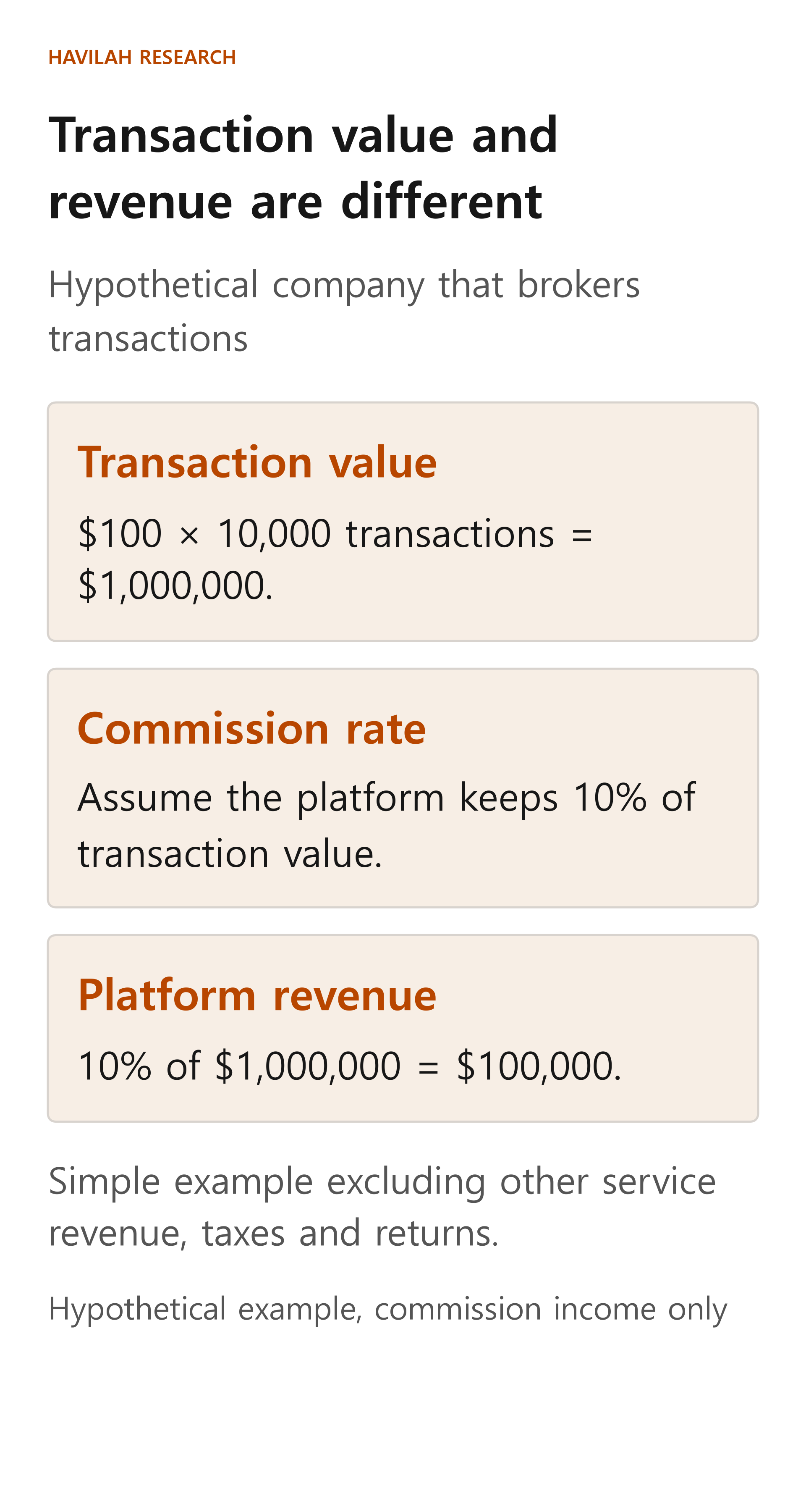
The following is a simple hypothetical example. Assume there are no taxes, returns or revenue from other services, and that the company brokering the transactions receives only a fixed percentage of transaction value as its commission. These are not a real company's results or accounting treatment.
In the first year, 10,000 transactions of $100 each took place. Transaction value is $100 × 10,000 transactions = $1 million.
If the commission is 10% of transaction value, platform revenue is $1 million × 10% = $100,000. If the cost of providing the service is $30,000 and operating expenses are $80,000, the operating loss, excluding other items, is $10,000.
$100,000 − $30,000 − $80,000 = −$10,000.
Now suppose that the next year transactions grow to 20,000 and the amount per transaction stays at $100, but the commission rate falls to 8%. Transaction value is $2 million, and platform revenue is $2 million × 8% = $160,000.
Assume the cost of the service is $60,000 and operating expenses are $70,000. With no other items, operating income is $160,000 − $60,000 − $70,000 = $30,000.
In this example, transaction value doubled, but because the commission rate fell, revenue rose from $100,000 to $160,000. Costs changed as well, so you cannot judge profit from transaction value alone. In reality, other revenue such as advertising, various discounts, and the accounting judgment of whether the company is the principal party in a transaction also change the result.
Look inside the user numbers
Even if sign-ups grow, people who come once and leave are unlikely to lead to ongoing transactions. Where possible, look at the number of people who actually used the service, the share who come back, how often they buy and transaction value together.
Sellers matter too. Sellers have a reason to keep listing products only if they can still make a profit after paying advertising costs and commissions. If a platform charges one side too much, short-term revenue may rise, but the service can become less attractive.
One person can also use several platforms at once. If buyers and sellers can easily move elsewhere, it is hard to assume that a large number of users always gives a company an edge over competitors. User protection, delivery, dispute resolution and regulatory compliance also cost money.
What should investors check?
First, check whom the company connects and which side pays it. If it has advertising or subscription revenue in addition to commissions on sales, look at the share of each separately.
Next, break down why transaction value grew. Whether it came from more transactions, a higher amount per transaction or the acquisition of another company can make a difference to how sustainable the growth is.
Finally, check profit, meaning revenue minus the cost of services and operating expenses, and cash flow. It is important to see whether customers stay even when the discounts or advertising spending used to attract users are reduced.
Summary
A platform connects several types of participants, and participation on one side can raise the value for the other side. But more participants do not automatically bring more transactions and profit.
Separate transaction value from company revenue, and look at commissions, costs and repeat use together. That is how you can understand how the phrase "platform growth" connects to a company's actual results.