
As AI data centers grow, attention turns not only to the companies that make semiconductors but also to the companies that connect chips and carry data. Yet taking part in the same technology does not mean every company's revenue and profit will grow in the same way.
What an investor needs to know first is what each company actually sells and who pays it. Once you understand this flow, you can tell the growth of an industry apart from the results of an individual company.
Packaging that connects chips
Packaging, which we looked at in the previous lesson, is the process that protects a semiconductor and lets it be connected to other components. Advanced packaging is used to place several chips close together and connect them so that they can exchange signals quickly.
For example, TSMC's CoWoS is a method that can combine a processor chip with HBM, a type of high-bandwidth memory. Even when the company that designed the chip sells the finished product to its customers, the company that handled the packaging is paid for its own service.
Companies that supply materials, companies that sell testing equipment and others can also take part. However, one company may handle several stages itself or outsource some of them. You can only know the actual business relationships by checking the products and contracts.
Optical communications: sending data with light
As the number of computers that process AI grows, so does the amount of data they exchange with each other. This information can be sent as electrical signals, or it can be converted into light and carried through thin strands called optical fibers.
Optical communications equipment contains parts that generate light, parts that convert between light and electrical signals, and parts that connect to the optical fiber, among others. An optical module is a product that bundles these functions so that it can be connected to equipment. The actual makeup differs from product to product.
One existing approach is to plug optical modules into network equipment. By contrast, CPO (co-packaged optics) is an approach that places the part that handles light very close to the switch chip that carries network signals. You can think of a switch as a device that sends data to its destination among many pieces of equipment.
Broadcom explains that in CPO, the optical engine and the switch chip are tightly combined. This does not mean, however, that every optical communications product will switch to CPO. Customers consider not only performance but also price, heat, and how parts are replaced and maintained when they fail.
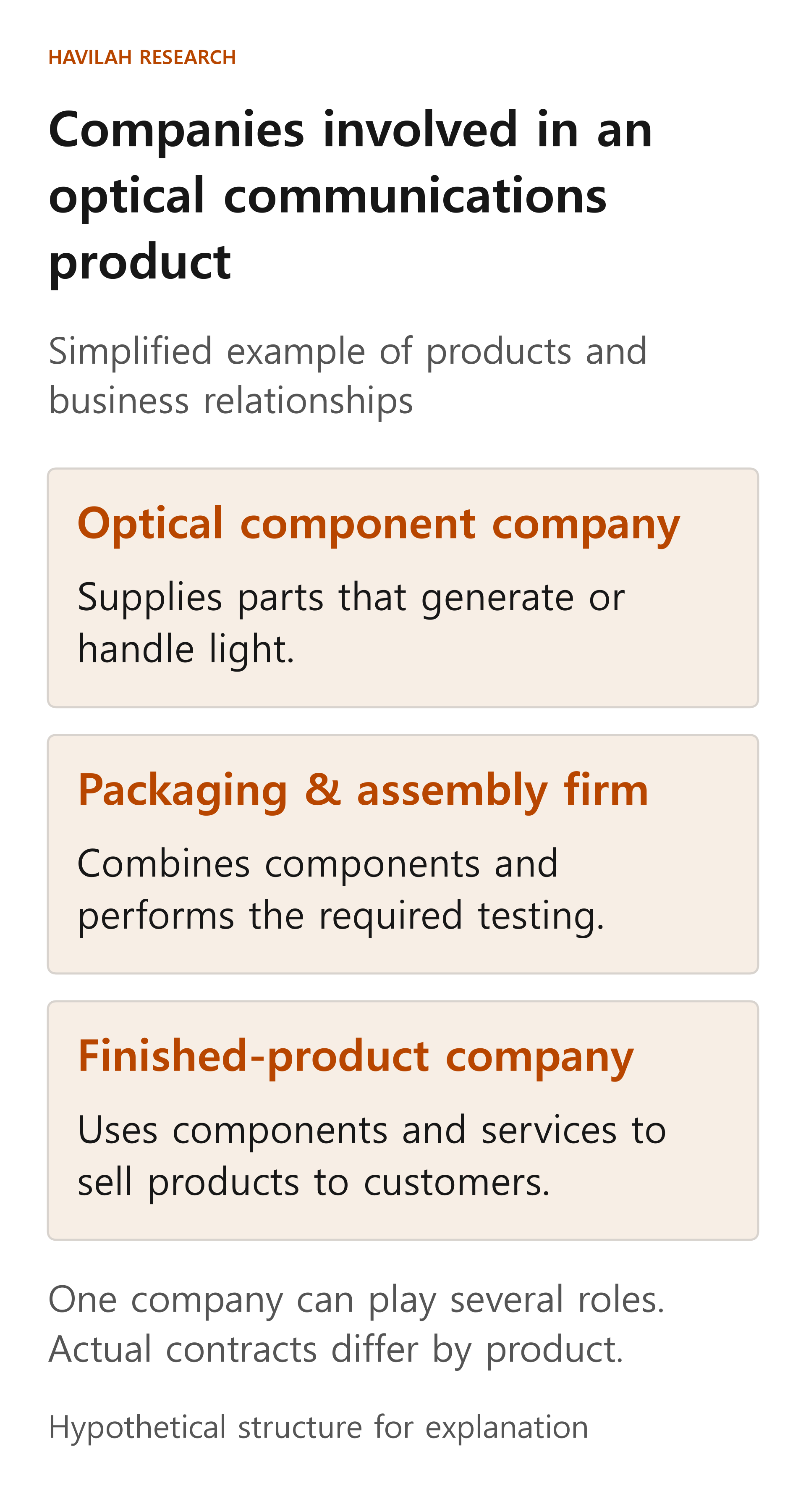
Who sells what?
A company that sells parts that generate light is paid for those parts. A company that makes optical modules puts several parts together and sells them as a product customers can use. A company that sells switches or data center equipment is paid for that equipment.
Some companies carry out several stages themselves, from components to finished products. For example, Applied Optoelectronics states in its filings that it makes a significant share of the laser chips and optical components used in its own products. That does not mean every company in the optical communications industry has the same structure.
What matters is the content of the transaction rather than the company's name. Whether a company sells finished products, supplies components or provides assembly services changes the conditions under which its revenue grows, and its cost structure.
Be careful when adding up revenue from the same product
Suppose hypothetical company A, which makes optical communications products, sells 1,000 products at $1,000 each in one period. These are not any real company's prices or results.
1,000 products × $1,000 = revenue for A of $1 million.
For this product, A buys optical components from Company B for a total of $400,000 and pays Company C a total of $150,000 for packaging services. Assume the rest of its product cost is $250,000.
A's product cost: $400,000 + $150,000 + $250,000 = $800,000.
A's gross profit: $1 million − $800,000 = $200,000.
Gross profit is revenue minus the cost of the products sold. Research and development costs, selling expenses, interest, taxes and other items have not yet been subtracted, so it is not net income.
B's revenue is the $400,000 it receives from A, and C's revenue is $150,000. The three companies' revenue adds up to $1.55 million, but you should not read this as end customers having spent $1.55 million. That is because B's and C's revenue is also money that A paid to make and sell its product.
Now assume that B spent $300,000 to make the components and C spent $90,000 to provide its service. B's gross profit is $400,000 − $300,000 = $100,000. C's gross profit is $150,000 − $90,000 = $60,000.
Even when companies take part in the same product, how much each one keeps depends on its selling prices and costs. These numbers are a simple example built around only three companies; they are not an estimate of the actual profit of the whole industry.
When technology improves, does everyone profit?
If a new technology reduces a customer's power use or the space it needs, the customer may be willing to pay for that value. On the other hand, if the product is too expensive to make, or a competitor offers similar performance for less, the supplier's profit can shrink.
A company that sold the existing products well may supply different components under the new approach, or it may lose part of its existing revenue. This is why news that a new product has started to bring in revenue is not enough to confirm that the company's total profit will rise.
The optical products company Lumentum also explains in its filings that competition can affect its prices, revenue and profit margins. This is a risk the company itself has disclosed, not a figure that predicts the future results of every company.
When you look at a real company
First, check the annual report to see what products and services the company sells. If it discloses what share of total revenue comes from the area you are interested in, also look at how that figure is defined and for what period. If the company does not disclose figures by area, do not split its revenue up on your own.
Next, check whether customers are actually adopting the product, whether repeat orders have appeared, and how product prices and costs are changing. Expanding factories and research and development also cost money, so look separately at whether higher revenue turns straight into more cash.
If the company's customers are concentrated in one or two firms, a change in a particular customer's orders can have a large effect on the company. This is why you need to read the technology description, the customer relationships and the financial statements together.
Summary
Advanced packaging and optical communications involve companies that sell different products and services. Rather than just hearing that the industry is growing, check each company's customers, the products it sells, and its prices and costs.
In the next lesson, we continue to look at how an industry's growth connects to individual companies' actual earnings.