
A semiconductor company has announced that it will expand its factories. Investors may immediately expect it to sell more chips and earn more profit.
But there are several steps between how much a factory can make and how much is actually sent to customers. The chips have to work properly, and after they are combined with other components they also have to pass testing. Orders and delivery preparations are needed as well.
So when you see news of an expansion, ask one more question: "Can the added volume actually turn into sales?"
Production capacity and shipments are different
Production capacity is the amount that a facility can produce over a given period. Actual production is the amount that was made in that period, and shipments are the amount that was sent to customers.
Even if a restaurant kitchen can make 100 boxed lunches a day, it does not always sell all of them. If ingredients run short, or there are orders for only 70, the number sold will be different. Semiconductors are similar: the earlier and later production steps, and the orders, all have to line up.
Semiconductors, however, are far more complicated than boxed lunches. One product passes through several companies and processes, and production capacity can be stated in different units, such as the number of wafers or the number of finished products. When you compare numbers, first make sure the periods and units match.
From wafer to finished product
A wafer is the round disc on which semiconductor circuits are formed. Many small chips are made on one wafer, but not all of them work properly.
Yield is the share of tested items that meet the required standard. For example, if 100 chips are tested and 80 pass, the yield at this step is 80%. What yield means depends on which step it refers to and what was tested, so do not compare different companies' yields without care.
Chips that work are then enclosed in a protective casing so that they can be connected to other components. In the semiconductor industry, this process is called packaging. Packaged products must also be tested.
Advanced products sometimes place the chip that does the calculations right next to memory that exchanges data with it quickly. HBM (high-bandwidth memory) is memory in which several memory chips are stacked to widen the path for data. TSMC's CoWoS is one example of an advanced packaging method that combines several chips and HBM.
In that case, even if many processor chips are made, finished-product output can be held up when memory or packaging capacity runs short. The step that limits the whole flow is called a bottleneck. Think of a stretch of highway where the wide lanes suddenly narrow.
A bottleneck in numbers
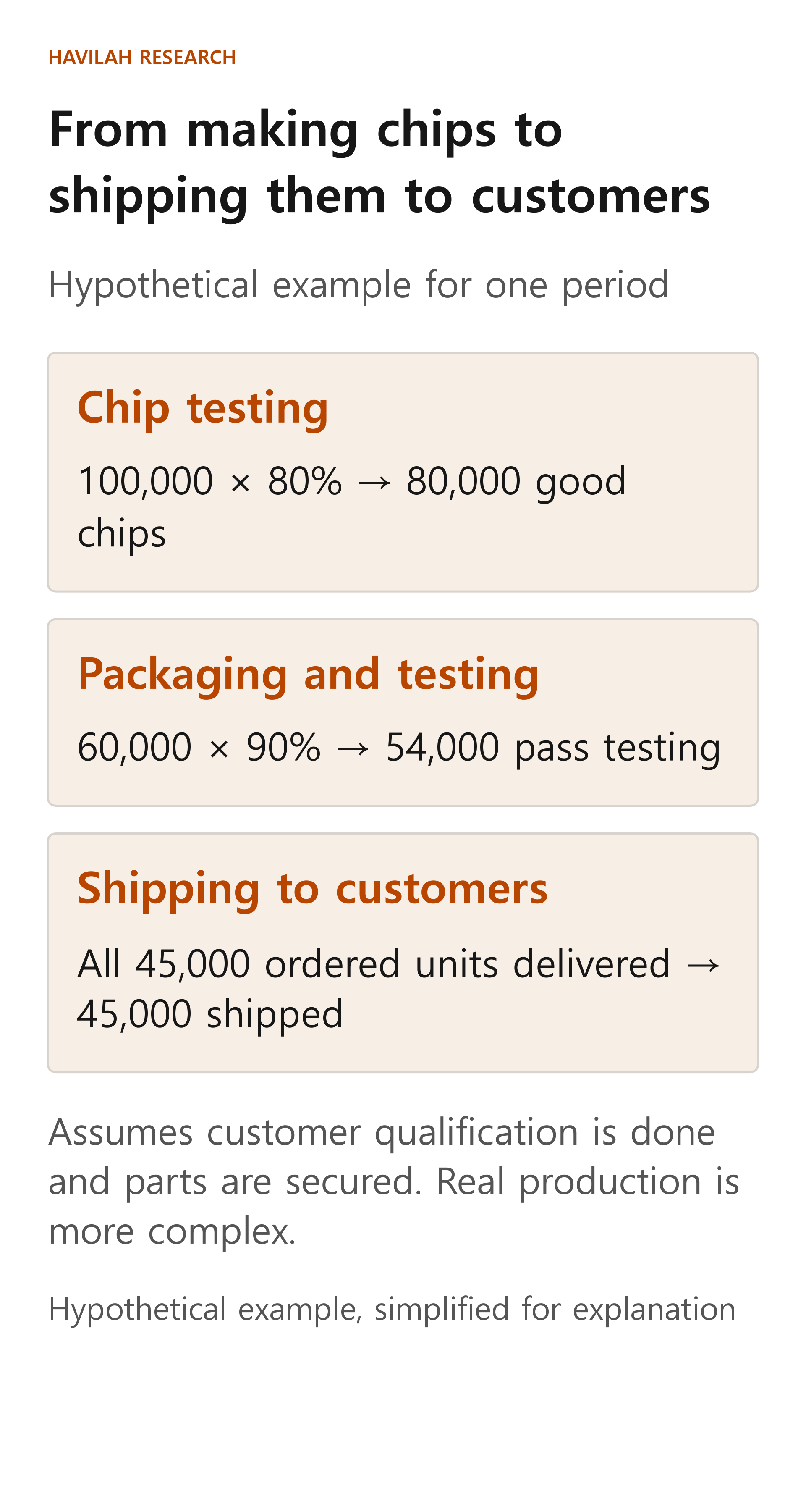
The following is a hypothetical example for one period. These are not any real company's production volumes. To make it easier to follow, assume that each finished product contains one processor chip and that there is enough of the memory it needs. There is also no inventory from the previous period.
In theory, the wafers produced 100,000 chips. The chip-testing yield is 80%.
100,000 chips × 80% = 80,000 good chips.
But the packaging equipment can handle only 60,000 in the same period. So 60,000 chips can be packaged this period, and the remaining 20,000 wait for the next step.
If the final-test yield on the 60,000 packaged chips is 90%, the result is as follows.
60,000 × 90% = 54,000 products that pass testing.
Suppose the customer's required approvals are already complete and orders for this period are 45,000. If the company ships all of those orders, actual shipments are 45,000. Products that passed testing and products sent to customers are not the same number either.
Now assume that only the chip-testing yield rises to 90%. Good chips increase to 90,000, but if packaging capacity is still 60,000, the number that passes final testing stays at 54,000. If orders are unchanged, shipments also stay at 45,000, as before.
This time, assume that packaging capacity also rises to 70,000 and there are enough chips and memory. If the final-test yield is the same, 70,000 × 90% = 63,000 pass testing. But if orders are 45,000, there is no reason to ship more than that this period. Only when orders rise to 63,000 and the delivery conditions are also met, so that everything is sent, do shipments reach 63,000.
In reality, one product contains several chips and several memory units, and each step takes a different amount of time. The calculation above is a simple example to help you understand bottlenecks; it does not represent a real factory's production plan.
Customer testing is not the same as mass production
A new chip being made does not mean it is immediately delivered in large volumes. The customer may need to receive sample products and check their performance and reliability in its own equipment. Confirming through this process that the product or its manufacturing process meets the requirements is called customer qualification.
For example, Micron announced in 2025 that it had shipped HBM4 samples to key customers. That was an announcement about shipping samples at the time. From that announcement alone, you cannot conclude that every customer qualification was already complete or that large-volume sales had taken place.
The test results, the customer's product launch schedule and actual orders each need to be checked separately. Customer qualification is not a step you can model by multiplying each finished product by 90%, as in the numerical example above. What is checked, and how, differs by product and customer.
What should investors check?
When a company announces an expansion, first see which step's capacity it refers to. Wafer production, memory and packaging are different stories. Also check whether the number is capacity already in operation or capacity the company plans to add in the future.
Next, look at whether there are other constraints before or after that step. Even if factory capacity grows, it may not lead straight to higher shipments if the company cannot get the components it needs or customer orders are not large enough. Semiconductor companies' own filings also mention component shortages, production yields and delivery delays as risks that can affect the business.
Even when shipments rise, revenue and profit do not necessarily rise at the same rate. Selling prices and costs differ by product, and you also need to consider what was spent on the new facilities. The timing of a shipment and the timing of when revenue is recognized in the accounts can also differ, depending on contract terms and other factors.
If you do not have enough information to check something, leave it blank. If the company has not disclosed orders by customer or yields at each process step, do not fill them in with your own estimates and treat those estimates as confirmed numbers.
Summary
Production capacity is the starting point for shipments. Real deliveries are possible only when testing yields, component supply, packaging capacity, customer qualification and orders all follow on from it.
When you see news of an expansion, check in turn which step has grown and whether the other steps and orders support it. In the next lesson, we look at the roles that different companies play in advanced packaging and optical communications, and where they make money.