
Providing an AI service does not end with buying chips. You need a building to house the servers, and electricity has to be supplied without interruption. You also need equipment to cool down the hot machines.
When you look at data center investment, ask not only "How many chips were bought?" but also "How reliably can those chips be kept running, and who pays for that?"
Electricity is needed for more than the equipment
A data center is a facility that brings together servers, storage devices and other equipment to process data. This equipment uses electricity and gives off heat, so cooling equipment is needed. Facilities that deliver electricity safely and prepare for power outages are also needed.
Power is the rate at which electricity is being used at a given moment. It is measured in kilowatts (kW). Energy is the amount of electricity actually used over a period of time, measured in kilowatt-hours (kWh).
For example, a 1 kW device running for one hour uses 1 kWh of electricity. Just as a car's speed is different from the distance it travels, power is different from energy. In a simple electricity bill calculation, you usually multiply the energy used by the price per unit.
How is cooling done?
Air cooling moves heat away using cold air. Liquid cooling uses water or another liquid to help carry the heat. Depending on the method, a cold plate may be attached to the equipment, or heat may be exchanged between liquid and air through other equipment.
Using liquid cooling does not automatically reduce water use or electricity bills in every case. The results depend on how the facility is designed, the weather, how the water is circulated and how heat is released outside.
Cooling equipment matters not only for saving electricity but also for keeping the equipment running safely. If a breakdown or shutdown means customers cannot be served, it can lead to costs.
Reading a number called PUE
PUE (power usage effectiveness) is the energy used by the whole data center divided by the energy used by the IT equipment, such as servers. Comparisons must use the same period and the same measurement boundaries.
PUE = total facility energy use ÷ IT equipment energy use.
For example, if the whole facility used 150 kWh while the IT equipment used 100 kWh, the PUE is 1.5. The remaining 50 kWh is energy used to run the facility, for cooling, losses in delivering power and so on. Not all of it went to cooling.
A lower PUE means that, relative to the same IT equipment energy use, a smaller share of extra energy goes into running the facility. But PUE alone cannot tell you how much useful work the servers did, how much electricity was used in total, or how much water was used.
If the facilities being compared differ in where they measure, the period, the weather or how heavily they are running, the numbers can also differ. When you look at numbers from different facilities, start by checking how they were calculated.
Let's calculate the savings on the electricity bill
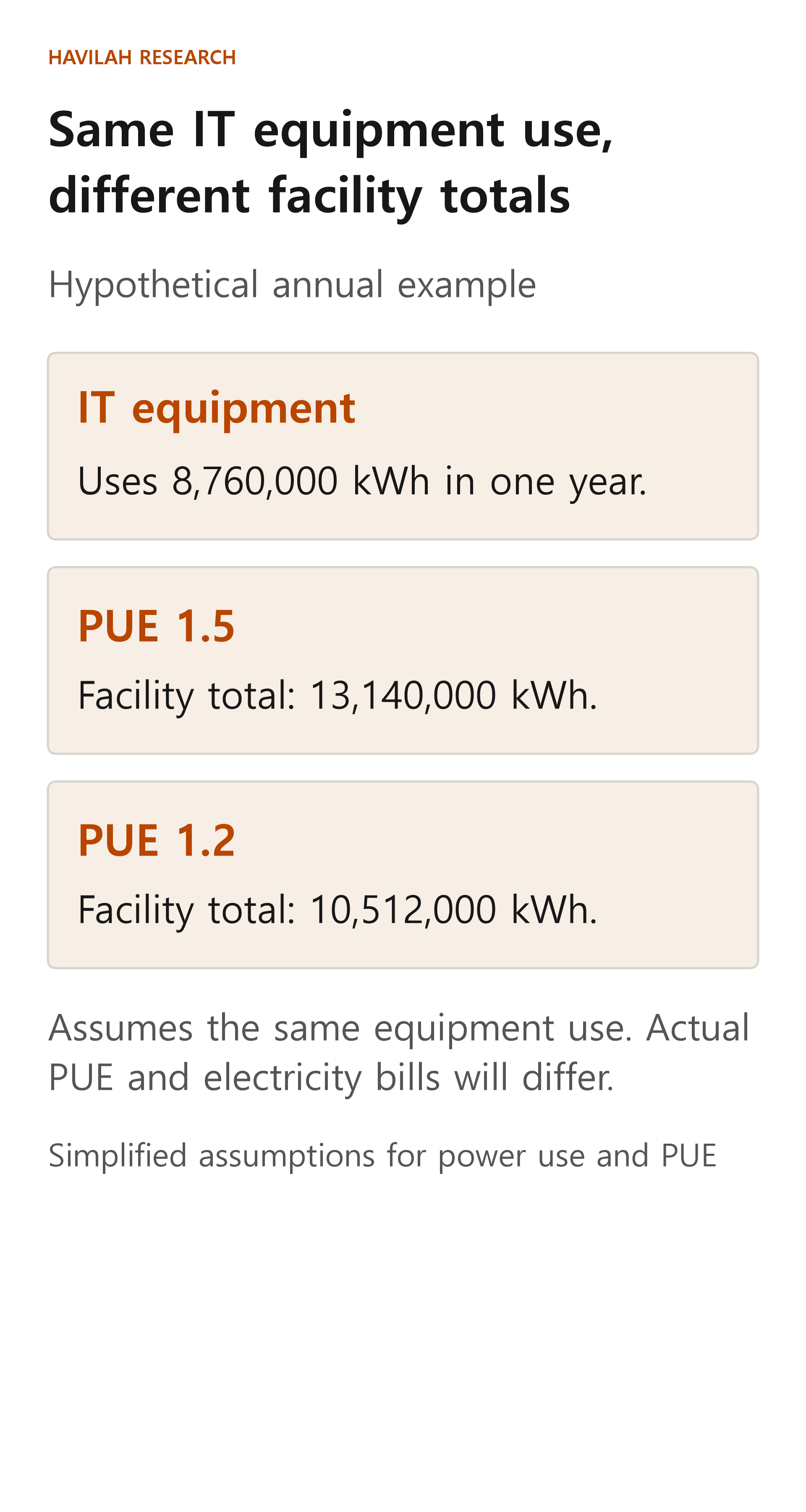
The following is a hypothetical example for explanation. These are not a real data center's operating figures or electricity bills. Assume that the IT equipment uses a constant 1,000 kW all year round and that a year has 8,760 hours.
Annual IT energy use is 1,000 kW × 8,760 hours = 8,760,000 kWh.
If the facility's annual PUE is 1.5, total use is 8,760,000 × 1.5 = 13,140,000 kWh. If the PUE is 1.2, it is 8,760,000 × 1.2 = 10,512,000 kWh.
The difference between the two cases is 2,628,000 kWh a year. If the electricity price is assumed to be a constant $0.10 per kWh, the annual difference in energy charges is $262,800.
This leaves out fixed basic charges, charges based on peak demand, time-of-day rates, taxes and equipment costs. In a real contract, these items can change the result. It also does not mean that PUE and equipment use stay constant all year.
Savings are not the same as a return on investment
Suppose that installing new equipment to improve PUE costs $1.2 million and adds $30,000 a year in maintenance costs. To keep things simple, assume there are no other costs or income, and that the difference in electricity charges above is the same every year.
The annual net saving is $262,800 − $30,000 = $232,800. Dividing the initial investment by the annual net saving gives about 5.15 years.
This is a simple payback period. It is not a return on investment that reflects the time value of money, taxes, repairs, equipment replacement or changes in electricity prices. In practice, you also need to check who keeps the savings over the life of the contract.
For example, in a contract to lease data center space, the operator's burden can differ depending on whether the customer pays the electricity bill separately or it is included in the rent. Depending on the contract terms, the way the savings are shared between the operator and the customer also differs.
Where should investors look?
If you are analyzing a data center operator, look at the power it has secured, its actual start-up schedule, customer contracts, who bears the electricity costs, and capital spending together. Announced plans can differ from the facilities that are actually available for use.
Like a factory, a facility requires a large amount of money up front to build. Check whether the company is investing with cash it already has, borrowing money or issuing new shares. Borrowing creates interest and repayment burdens, and issuing new shares can reduce existing shareholders' ownership percentage. If a delay in connecting to the power grid holds up operations, the company may spend the investment money and still not earn revenue when expected.
Even with long-term contracts, look separately at the contracted power, the actual level of use and the customer's payment terms. If the facility sits empty, there is less revenue to spread fixed costs over, and profitability can suffer.
For a power company, even if demand from data centers grows, look at the cost of adding generation and transmission capacity and the terms under which it can recover that cost through its rates. For a cooling equipment company, check when orders turn into revenue, the cost of the equipment and maintenance revenue.
A change that benefits one company does not necessarily bring the same benefit to another. For example, you cannot assume that the savings of a customer who cut its power use move in the same direction as the revenue growth of the electricity supplier.
Summary
A data center needs power and cooling equipment running alongside its servers. PUE is a measure of the share of extra energy needed to run the facility; it does not explain electricity bills or investment returns on its own.
In annual reports, read the power a company has secured, its capital spending, its customer contracts and who bears the costs, and connect them. The money a company actually receives and spends is more directly tied to your investment decision than the growth of the industry.