
When you hear that demand for semiconductors is rising, it is easy to think of every related company in the same way. But a company that designs and sells chips, a company that makes chips for others and a company that supplies equipment to factories are paid by different customers.
Even within the same semiconductor market, the reasons revenue grows and the reasons profit shrinks can differ from company to company. When you look at a company to invest in, first find out what it sells and who pays for it.
No single company makes a chip from start to finish
A semiconductor is a small component that helps an electronic device calculate or store information. Before a chip is finished, it goes through several stages, including design, production, assembly and testing.
First, a design company decides which functions the chip will have. A production plant then builds the designed circuits on a wafer, a thin, round slice of silicon. After that, the chips are cut from the wafer, packaged so that they can be connected to other components, and tested to see whether they work.
Each of these stages can be handled by a different company. Nvidia outsources chip production to outside manufacturers, and it also uses several suppliers to buy memory and to handle assembly and testing. This is why companies that all go by the name "semiconductor company" can do very different work.
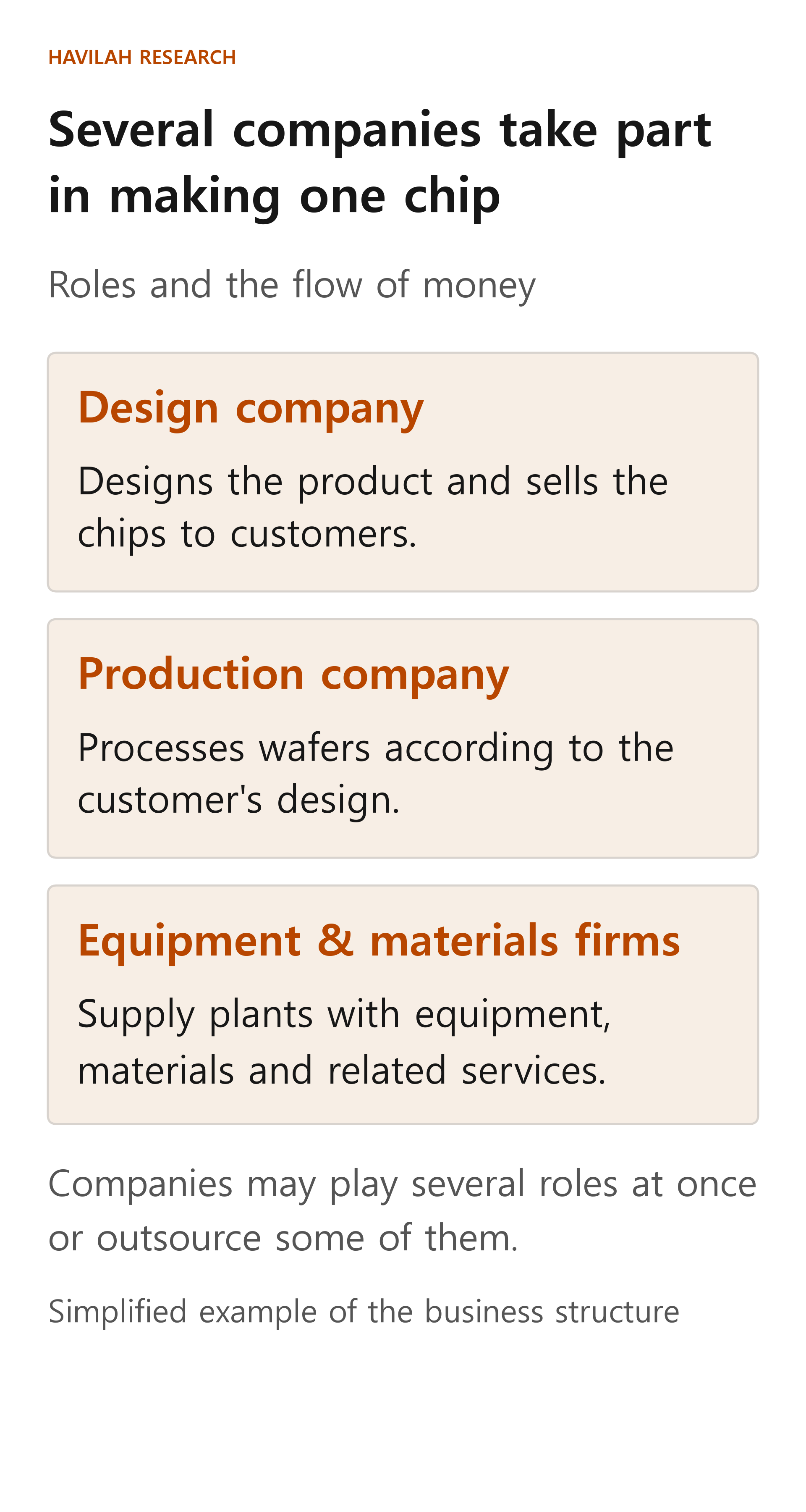
What do design companies and production companies sell?
A company that mainly designs and sells chips without running its own factories is called a fabless company. It designs the product's performance and the features customers want, and it leaves manufacturing to others. This lightens the burden of building factories, but it makes the company depend on its partners for production capacity, delivery times and manufacturing costs.
A foundry is a company that takes a customer's design and produces the semiconductors on the customer's behalf. Its revenue depends on how much production customers give it, at what price, and which manufacturing process is used. TSMC is an example of a foundry: it manufactures semiconductors on wafers according to designs provided by its customers.
A company that both designs and produces its own chips is called an integrated device manufacturer, or IDM. Some memory companies develop their products, manufacture them in their own factories and sell them. An IDM can manage design and factories together, but it needs to invest heavily in factories and equipment. Real companies sometimes outsource some steps, so do not assume from one label that a company does everything itself.
Where do equipment and materials companies fit in?
A chip factory needs equipment to build circuits and to test them. Equipment companies sell this equipment to the chipmakers that run the factories, and some also provide maintenance and performance-upgrade services for equipment that is already installed.
For example, ASML provides lithography equipment used in chip manufacturing, along with related services. Lithography is one of the steps that create circuits on a wafer. Demand for equipment is affected by customers' plans to invest in factories, while service revenue is also affected by how much the installed equipment is used and maintained.
Materials companies supply what manufacturing needs, such as wafers, specialty chemicals and gases. Equipment is closely tied to investment when a factory is built or expanded, while materials are often used again and again during production. Still, how products are sold differs by product and contract, so check each company's annual report.
Following the money with numbers
The example below is hypothetical; it does not use any real company's prices or production volumes. To keep the calculation simple, assume that all products are sold in the same period and that there are no returns and no inventory.
| Company | Sales and costs | Gross profit |
|---|---|---|
| Foundry | 100 wafers × $10,000 = revenue of $1 million. Production cost $800,000 | $200,000 |
| Design company | 10,000 chips × $200 = revenue of $2 million. Product cost $1.5 million | $500,000 |
Assume that the design company's product cost of $1.5 million includes the $1 million it paid the foundry and $500,000 of other product costs, such as assembly. The foundry's revenue is also the design company's cost. So you should not treat the two companies' revenue added together as the amount that end customers actually spent.
The foundry's gross margin is $200,000 ÷ $1 million, or 20%. The design company's is $500,000 ÷ $2 million, or 25%. Gross profit is revenue minus the cost of the products sold. It comes before research and development costs, selling and administrative expenses, taxes and other items are taken into account, so it is not the same as the final net income.
Even if the design company's selling price stays the same, its profit can fall if the cost of producing each chip rises. On the other hand, even when the foundry gets more orders, its profit may not grow as much as expected, depending on how fully its factories are used, its production costs or its contract prices. The ratios in this example do not mean that one business is better than the other.
What should you look at when investing?
For a design company, look at why customers choose its products, its selling prices and the supply capacity of the manufacturer it relies on. For a manufacturing company, check customer orders, how fully its factories are used, prices and the burden of capital spending together.
In areas such as memory, where product prices can change sharply, look separately at whether shipments rose and whether selling prices rose. Even when the revenue increase is the same, growth from higher volumes and growth from higher prices can differ in how long they are likely to last.
For an equipment company, look at investment in new factories, customer orders and how much of its revenue comes from services after installation. For a materials company, you can check the volumes it supplies, how concentrated its customers are and whether another company could easily replace it. A single company can play several roles at once, so start by checking the revenue and costs by business segment in its filings.
Key points to remember
Money in the semiconductor industry comes from many kinds of transactions: chip sales, contract manufacturing, the supply of equipment and materials, and services. One company's revenue can be another company's cost.
Rising demand alone does not mean every company's profit grows at the same pace. Start by checking who sells what to whom, and how prices and costs are changing. In the next lesson, we look at the factors that can hold back actual production and shipments.