
If you calculate a company's enterprise value at $1 billion, could you buy all of its shares for $1 billion? Not necessarily. The cash the business generates goes not only to shareholders but also to lenders.
To find the value per share, you first need to separate the shareholders' part from the enterprise value, then divide that amount by the number of shares. After that, you also need to think about the chance that your calculation is wrong and about the actual costs of trading.
Finding the shareholders' part of enterprise value
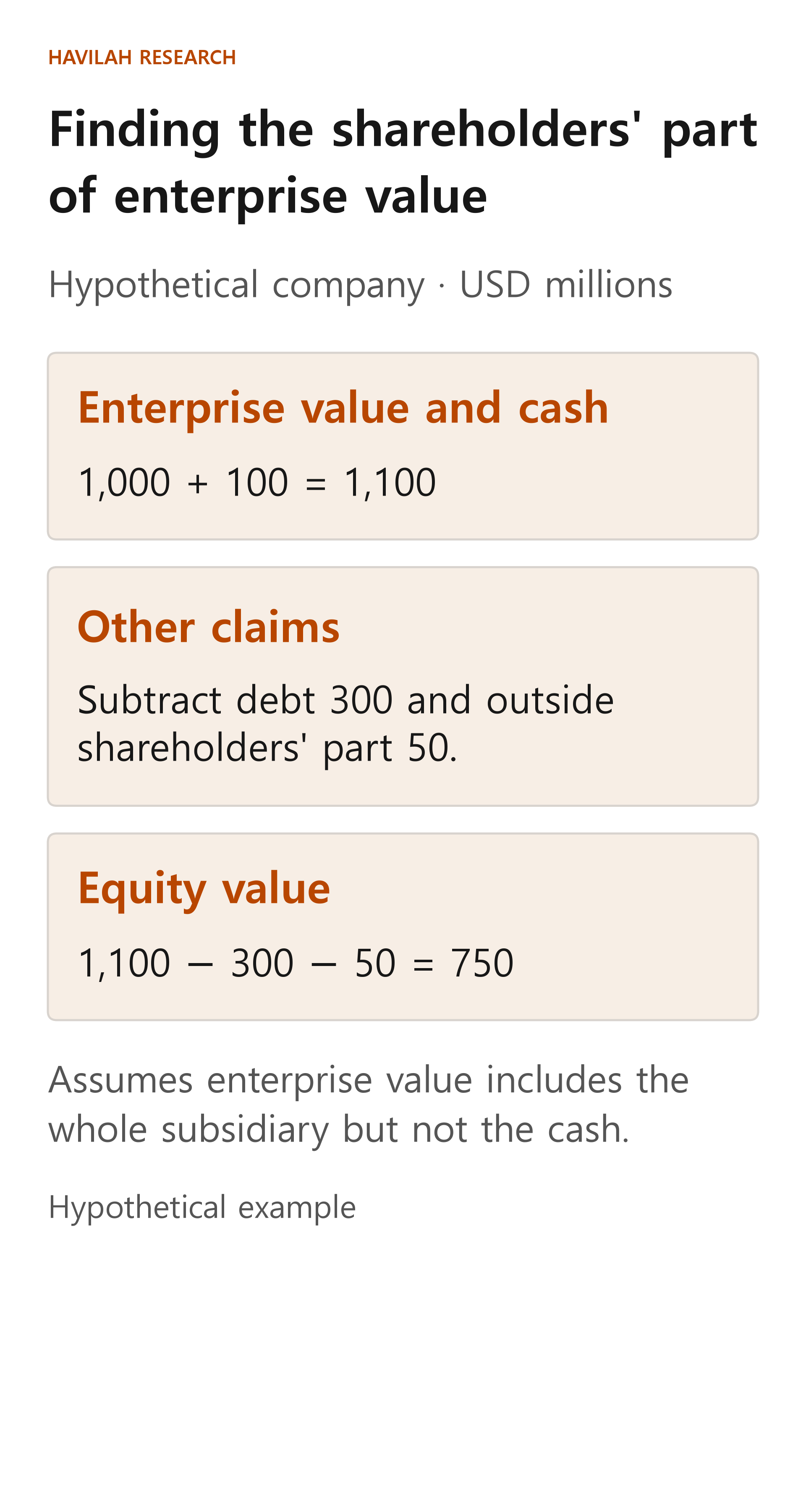
Suppose you have estimated a hypothetical company's enterprise value at $1,000 million. The numbers below are a hypothetical example for the calculation.
The company holds $100 million of surplus cash that is not included in the enterprise value. The debt of the parent company and its consolidated subsidiary adds up to $300 million. The enterprise value you calculated includes the whole subsidiary, but assume that the part of the subsidiary owned by other shareholders is worth $50 million.
This part owned by other shareholders is called a non-controlling interest. Think of it as the share that belongs to outside investors who co-own the subsidiary. If the enterprise value includes the whole subsidiary, you need to subtract this part when you work out the value that belongs to the parent company's shareholders.
In this example, the equity value is 1,000 + 100 − 300 − 50 = $750 million. We assume there are no preferred shares or other claims.
If the cash is already included in the enterprise value, do not add it again. Likewise, deal with non-controlling interests only after checking whether the enterprise value includes the whole subsidiary. And do not assume that the amounts recorded on the books are the same as their actual market values.
What if the number of shares can grow?
If there are currently 100 million common shares outstanding, the simple calculation gives 750 ÷ 100 = $7.50 per share.
But suppose that stock-based compensation already promised will be paid out in the future and could add 10 million shares. Take the simple case in which the company receives no new cash and the equity value stays the same. Dividing by 110 million shares gives a value of about $6.82 per share.
When the number of shares grows and each existing shareholder's slice gets smaller, this is called dilution. In practice, you need to check whether every promise will actually turn into shares, whether the company receives cash in return for issuing them, and whether the related costs are already reflected in the cash flows. Convertible securities and options need more complex calculations depending on their terms, and you should be careful not to subtract the same dilution twice.
What does a margin of safety protect?
Even if the value per share is about $6.82, there is no guarantee that the future profits and the discount rate used in the calculation are right. So some investors leave a cushion and aim to buy at a price below their estimated value. This gap is called the margin of safety.
For example, if you decide to leave a cushion of 20% of the value per share, you can multiply the unrounded value per share by 80% and use about $5.45 as your reference price. The 20% is an assumption for illustration, not a rule that suits every investor.
Even with a margin of safety, you can still lose money. The business outlook may turn out wrong so that the actual value is much lower than expected, or the share price may not recover for a long time.
Write down your conditions for buying and for taking another look
Suppose this hypothetical investor sees a current price of $5.20. That is below the $5.45 reference price calculated above. Even so, you do not need to decide to buy on the price alone.
First, check whether the revenue growth and margins used in the value calculation make sense in light of recent filings and the state of the business. Also check the actual cost of buying, including commissions and currency conversion costs. Decide how much to put into one company by considering several things together: money left after living expenses and an emergency fund, overlap with your other holdings, and the loss you can bear.
Also write down in advance the conditions that would change your mind. For example, if the company loses a key customer, or it becomes clear that the expected margin will be hard to maintain, you can recalculate the cash flows with the new information. A falling share price alone does not necessarily mean your estimate of enterprise value was wrong, and a rising share price alone does not confirm that your analysis was right.
Selling starts from the same questions
Check whether the business has done worse than expected so that the basis for your value estimate no longer holds, or whether the position has grown too large a part of your portfolio for you to handle. Conversely, if the share price has risen, check again how the price compares with a value estimate that reflects the latest results and risks.
Whatever criteria you set, there is no guarantee that you will trade at the price you want. Depending on market conditions, the price at which your order is actually filled can differ from what you expect. Your investment horizon and when you will need the money also affect your decisions to buy and sell.
Key points to remember
If you add the surplus cash not included in the enterprise value and make the right adjustments for other claims, such as debt and outside shareholders' interests, you can estimate the equity value. Divide it by the number of shares, but also look at the possibility of dilution.
A margin of safety is a cushion that reflects the fact that your estimate may be wrong. It does not eliminate losses. Judge the price, changes in the business and the size of your investment together.