
Even when you have found a good company, it is hard to know exactly what it will look like in 10 years. But you also cannot calculate as if the company will disappear after 10 years, because it may keep running its business after that.
So investors often estimate the cash for the next several years in detail and calculate the cash that comes after that period as one lump sum. This lump sum is called the terminal value.
The terminal value is not a definite answer. It is an estimate that puts your assumptions about the distant future into a number.
What do you calculate at year 10?
The cash a company earns from its business that can be left for both its lenders and its shareholders is called free cash flow to the firm. The WACC you learned about earlier is a discount rate you can use to calculate the present value of this cash.
For example, suppose you have estimated the cash at the end of each year for 10 years, starting this year. If the business continues after year 10, the cash from year 11 onward remains. The terminal value bundles that later cash into one value as of year 10.
So the year-10 cash and the terminal value cover different periods. If you add the year-10 cash separately and also put the same cash into the terminal value, you count it twice.
Calculating with a hypothetical company
The following numbers are a hypothetical example to help you understand the idea. They do not forecast any real company or future returns.
Assume this company generates $1 million of free cash flow to the firm at the end of every year from year 1 to year 10. From year 11, assume this cash grows steadily by 2% a year, and that the reinvestment needed to sustain that growth is already reflected. The discount rate stays at 10% a year for the whole period.
The year-10 cash is $1 million, so the year-11 cash is $1 million × 1.02 = $1,020,000.
The formula that assumes a constant growth rate continues forever is as follows.
Terminal value = next year's cash ÷ (discount rate − long-term growth rate)
Putting in the numbers gives $1,020,000 ÷ (10% − 2%) = $12,750,000. This is the value as of year 10. It is not today's value.
Bringing the value at year 10 back to today
A value you will receive in 10 years is worth less than the same value received today. Reducing it to today's terms is called discounting it to present value. With a discount rate of 10% a year, you divide the value at year 10 by 1.1 multiplied by itself ten times.
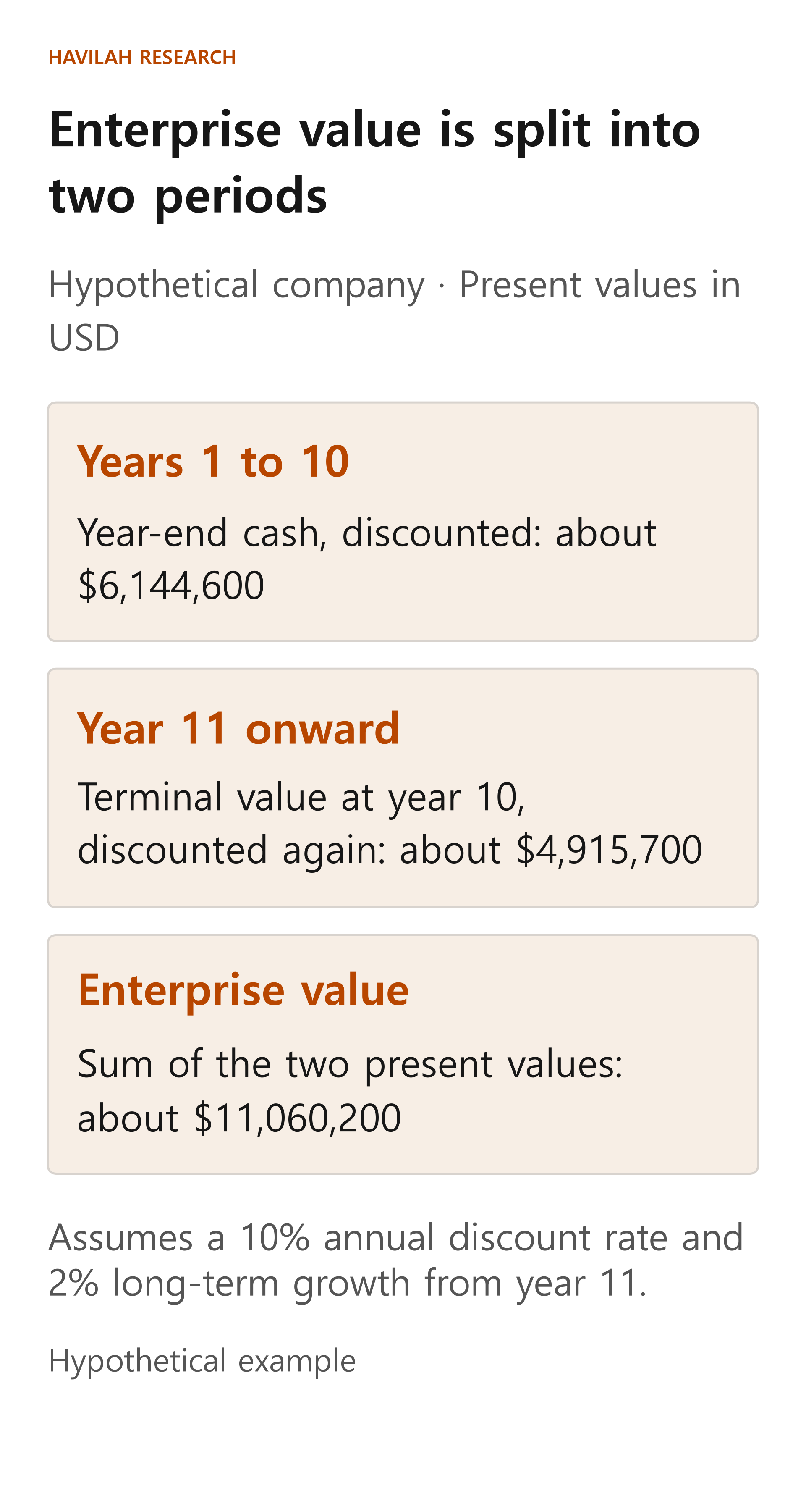
$12,750,000 ÷ 1.1 to the power of 10 = about $4,915,700. This is the present value of the terminal value.
The cash for years 1 to 10 is also discounted separately, each according to when it arrives. For example, the $1 million in year 1 is divided by 1.1, and the $1 million in year 2 by 1.1 to the power of 2. Adding up all 10 years this way gives about $6,144,600.
Adding the two amounts gives an enterprise value, the value of the business, of about $11,060,200. This result adds the unrounded values. The terminal value makes up about 44.44% of it.
A small change in the growth rate changes the result
Keep the year-10 cash and the discount rate as they are, and change only the long-term growth rate from year 11 onward. The comparison below is a simple sensitivity example that holds every other condition the same.
| Long-term growth rate | Cash in year 11 | Terminal value at year 10 |
|---|---|---|
| 1% | $1,010,000 | About $11,222,200 |
| 2% | $1,020,000 | $12,750,000 |
| 3% | $1,030,000 | About $14,714,300 |
The growth rate changed by just 1 percentage point at a time, yet the terminal values differ a lot. In particular, as the growth rate gets closer to the discount rate, the denominator shrinks and the result grows sharply. To use this formula, the long-term growth rate must be lower than the discount rate.
However, a comparison that raises only the growth rate and leaves the required reinvestment unchanged may not be realistic. Growing faster can take more money for equipment, inventory, development and so on. The table above is a calculation that shows sensitivity; it does not mean a higher growth rate comes for free.
How should you use this number in an investment decision?
First, consider whether the long-term growth rate could be sustained for a long time even by a mature company. It is hard to assume that even a fast-growing company will keep growing at the same pace forever. The growth rate and the discount rate must be on the same currency and the same inflation basis as the cash.
Next, check how large a part of the total the terminal value makes up. The larger its share, the more the result depends on assumptions about the distant future. A high share alone does not mean the calculation is wrong, but it is a reason to change the growth rate and the discount rate and check the range of results.
What this calculation gives you is the enterprise value. To see the value of the shares that shareholders own, you need to look separately at items that affect the shareholders' part, such as cash and debt. Do not compare it directly with the company's market capitalization.
The assumption that the business continues may not hold. If liquidation or a sale of the company is likely, you need to estimate its future value another way. Whichever method you use, numbers for the distant future are assumptions, not facts.
Key points to remember
The terminal value bundles the cash after the period you estimated in detail into one value at a future point in time. You discount it back to today's value and add it to the present value of the earlier period.
More important than any single calculated number are these questions. Have you reflected the investment needed for long-term growth? Does your judgment still hold if you change the growth rate and the discount rate a little?
In the next lesson, we will link everything from revenue to cash flow and the discount rate in a spreadsheet.