
A company needs money to build a factory. It can raise the money from shareholders, or it can borrow from banks or other lenders. Each source of money comes with a different cost.
When you value the cash a company will generate from its business, you consider the two costs together, in proportion to how much of each the company uses. The rate calculated this way is the weighted average cost of capital, or WACC for short.
Shareholders' money and borrowed money cost different amounts
The return shareholders require is called the cost of equity. As you saw in Lesson 128, it is not a number that guarantees future returns but an estimate that takes into account risk and other investment opportunities.
The cost a company bears for the money it borrows is called the cost of debt. Do not look only at the interest rate on existing loans; also consider what it would cost the company to raise money now on similar terms.
Interest can be recognized as an expense in the tax calculation. In that case, the tax the company actually pays falls, which can lower the after-tax cost of debt. However, the deduction may be limited, or the company may not get the full benefit of the tax saving, so check the conditions that apply.
First find the weights of the capital
Suppose a hypothetical company's shares have a market value of $6 million and its debt has a market value of $4 million. To keep things simple, assume there are no other sources of funding, such as preferred shares.
The two amounts add up to $10 million. So the weight of equity is $6 million ÷ $10 million = 60%, and the weight of debt is $4 million ÷ $10 million = 40%.
These weights can differ from the book values on the balance sheet. In practice, you may estimate the market values of equity and debt, or use the capital structure the company is expected to maintain over the long term. Record which one you used, and check that it fits the cash flows and the time period you are comparing.
Multiply each cost by its weight and add them up
Assume this company's cost of equity is 10% a year, its pre-tax cost of debt is 5% a year and the applicable tax rate is 25%. As a hypothetical condition, all of the interest is deductible in the tax calculation, so the company actually gets the tax saving.
First, the after-tax cost of debt is 5% × (1 − 25%) = 3.75% a year. Multiplying this by the 40% weight of debt gives a contribution of 1.5 percentage points to the cost of the total capital.
On the equity side, the 10% cost of equity multiplied by the 60% weight of equity gives 6 percentage points. Adding the two contributions gives a WACC of 7.5% a year.
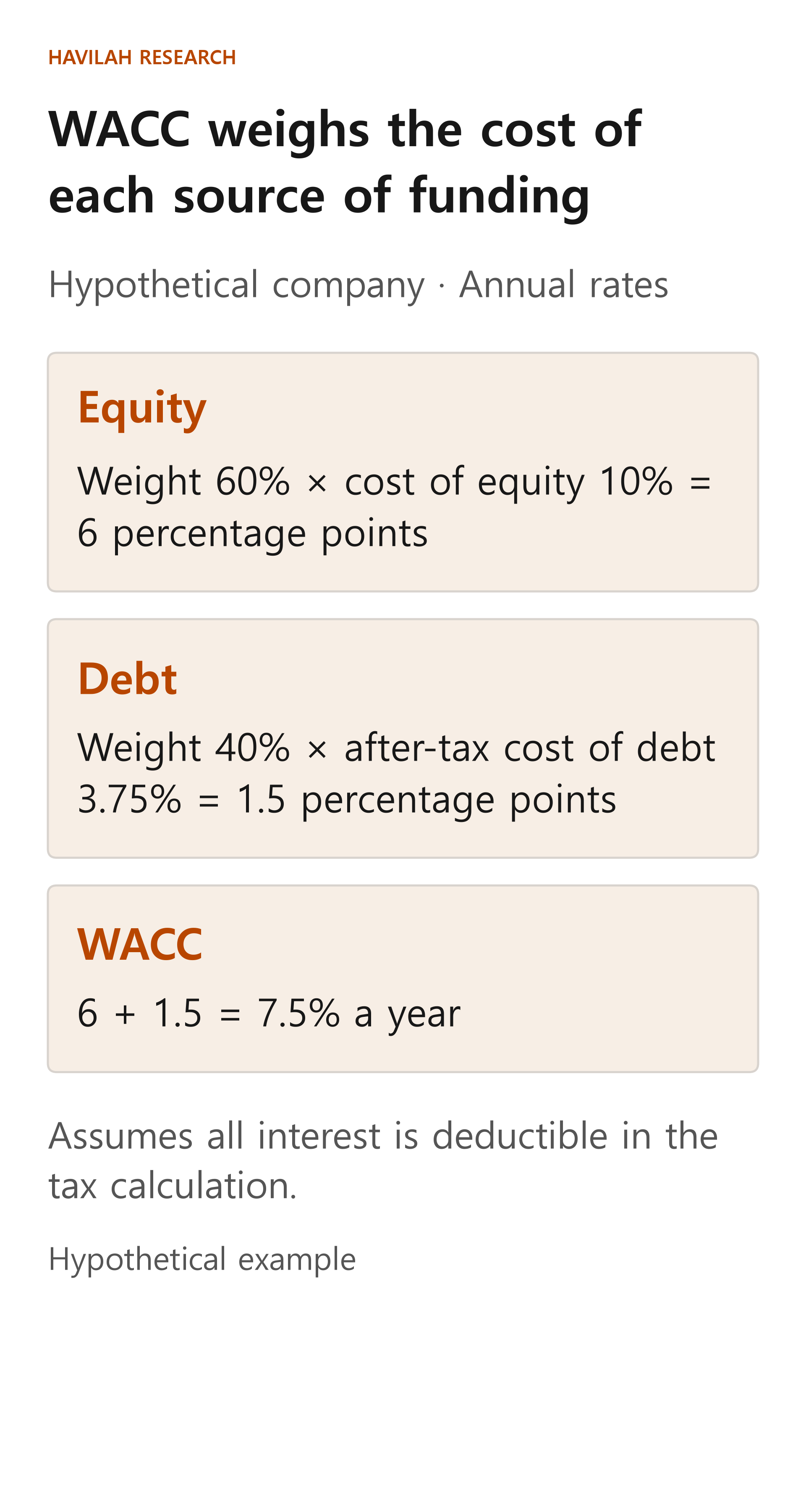
This number is calculated on the assumption that the conditions above hold. It does not mean the company actually earns a 7.5% return every year, or that investors are guaranteed that return.
Does more debt always lower the cost?
Even if the after-tax cost of debt is lower than the cost of equity, using a lot of debt does not necessarily keep pushing WACC down. As debt grows, so does the risk that the company will struggle to pay interest and principal, and the returns that shareholders and lenders require can change too.
For example, under another set of hypothetical conditions, suppose the weight of equity becomes 40% and the weight of debt 60%, while the cost of equity rises to 12% and the pre-tax cost of debt to 7%. The tax rate and the interest deduction conditions are the same as before.
On the equity side, 40% × 12% = 4.8 percentage points. On the debt side, 60% × 7% × (1 − 25%) = 3.15 percentage points. The total WACC is 7.95% a year, higher than the earlier 7.5%.
This is one hypothetical case in which both the funding weights and the costs changed. It does not show a general rule that WACC always rises or always falls when debt increases.
Be careful when you apply it in a DCF
In Lesson 126, when you discounted the cash left for the whole company, you used the cost of capital for the whole company. If you have calculated the cash left only for shareholders, you should use the cost of equity instead. The cash and the discount rate must match in terms of whom the cash is for.
Also be careful not to count the tax effect of interest on debt twice, in both the cash flows and the discount rate. If the future cash is forecast in dollars, the discount rate should also match that currency and the same inflation basis.
In a real analysis, the capital weights, the return shareholders require, the cost of debt and the tax rate all affect the estimate. Rather than relying on a single number, compare how much the company's value changes when each assumption changes.