
In Lesson 127, you saw that when you convert future cash for shareholders into today's value, you use the return that shareholders require. But what percentage should that rate be?
There is no single right answer. You have to estimate it by thinking about the other places the money could be invested and the risks that come with owning shares. One method often used for this is the capital asset pricing model, or CAPM for short.
The cost of equity is the return shareholders require
Money a company raises by issuing shares does not require it to pay a set amount of interest, the way borrowed money does. That does not mean the money is free. In return for providing it, shareholders expect a return that makes the risk of the investment worth taking.
The return that shareholders require in this way is called the cost of equity. It does not mean the company actually earns that much every year. It is an estimated yardstick you use when converting future cash for shareholders into present value.
CAPM uses three numbers
CAPM estimates the cost of equity as follows.
Cost of equity = risk-free rate + beta × equity market risk premium
The risk-free rate is the return you could earn on an investment that is assumed to carry no risk. In a real analysis, you need to choose a benchmark that matches the currency and the time period of the future cash. Real financial products carry various risks depending on their terms, so think of "risk-free" as a reference point for the calculation.
The equity market risk premium is the extra return, above the risk-free rate, that investors are assumed to require for investing in the stock market as a whole. Because no one can know the future extra return exactly, the number differs depending on how it is estimated.
Beta is a measure of how much a stock's returns move together with the returns of the market you choose. If the market is set at 1, a beta of 1.2 means the stock is estimated to react relatively strongly to market movements. It does not mean the stock moves in the same direction as the market, by exactly 1.2 times as much, every time.
Calculating it yourself with hypothetical numbers
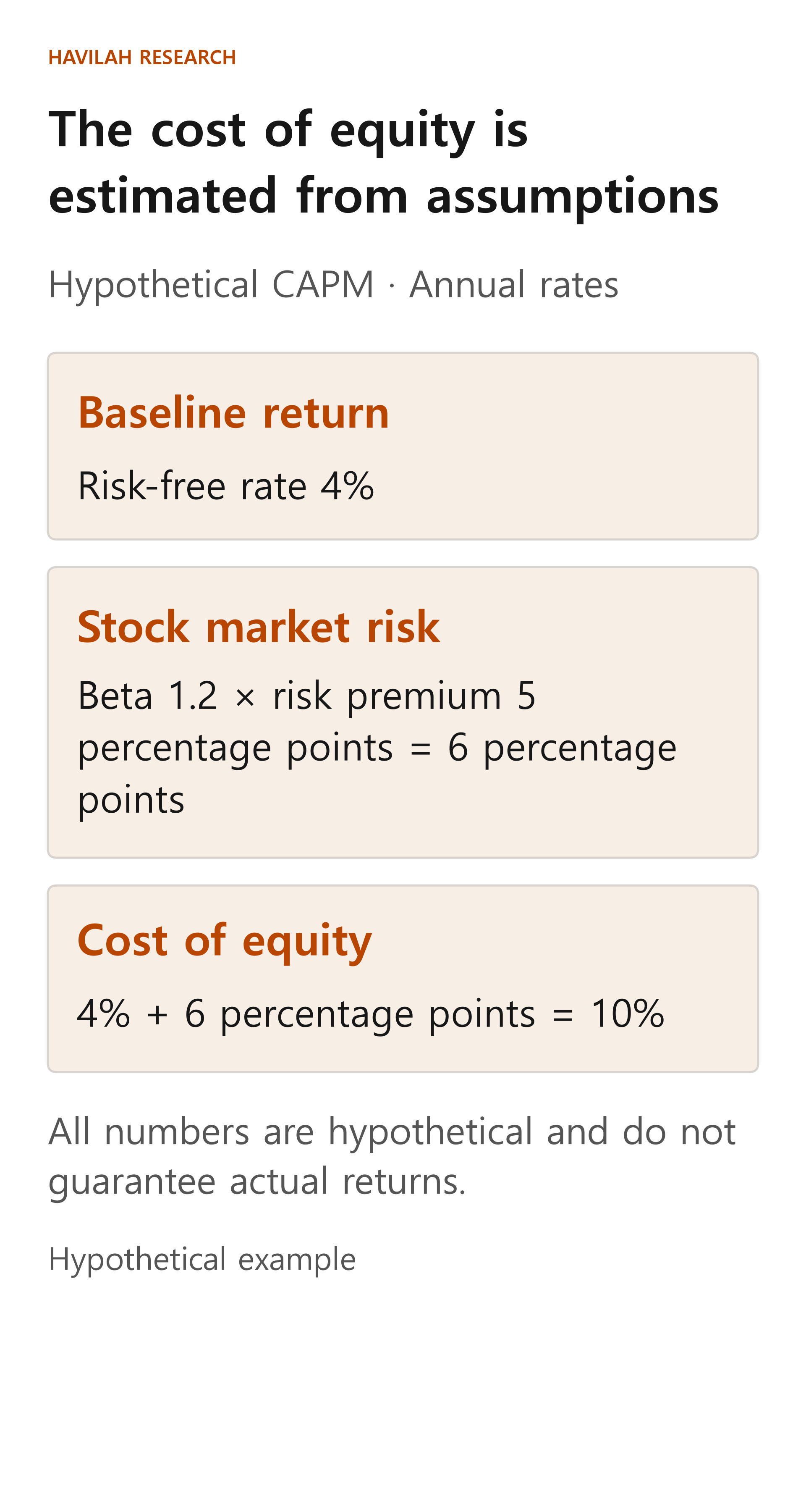
Assume a risk-free rate of 4% a year, a market risk premium of 5 percentage points a year and a company beta of 1.2. These numbers do not represent any current figures in the real market.
Multiplying the beta by the risk premium gives 1.2 × 5 percentage points = 6 percentage points. Adding the 4% risk-free rate gives a cost of equity of 10% a year.
If you use the same risk-free rate and risk premium but lower only the beta to 0.8, you get 4% + 0.8 × 5 percentage points = 8% a year. Within this model, assuming a different degree of co-movement with the market changes the required return as well.
The discount rate changes today's value
Suppose you will receive a hypothetical $100 of cash for shareholders at the end of year 1. Discounted at 10% a year, it is worth 100 ÷ 1.10, or about $90.91, today. Discounted at 8% a year, the same cash is worth 100 ÷ 1.08, or about $92.59.
This is a simple example in which cash arrives only once. To value a real stock, you also have to estimate the cash and the risks that come after. A low discount rate alone does not tell you that a stock is safe or suitable to invest in.
Does a low beta mean low risk?
Beta is a measure for looking at how a stock moves together with the market. It is not a number that captures every risk a company faces. There are also risks specific to an individual company, such as losing a particular customer or an accounting problem.
A beta calculated from past share prices can differ depending on the market index and the observation period you choose, and the relationship can change in the future as the company's business and debt change. CAPM is a model that simplifies reality, and some research suggests that beta alone has difficulty fully explaining expected returns.
Applying it in a real analysis
If you are valuing a U.S. company's cash flows in dollars, think about the discount rate on the same dollar basis. If you mix cash measured in your home currency with a discount rate based on the dollar, your assumptions about exchange rates and inflation may not line up. You also need to match the time period and whether inflation is included.
Record where you took the risk-free rate, the market risk premium and the beta from, and change the numbers a little at a time to see how much the value changes. If you have already reflected the risk of future cash conservatively in the cash flows themselves, be careful not to add the same risk again to the discount rate.
The cost of equity is not a number that guarantees future returns. It is a starting point that shows which risks and alternatives you are considering when you value shareholders' future cash.