
When a company generates cash from its business, whose money is it? It is easy to think only of shareholders, but the company also has to pay interest and repay principal to the people who lent it money.
When you calculate what a company is worth, first decide whom the cash is for. Even for the same company, cash before debt is taken into account differs from cash after it.
Cash for the whole company and cash for shareholders
Free cash flow to the firm is the cash left, after the taxes and reinvestment the business needs, for everyone who provided the company's money, such as shareholders and lenders. It is abbreviated as FCFF.
Free cash flow to equity is the cash left for common shareholders after financing items, such as interest, debt repayments and new borrowing. It is abbreviated as FCFE.
Neither number is the same as the dividends shareholders actually received that year. A company can keep the remaining cash instead of paying it out as dividends, or use it for other purposes.
Calculating with the same company's numbers
Suppose a hypothetical company reports operating income of $2 million for the year. Depreciation of $200,000 has already been deducted as an expense in arriving at operating income, and assume the applicable tax rate is 25%.
Suppose the company spends $500,000 in cash on equipment, and the working capital the business needs increases by $200,000. To keep things simple, assume there are no other non-cash adjustments and no other changes in operating assets and liabilities, and that taxes and equipment are paid for in cash during the period.
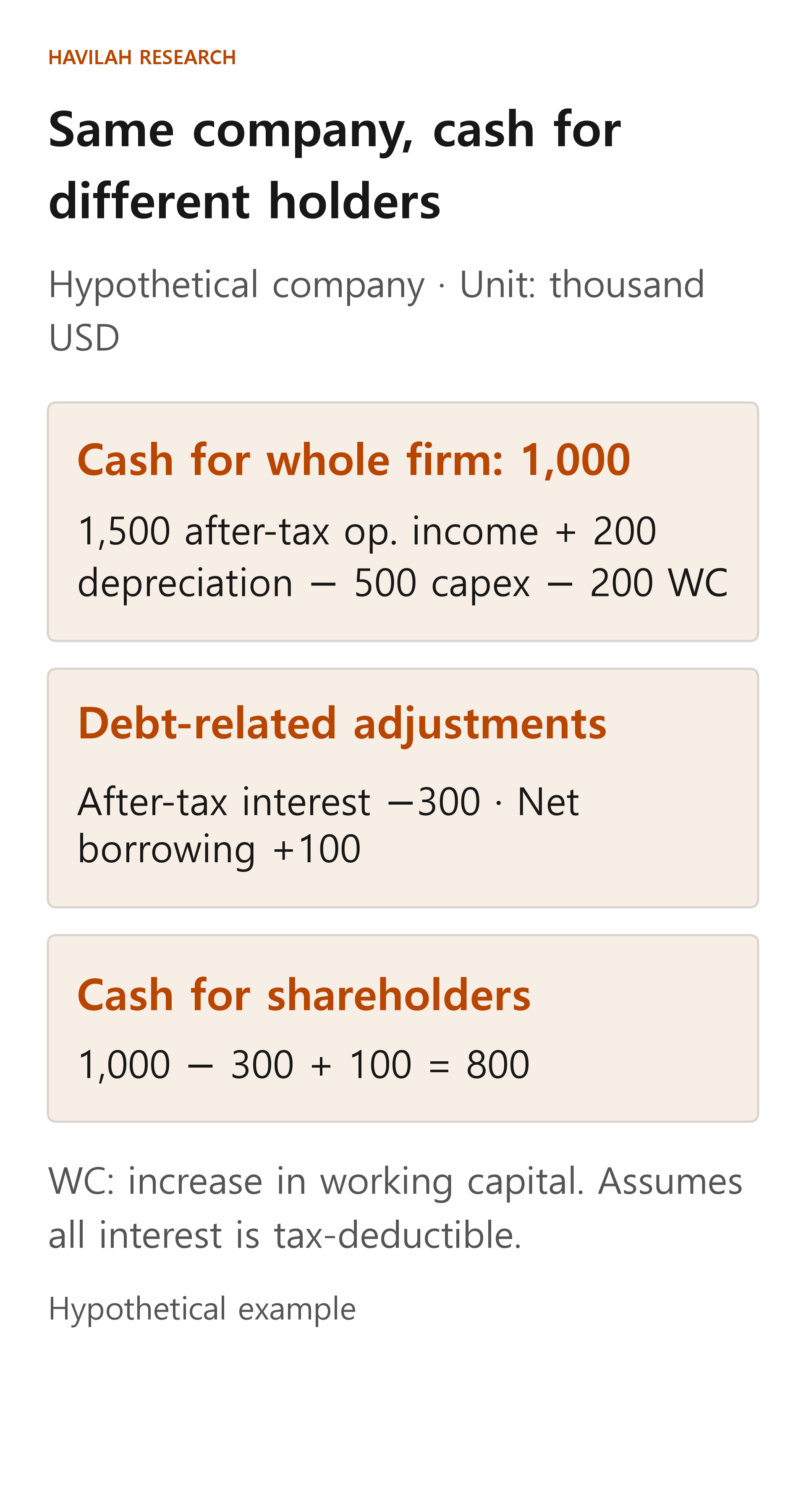
After-tax operating income is $2 million × (1 − 25%) = $1.5 million. Add back the $200,000 of depreciation that was already deducted as an expense, then subtract $500,000 of capital expenditure and the $200,000 increase in working capital. Free cash flow to the firm is $1 million.
This $1 million is an amount before financing. If you jump straight to the conclusion that it is cash for shareholders alone, you miss the effect of debt.
Account for interest and changes in borrowing
Assume that in the same year the company pays $400,000 of interest in cash, and that all of the interest expense is deductible in the tax calculation, so it actually reduces the tax bill. There are no other non-operating gains or losses and no amounts going to preferred shareholders. The interest cost after its tax effect is $400,000 × (1 − 25%) = $300,000.
If the company borrows $200,000 of new debt and repays $100,000 of existing debt, its net borrowing, the new borrowing minus the repayment, is $100,000. Take the $1 million of cash for the whole company, subtract the $300,000 of after-tax interest and add the $100,000 of net borrowing: free cash flow to equity is $800,000.
New borrowing can temporarily increase cash flow to shareholders, but that money has to be repaid later. Do not conclude that the business generated better cash just because borrowing went up.
You can also check by starting from net income
In this example, income before tax is $2 million of operating income minus $400,000 of interest, or $1.6 million. Applying the 25% tax rate gives net income of $1.2 million.
Add $200,000 of depreciation, subtract $500,000 of capital expenditure and the $200,000 increase in working capital, then add $100,000 of net borrowing, and you again get $800,000. Net income already reflects interest, so you do not subtract the same interest a second time.
At real companies, the tax deduction for interest may be limited, and other non-cash expenses, working capital items and the timing of interest payments can differ. Check the line items in the filings and the assumptions you applied.
Match the discount rate to the owner of the cash
When you convert cash for the whole company into today's value, as in Lesson 126, you use the weighted average cost of capital, which combines the costs that apply to shareholders and lenders according to their shares of the capital. From that result, you adjust for the claims of holders other than shareholders to arrive at equity value, the value that belongs to shareholders.
When you discount cash for shareholders directly, on the other hand, you calculate equity value with the return shareholders require, known as the cost of equity. In this case, if you subtract debt again in the valuation when it is already reflected in the shareholders' cash, you may deduct it twice. Check separately whether any assets have been left out, such as cash unrelated to the business.
Whichever method you use, the expected cash and the discount rate are assumptions. First decide whom the cash is for, then pair it with the matching discount rate and adjustments. That way you are less likely to count the same debt or cash twice.