
A company's shares are trading at $50. What should you look at to decide whether that price is attractive?
There are several ways to approach this. One is to estimate the cash the company will generate in the future, convert that cash into today's value and add it up. This method is called discounted cash flow, or DCF for short.
Bringing future cash back to today
In Lesson 125, you converted money you would receive in 5 years into today's value by dividing it by a discount rate. A DCF works on the same principle. The difference is that instead of one amount received at one time, you calculate each year's cash that the company is expected to generate over several years.
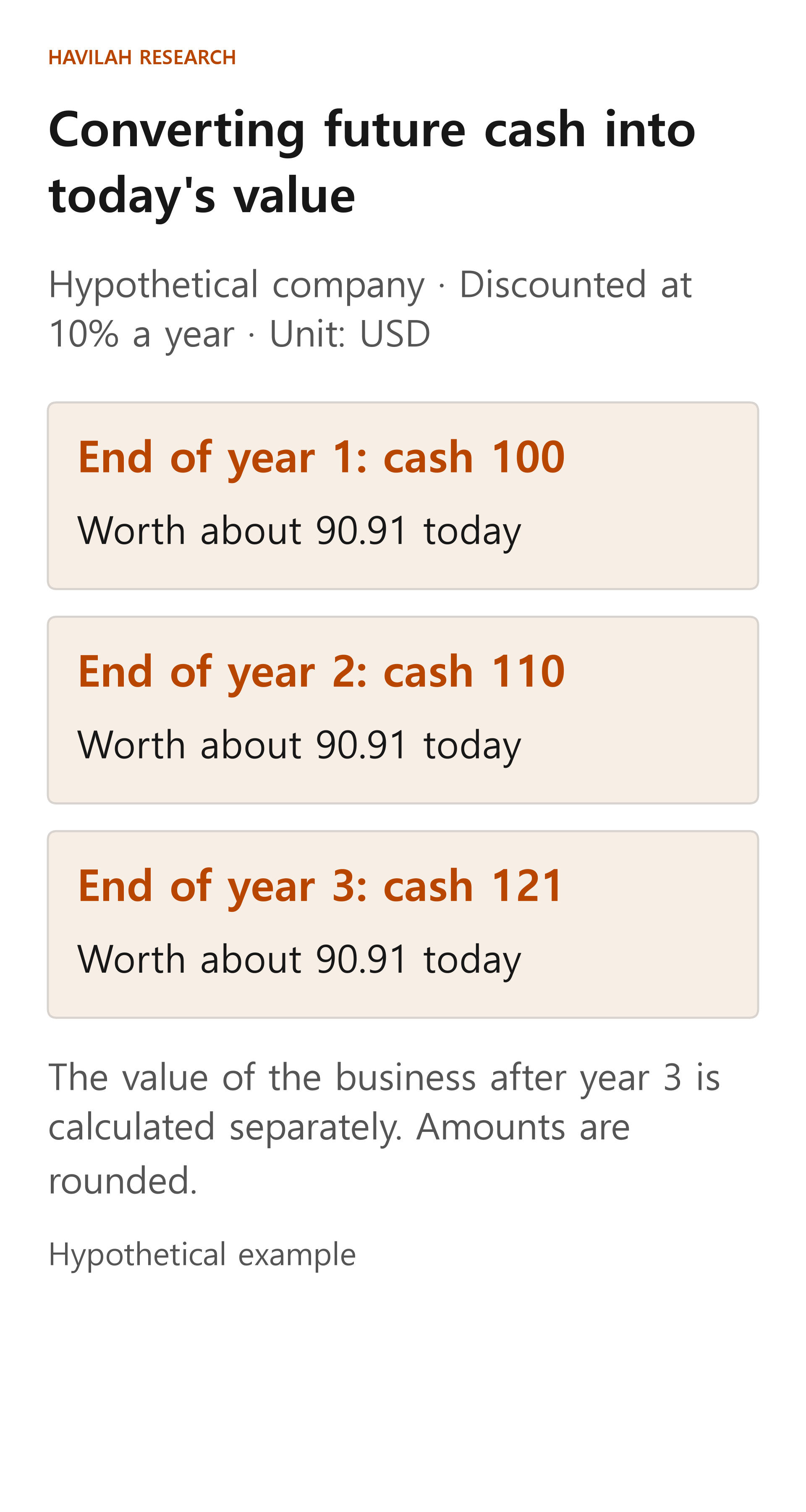
Suppose a hypothetical company generates cash that could go to all of its investors: $100 after 1 year, $110 after 2 years and $121 after 3 years. This is the cash left after running the business and paying the necessary taxes and reinvestment, but before financing items such as interest payments or debt repayments.
Assume a hypothetical discount rate of 10% a year, and assume each amount arrives at the end of the year. Think of this discount rate as the cost of capital for the whole company: the returns required by the shareholders and lenders who provided its money, combined according to each one's share of the capital. This is called the weighted average cost of capital (WACC), and when the cost of debt is calculated, the tax effect of interest is usually taken into account. A real company's cash flows and discount rate are not fixed in advance.
| When the cash arrives | Expected cash | Calculating today's value | Today's value |
|---|---|---|---|
| End of year 1 | $100 | 100 ÷ 1.10 | About $90.91 |
| End of year 2 | $110 | 110 ÷ 1.10 ÷ 1.10 | About $90.91 |
| End of year 3 | $121 | 121 ÷ 1.10 ÷ 1.10 ÷ 1.10 | About $90.91 |
Adding up these present values gives about $272.73. Each amount shown is rounded to two decimal places, but the total is calculated from the unrounded amounts.
The business after year 3 has value too
Unless the company operates for only 3 years and then disappears, you also need to account for the business after year 3. In an analysis, the value of the business beyond a certain period is often estimated as a single amount. This is called the terminal value (also known as continuing value or residual value).
As a hypothetical, say the value of this company's business after the end of year 3 is $330 at that point in time. This amount is an assumption about the business from then on, and it does not overlap with the $121 generated in year 3. It also does not include any cash the company holds apart from running the business.
Discounting $330 at 10% a year for 3 years gives 330 ÷ 1.10 ÷ 1.10 ÷ 1.10, or about $247.93. Adding this to the present value of the 3 years of cash calculated above, the value of the business today is about $520.66.
The $330 is a number chosen to explain the calculation. In practice, you need assumptions such as how much the cash will grow after that point and how long it will last. You also need to check that you are not counting the year-3 cash and the value after it twice.
From the value of the business to the value of one share
The $520.66 above values the cash coming from the business before financing. To find the part that belongs only to shareholders, you need to account for what other claim holders are owed and for any assets not included in the value of the business.
Suppose the hypothetical company has $50 of cash that is not needed to run the business and was not included in the value of the business above, debt with a market value of $100, and 10 shares outstanding. Assume there are no other adjustments, such as preferred shares.
The value that belongs to shareholders is 520.66 + 50 − 100, or about $470.66. Dividing this by 10 shares gives about $47.07 per share. The actual calculation used the unrounded value of the business. Be careful not to add back assets that are already included in the value of the business.
Even if this result is below the current share price of $50, that does not mean you should sell. If the expected cash, the discount rate or the value after year 3 changes, the result changes too.
Change the assumptions and the value changes
For example, suppose you keep the expected cash and the value of the business at the end of year 3 the same, and raise only the discount rate, the cost of capital for the whole company, from 10% to 12% a year. The present value of the business becomes about $497.99. Today's value is lower because the future amounts are divided by a higher discount rate.
This comparison is a hypothetical calculation that changes only the discount rate. In reality, when the growth rate or the risk changes, the expected cash and the terminal value can change along with it. If you move assumptions separately so that they no longer fit together, the result may look plausible but mean little.
A DCF is not a machine that tells you the exact future share price. It is a tool that lays out your assumptions about the cash the company will generate, when that cash will arrive and the risk of the investment, so that you can compare the result with the current price. In the next lesson, we will look at how to tell cash for the whole company apart from cash for shareholders.