
Suppose your home currency is the Korean won (KRW), and someone asks you to choose: would you rather receive KRW 1 million today, or the same KRW 1 million 5 years from now? The won is only an example here; the same arithmetic works in any currency.
The amount is the same, but the timing is not. If you have the money today, you can spend it now, or you can invest it in the meantime. In 5 years, the prices of goods may have changed, so the same money may buy a different amount.
Money you receive today can put time to work
As a hypothetical example, suppose you put KRW 1 million today somewhere that earns a 5% return every year for 5 years, and you reinvest all the returns on the same terms. To keep things simple, assume there are no taxes, fees or losses. This does not refer to any real product that guarantees such a return.
After 1 year, you have KRW 1 million × 1.05 = KRW 1,050,000. After 2 years, the first year's return grows along with the original KRW 1 million, so you have KRW 1,050,000 × 1.05 = KRW 1,102,500. Earning returns on earlier returns like this is called compounding.
Calculating the same way for 5 years gives KRW 1 million × 1.05 × 1.05 × 1.05 × 1.05 × 1.05, or about KRW 1,276,282. This result assumes that you withdraw nothing along the way and that the same rate applies every year.
Converting future money into today's value
Now turn the question around and think about KRW 1 million that you will receive in 5 years. At a hypothetical return of 5% a year, how much would you need today to have KRW 1 million in 5 years?
The answer is KRW 1 million divided by 1.05 five times, or about KRW 783,526. If you actually invested this amount and it grew by 5% every year, you would have KRW 1 million after 5 years, allowing for rounding.
Converting money you will receive in the future into an amount in today's terms by dividing it by a set rate like this gives its present value. The rate you use is called the discount rate. The 5% in the example above is an assumption for the calculation. It is not the right answer for every investment, and it is not a guaranteed return.
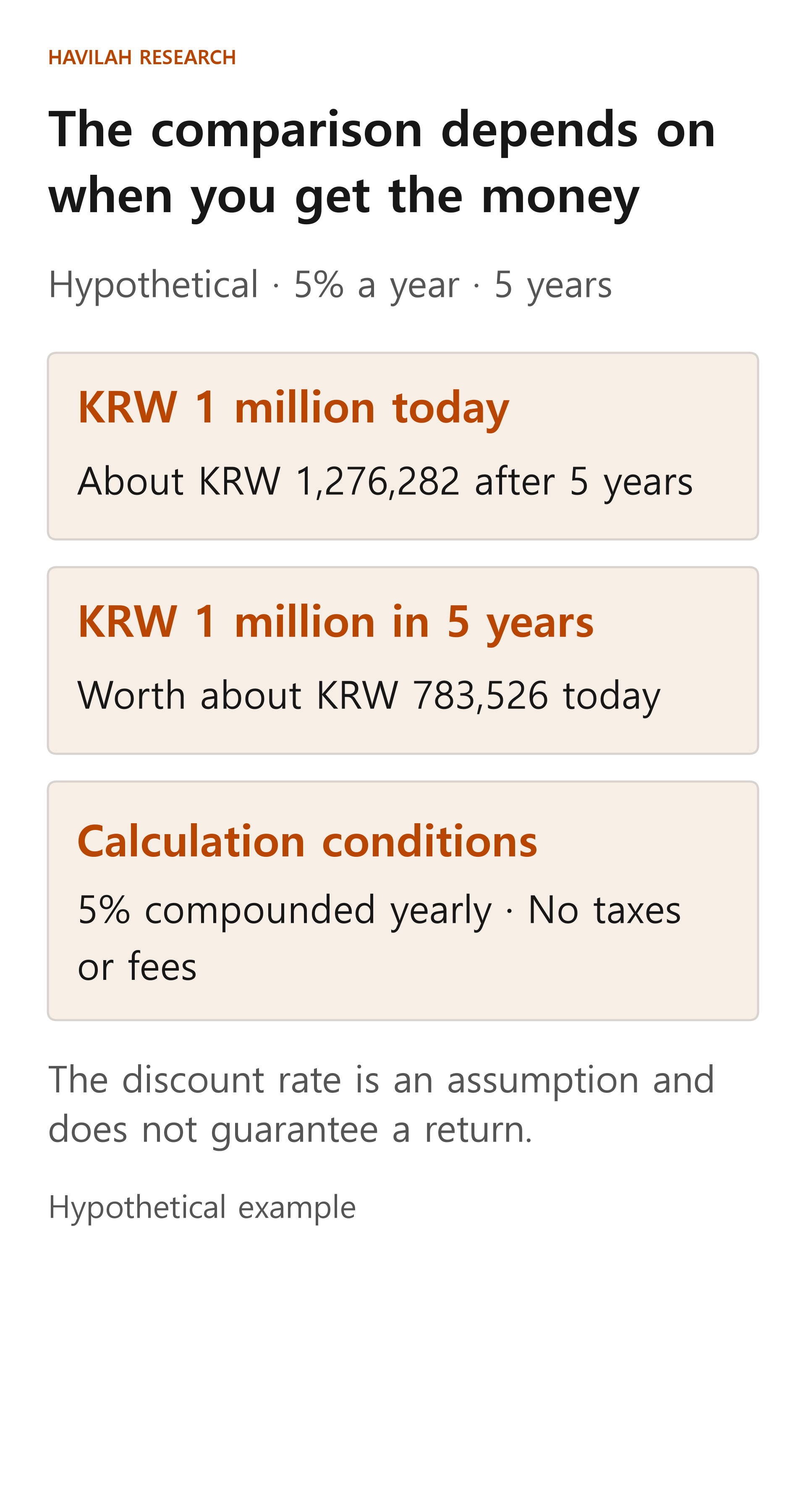
The higher the discount rate, the smaller today's value of the same future amount. Conversely, the lower the discount rate, the larger the present value. How to set the discount rate, however, depends on the investment period, the risk and the other choices you could compare it with.
When prices change, what you can buy changes too
Rising prices, or inflation, mean that the general price level of goods and services goes up. If the same KRW 1 million buys fewer things than before, the purchasing power of the money has fallen. The prices of individual items can move differently from prices overall.
For example, assume the price level rises by exactly 3% a year for 5 years. Goods that cost KRW 1 million today would cost about KRW 1,159,274 in 5 years. Put the other way, the purchasing power of KRW 1 million in 5 years equals about KRW 862,609 at today's prices.
This example compares purchasing power by assuming a steady price index. Actual inflation, and the prices of the things you personally buy, can change from year to year.
Do not confuse discounting with adjusting for inflation
The figure of about KRW 783,526 calculated earlier compares a future amount with today using a 5% annual discount rate. The figure of about KRW 862,609 compares purchasing power assuming 3% annual inflation. The two numbers answer different questions.
If your discount rate already includes expected inflation, adjusting the future amount for inflation and then applying the same discount rate can count inflation twice. If you forecast the future amount in won at the prices of that future time, use a discount rate set on the same basis. If you forecast it with inflation taken out, use a discount rate set on that basis instead.
How do you use this when investing?
The same principle applies when you estimate the cash a company will earn several years from now. For the same amount, cash received later is worth less today when you apply a positive discount rate.
But a stock's future cash is not fixed like the amounts in the examples above. A company's results, its dividends and its investment risks can change, so you need to compare several sets of assumptions. When future cash is uncertain, a result calculated to several decimal places does not mean the value has been pinned down exactly.
When you look at a future amount, first check when it will be received, what rate is used to convert it into today's value, and how inflation and risk have been handled.