
You have forecast a company's revenue and profit. But once you account for capital spending and debt repayments, how much cash will be left? And how will the company's assets and liabilities change as a result?
To answer these questions, you need to link the income statement, the cash flow statement and the balance sheet. It may sound difficult, but you only need to follow how one company's money moves, step by step.
What the three statements show
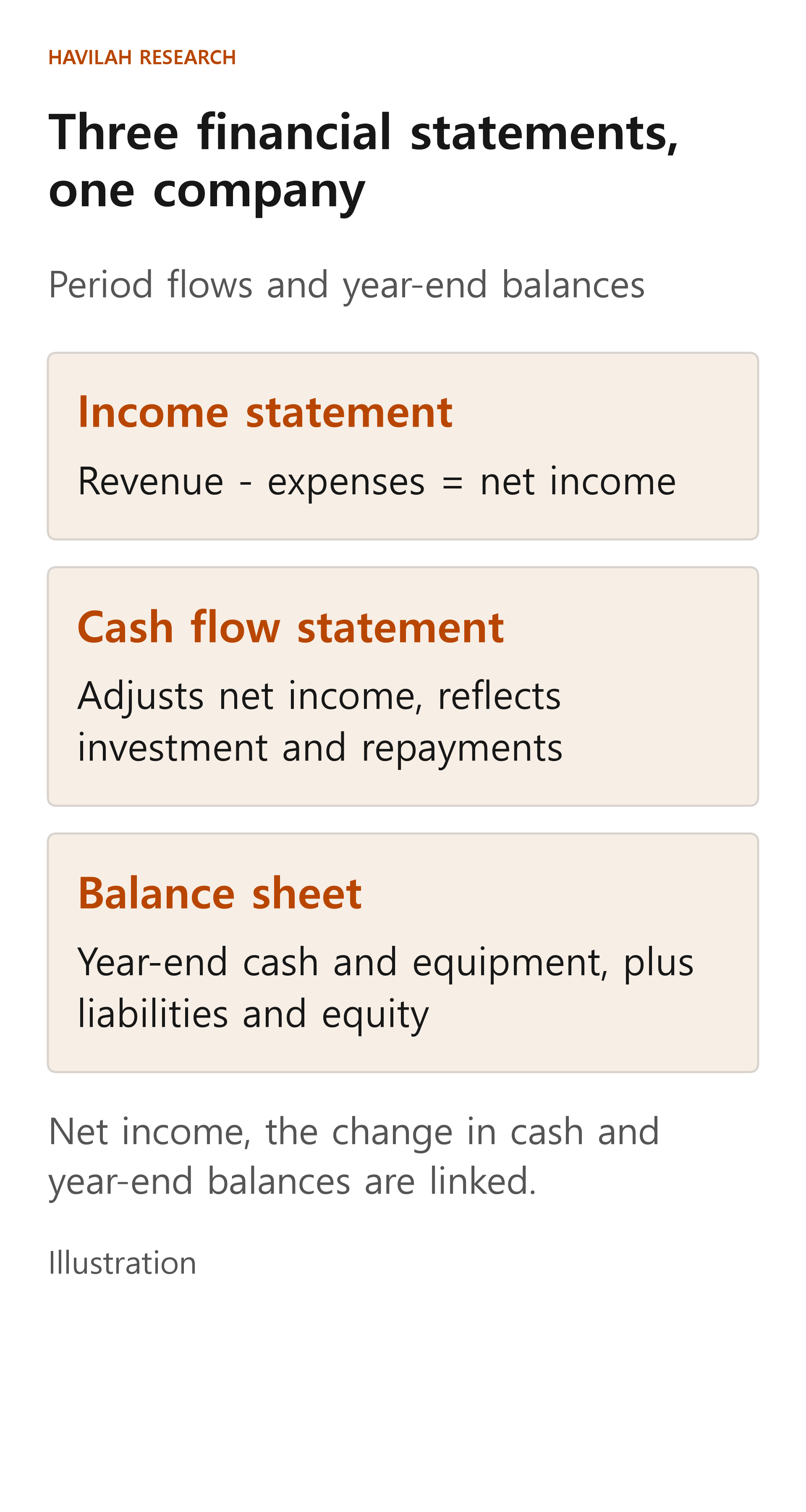
The income statement shows the revenue earned and the expenses incurred over a period, and the resulting net income. The cash flow statement shows how much cash actually came in and went out over the same period. The balance sheet shows, on a particular date, the assets the company has, the liabilities it must pay, and shareholders' equity, which is assets minus liabilities.
These three statements are connected. Net income affects equity, and the year-end cash calculated in the cash flow statement carries over to cash on the balance sheet. Depreciation, which is included as an expense in the income statement, links the book value of equipment with the cash flows.
First, set the starting point and the assumptions
Suppose a hypothetical company starts this year with $20,000 in cash, $20,000 of inventory and equipment with a book value of $60,000. Its total assets are $100,000. The company has $40,000 of borrowings and $60,000 of equity.
To make the example easier to follow, assume that revenue and all expenses other than depreciation are received or paid in cash in the same year, and that inventory, accounts receivable, accounts payable and other operating items do not change. There are no dividends, no new share issues and no asset sales or impairments, and nothing other than net income changes equity. Income tax and interest are paid in cash in the same year, and interest is included in cash flow from operating activities.
Assume the equipment purchases and depreciation are as shown in the table below. The company repays $10,000 of its borrowings at the start of each year, and interest of 5% a year is charged for the whole year on the amount left after the repayment. There is no new borrowing and no repayment fee.
| Assumption | Year 1 | Year 2 | Year 3 |
|---|---|---|---|
| Revenue | $120,000 | $140,000 | $160,000 |
| Cost of sales | $72,000 | $84,000 | $96,000 |
| Selling, general and administrative expenses (SG&A) | $31,000 | $32,000 | $33,000 |
| Depreciation included in SG&A | $5,000 | $6,000 | $7,000 |
| Cash paid for equipment | $10,000 | $12,000 | $14,000 |
Depreciation is already included in SG&A, so it is not subtracted again in the income statement. Assume income tax is 25% of profit after interest. A real company may have many more accounts and adjustments than this example.
Step 1: Work out net income from the income statement
Operating income in year 1 is revenue of $120,000 minus the cost of sales of $72,000 and SG&A of $31,000, which is $17,000.
The company repaid $10,000 of its $40,000 of borrowings at the start of the year, so interest on the remaining $30,000 is $30,000 × 5% = $1,500. Applying the 25% tax rate to the pre-tax profit of $15,500 gives tax of $3,875, and net income is $11,625.
| Income statement item | Year 1 | Year 2 | Year 3 |
|---|---|---|---|
| Operating income | $17,000 | $24,000 | $31,000 |
| Interest expense | $1,500 | $1,000 | $500 |
| Tax | $3,875 | $5,750 | $7,625 |
| Net income | $11,625 | $17,250 | $22,875 |
Interest expense is calculated on the balance left after each repayment. Unlike the before-financing calculation in Lesson 121, which subtracted only tax from operating income, net income here also reflects interest expense.
Step 2: Calculate how much cash is left
Net income of $11,625 in year 1 includes $5,000 of depreciation as an expense, even though no cash actually went out for it. There are no changes in other operating assets and liabilities in this example, so adding back depreciation gives operating cash flow of $16,625.
Then $10,000 goes out to buy equipment and $10,000 goes out to repay the principal of the borrowings. So over the year, cash changes by $16,625 − $10,000 − $10,000, a decrease of $3,375. Because the company started with $20,000 in cash, its cash at the end of the year is $16,625.
| Cash flow item | Year 1 | Year 2 | Year 3 |
|---|---|---|---|
| Net income | $11,625 | $17,250 | $22,875 |
| Add back depreciation | $5,000 | $6,000 | $7,000 |
| Operating cash flow | $16,625 | $23,250 | $29,875 |
| Equipment purchases | −$10,000 | −$12,000 | −$14,000 |
| Debt repayment | −$10,000 | −$10,000 | −$10,000 |
| Cash at end of year | $16,625 | $17,875 | $23,750 |
Year 2 starts from the cash at the end of year 1: $16,625 + $23,250 − $12,000 − $10,000 gives year-end cash of $17,875. In practice, changes in items such as accounts receivable, inventory and accounts payable, which we looked at in Lesson 121, can also change operating cash flow.
Step 3: Check that assets equal liabilities plus equity
The book value of equipment at the end of year 1 is the starting $60,000 plus $10,000 of new equipment minus $5,000 of depreciation, which is $65,000. Adding cash of $16,625 and the unchanged inventory of $20,000 gives total assets of $101,625.
Borrowings are $40,000 − $10,000 = $30,000. Because there are no dividends or new share issues, equity is the starting $60,000 plus net income of $11,625, or $71,625. Liabilities and equity together also come to $101,625, the same as total assets.
| Year-end balance sheet item | Year 1 | Year 2 | Year 3 |
|---|---|---|---|
| Cash | $16,625 | $17,875 | $23,750 |
| Inventory | $20,000 | $20,000 | $20,000 |
| Equipment book value | $65,000 | $71,000 | $78,000 |
| Total assets | $101,625 | $108,875 | $121,750 |
| Borrowings | $30,000 | $20,000 | $10,000 |
| Equity | $71,625 | $88,875 | $111,750 |
| Total liabilities and equity | $101,625 | $108,875 | $121,750 |
When you move this into a spreadsheet, link each year's net income to equity, and link the previous year's year-end cash to the next year's starting cash. If total assets do not equal total liabilities and equity, do not force one side to match. Look first for a missing item or a cost you have counted twice.
But numbers that balance do not mean your forecast is accurate. When you analyze a real company, check the accounts and units in its filings, when cash is actually paid and received, when its debt matures and what further investment it needs, and replace these simple assumptions one by one with ones that fit reality.