
If a company's profit grows, does each shareholder's slice always get bigger? Not necessarily. When a company issues new shares, the same profit is divided among more shares.
And if a company has borrowed money, it must pay interest and repay the principal on the agreed dates. That is why you need to look at changes in the number of shares and in debt, not just at the company's overall results.
Profit can grow while profit per share falls
Earnings per share (EPS) is the part of a company's net income that belongs to common shareholders, divided by the average number of common shares over the period. When you work out the profit that belongs to common shareholders, there may be items to take into account, such as dividends on preferred shares.
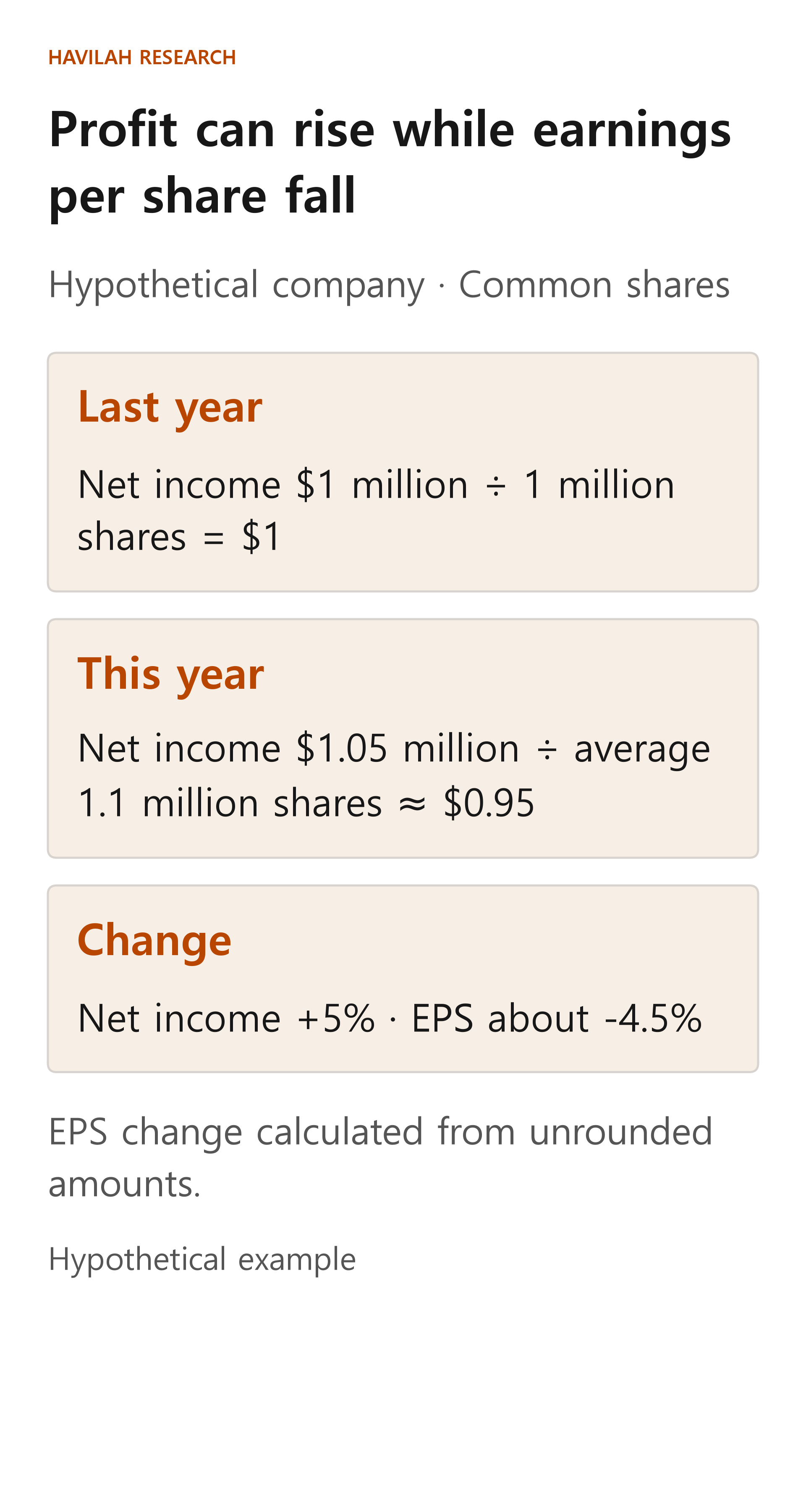
Suppose a hypothetical company has no preferred shares, earned net income of $1 million last year and had 1 million shares throughout the year. EPS is $1 million ÷ 1 million shares = $1.
This year, net income grows 5% to $1.05 million, but assume the company issued 200,000 new shares exactly halfway through the year. There were 1 million shares in the first half and 1.2 million in the second half, so the average, weighted for time, is 1.1 million shares.
This year's basic EPS is $1.05 million ÷ 1.1 million shares, or about $0.95. This does not include the effect of securities that could potentially become new shares. Based on the unrounded amounts, EPS fell about 4.5% from last year. The company's total profit grew, but the number of shares dividing it grew faster.
Issuing new shares is not always bad. The company can use the money raised to repay debt or invest in the business. What matters is looking at both how much the share count increases and what results that money will produce in the future.
The year-end share count differs from the average share count
In the example above, there are 1.2 million shares at the end of the year, but the 200,000 new shares did not exist for the whole year. That is why this year's profit was divided by 1.1 million shares, an average that reflects how long the new shares were outstanding. In a real calculation, check the dates on which the share count changed, such as when shares were issued or bought back.
The number of shares can also grow in the future if the company pays employees in shares or if other securities may be converted into shares. The diluted EPS that companies report takes these potential changes in the share count into account under set accounting rules. It does not mean that every such contract will necessarily turn into shares.
With debt, the repayment dates matter, not just the balance
Borrowings are money a company has borrowed and must repay. Even for the same amount borrowed, the cash needed differs depending on whether it must be repaid this year or several years from now. When a loan comes due, the company has to consider options such as repaying it in cash or borrowing new money to pay off the old debt.
Borrowing new money to repay existing debt is called refinancing. But whether a company can refinance, and at what interest rate, depends on market conditions and the company's financial position at that time. Also check whether the loan agreements contain terms that limit further borrowing or require the company to maintain certain financial conditions.
Repaying debt also changes the interest
Separately from the share example above, suppose a hypothetical company borrowed $10 million at the start of the year at an annual interest rate of 6%. Assume it repays $2 million in cash at the start of each year, borrows no new money, and pays the same interest rate on the remaining principal for the whole year. There are no fees or early repayment costs.
| Item | Year 1 | Year 2 | Year 3 |
|---|---|---|---|
| Debt at start of year, before repayment | $10 million | $8 million | $6 million |
| Repayment at start of year | $2 million | $2 million | $2 million |
| Debt after repayment | $8 million | $6 million | $4 million |
| Interest for the year | $480,000 | $360,000 | $240,000 |
In year 1, the principal becomes $10 million − $2 million = $8 million, and interest is $8 million × 6% = $480,000. If the company had not repaid anything and the principal had stayed at $10 million all year, interest at the same rate would have been $600,000.
Repaying debt can reduce the interest burden, but it also uses cash. This hypothetical calculation assumes the company has enough cash for the repayments. For a real company, look at maturities, repayment timing, whether interest rates are fixed or floating, cash holdings and investment plans together.
What investors should check
Once you have forecast a company's net income, check next how profit per share will change. Looking at the timing of new share issues or share buybacks, stock-based compensation and convertible securities helps you find reasons why the average share count may change.
For borrowings, check the maturities and interest terms in the filings, and look at them alongside the cash expected from operations and the capital spending needed in the future. Even if the value of the company as a whole is the same, the value that goes to shareholders can differ depending on the mix of debt and cash.
The goal is not to predict numbers exactly. What matters is linking the company's growth to how its share count, interest and the money needed for repayments may change.